


Page 304 - ACCCN's Critical Care Nursing
P. 304
Cardiac Rhythm Assessment and Management  281


                      Bi-V                                         RV only


                       RV                                         Bi-V


                      Bi-V                                  LV only


                    LV                                                          Bi-V

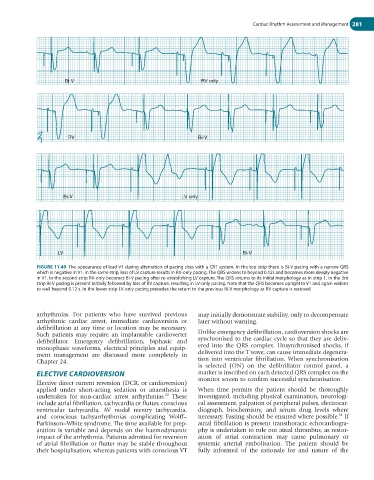
             FIGURE 11.49  The appearance of lead V1 during alternation of pacing sites with a CRT system. In the top strip there is Bi-V pacing with a narrow QRS
             which is negative in V1. In the same strip, loss of LV capture results in RV-only pacing. The QRS widens to beyond 0.12s and becomes more deeply negative
             in V1. In the second strip RV-only becomes Bi-V pacing after re-establishing LV capture. The QRS returns to its initial morphology as in strip 1. In the 3rd
             strip Bi-V pacing is present initially followed by loss of RV capture, resulting in LV-only pacing. Note that the QRS becomes upright in V1 and again widens
             to well beyond 0.12 s. In the lower strip LV-only pacing precedes the return to the previous Bi-V morphology as RV capture is restored.


             arrhythmias.  For  patients  who  have  survived  previous   may initially demonstrate stability, only to decompensate
             arrhythmic  cardiac  arrest,  immediate  cardioversion  or   later without warning.
             defibrillation at any time or location may be necessary.
             Such  patients  may  require  an  implantable  cardioverter   Unlike emergency defibrillation, cardioversion shocks are
             defibrillator.  Emergency  defibrillation,  biphasic  and   synchronised to the cardiac cycle so that they are deliv-
             monophasic waveforms, electrical principles and equip-  ered  into  the  QRS  complex.  Unsynchronised  shocks,  if
             ment  management  are  discussed  more  completely  in   delivered into the T wave, can cause immediate degenera-
             Chapter 24.                                          tion into ventricular fibrillation. When synchronisation
                                                                  is  selected  (ON)  on  the  defibrillator  control  panel,  a
             ELECTIVE CARDIOVERSION                               marker is inscribed on each detected QRS complex on the
             Elective direct current reversion (DCR, or cardioversion)   monitor screen to confirm successful synchronisation.
             applied  under  short-acting  sedation  or  anaesthesia  is   When  time  permits  the  patient  should  be  thoroughly
                                                       90
             undertaken  for  non-cardiac  arrest  arrhythmias.   These   investigated, including physical examination, neurologi-
             include atrial fibrillation, tachycardia or flutter, conscious   cal assessment, palpation of peripheral pulses, electrocar-
             ventricular  tachycardia,  AV  nodal  reentry  tachycardia,    diograph,  biochemistry,  and  serum  drug  levels  where
                                                                                                                91
             and  conscious  tachyarrhythmias  complicating  Wolff–  necessary. Fasting should be ensured where possible.  If
             Parkinson–White syndrome. The time available for prep-  atrial fibrillation is present transthoracic echocardiogra-
             aration  is  variable  and  depends  on  the  haemodynamic   phy is undertaken to rule out atrial thrombus, as restor-
             impact of the arrhythmia. Patients admitted for reversion   ation  of  atrial  contraction  may  cause  pulmonary  or
             of atrial fibrillation or flutter may be stable throughout   systemic  arterial  embolisation.  The  patient  should  be
             their hospitalisation, whereas patients with conscious VT   fully  informed  of  the  rationale  for  and  nature  of  the

