


Page 306 - ACCCN's Critical Care Nursing
P. 306
Cardiac Rhythm Assessment and Management  283


                    403400            11/11/02   13:20:12   BASELINE                                   25 mm/sec 0.40
               I


               II


               III


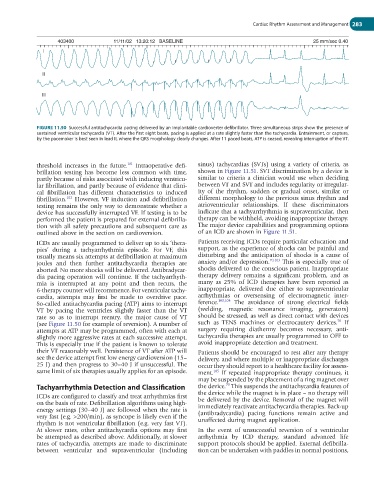
             FIGURE 11.50  Successful antitachycardia pacing delivered by an implantable cardioverter defibrillator. Three simultaneous strips show the presence of
             sustained ventricular tachycardia (VT). After the first eight beats, pacing is applied at a rate slightly faster than the tachycardia. Entrainment, or capture,
             by the pacemaker is best seen in lead II, where the QRS morphology clearly changes. After 11 paced beats, ATP is ceased, revealing interruption of the VT.


             threshold  increases  in  the  future.   Intraoperative  defi-  sinus) tachycardias (SVTs) using a variety of criteria, as
                                           101
             brillation  testing  has  become  less  common  with  time,   shown in Figure 11.51. SVT discrimination by a device is
             partly because of risks associated with inducing ventricu-  similar  to  criteria  a  clinician  would  use  when  deciding
             lar fibrillation, and partly because of evidence that clini-  between VT and SVT and includes regularity or irregular-
             cal  fibrillation  has  different  characteristics  to  induced   ity  of  the  rhythm,  sudden  or  gradual  onset,  similar  or
             fibrillation.   However,  VF  induction  and  defibrillation   different morphology to the previous sinus rhythm and
                       102
             testing remains the only way to demonstrate whether a   atrioventricular  relationships.  If  these  discriminators
             device has successfully interrupted VF. If testing is to be   indicate that a tachyarrhythmia is supraventricular, then
             performed the patient is prepared for external defibrilla-  therapy can be withheld, avoiding inappropriate therapy.
             tion with all safety precautions and subsequent care as   The major device capabilities and programming options
             outlined above in the section on cardioversion.      of an ICD are shown in Figure 11.51.
             ICDs are usually programmed to deliver up to six ‘thera-  Patients receiving ICDs require particular education and
             pies’  during  a  tachyarrhythmia  episode.  For  VF,  this   support, as the experience of shocks can be painful and
             usually means six attempts at defibrillation at maximum   disturbing  and  the  anticipation  of  shocks  is  a  cause  of
             joules  and  then  further  antitachycardia  therapies  are   anxiety and/or depression. 70,103  This is especially true of
             aborted. No more shocks will be delivered. Antibradycar-  shocks delivered to the conscious patient. Inappropriate
             dia pacing operation will continue. If the tachyarrhyth-  therapy  delivery  remains  a  significant  problem,  and  as
             mia  is  interrupted  at  any  point  and  then  recurs,  the   many  as  25%  of  ICD  therapies  have  been  reported  as
             6-therapy counter will recommence. For ventricular tachy-  inappropriate,  delivered  due  either  to  supraventricular
             cardia,  attempts  may  first  be  made  to  overdrive  pace.   arrhythmias  or  oversensing  of  electromagnetic  inter-
             So-called antitachycardia pacing (ATP) aims to interrupt   ference. 103,104   The  avoidance  of  strong  electrical  fields
             VT  by  pacing  the  ventricles  slightly  faster  than  the  VT     (welding,  magnetic  resonance  imaging,  generators)
             rate  so  as  to  interrupt  reentry,  the  major  cause  of  VT    should be stressed, as well as direct contact with devices
                                                                                                               70
             (see Figure 11.50 for example of reversion). A number of   such  as  TENS  machines  or  electrocautery  devices.   If
             attempts at ATP may be programmed, often with each at   surgery  requiring  diathermy  becomes  necessary,  anti-
             slightly more aggressive rates at each successive attempt.   tachycardia therapies are usually programmed to OFF to
             This is especially true if the patient is known to tolerate   avoid inappropriate detection and treatment.
             their VT reasonably well. Persistence of VT after ATP will   Patients should be encouraged to rest after any therapy
             see the device attempt first low energy cardioversion (15–  delivery, and where multiple or inappropriate discharges
             25 J) and then progress to 30–40 J if unsuccessful. The   occur they should report to a healthcare facility for assess-
             same limit of six therapies usually applies for an episode.  ment.   If  repeated  inappropriate  therapy  continues,  it
                                                                       105
                                                                  may be suspended by the placement of a ring magnet over
                                                                           70
             Tachyarrhythmia Detection and Classification         the device.  This suspends the antitachycardia features of
             ICDs are configured to classify and treat arrhythmias first   the device while the magnet is in place – no therapy will
                                                                  be delivered by the device. Removal of the magnet will
             on the basis of rate. Defibrillation algorithms using high-  immediately reactivate antitachycardia therapies. Back-up
             energy settings (30–40 J) are followed when the rate is   (antibradycardia)  pacing  functions  remain  active  and
             very fast (e.g. >200/min), as syncope is likely even if the   unaffected during magnet application.
             rhythm is not ventricular fibrillation (e.g. very fast VT).
             At  slower  rates,  other  antitachycardia  options  may  first     In  the  event  of  unsuccessful  reversion  of  a  ventricular
             be attempted as described above. Additionally, at slower   arrhythmia  by  ICD  therapy,  standard  advanced  life
             rates  of  tachycardia,  attempts  are  made  to  discriminate   support protocols should be applied. External defibrilla-
             between  ventricular  and  supraventricular  (including   tion can be undertaken with paddles in normal positions,

