


Page 322 - ACCCN's Critical Care Nursing
P. 322
Cardiac Surgery and Transplantation  299


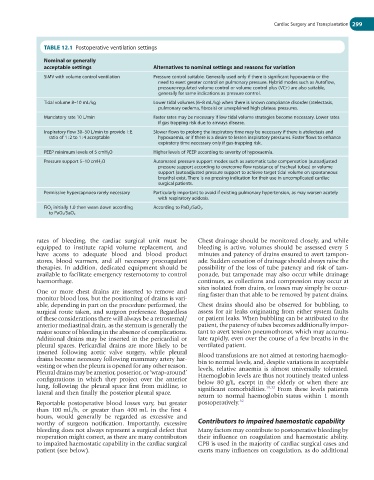
               TABLE 12.1  Postoperative ventilation settings

               Nominal or generally
               acceptable settings                 Alternatives to nominal settings and reasons for variation
               SIMV with volume control ventilation  Pressure control suitable. Generally used only if there is significant hypoxaemia or the
                                                     need to exert greater control on pulmonary pressure. Hybrid modes such as Autoflow,
                                                     pressure-regulated volume control or volume control plus (VC+) are also suitable,
                                                     generally for same indications as pressure control.
               Tidal volume 8–10 mL/kg             Lower tidal volumes (6–8 mL/kg) when there is known compliance disorder (atelectasis,
                                                     pulmonary oedema, fibrosis) or unexplained high plateau pressures.
               Mandatory rate 10 L/min             Faster rates may be necessary if low tidal volume strategies become necessary. Lower rates
                                                     if gas trapping risk due to airways disease.
               Inspiratory flow 30–50 L/min to provide I : E   Slower flows to prolong the inspiratory time may be necessary if there is atelectasis and
                 ratio of 1 : 2 to 1 : 4 acceptable  hypoxaemia, or if there is a desire to lessen inspiratory pressures. Faster flows to enhance
                                                     expiratory time necessary only if gas-trapping risk.
               PEEP minimum levels of 5 cmH 2 O    Higher levels of PEEP according to severity of hypoxaemia.
               Pressure support 5–10 cmH 2 O       Automated pressure support modes such as automatic tube compensation (autoadjusted
                                                     pressure support according to overcome flow resistance of tracheal tubes) or volume
                                                     support (autoadjusted pressure support to achieve target tidal volume on spontaneous
                                                     breaths) exist. There is no pressing indication for their use in uncomplicated cardiac
                                                     surgical patients.
               Permissive hypercapnoea rarely necessary  Particularly important to avoid if existing pulmonary hypertension, as may worsen acutely
                                                     with respiratory acidosis.
               FiO 2  initially 1.0 then wean down according   According to PaO 2 /SaO 2.
                 to PaO 2 /SaO 2


             rates  of  bleeding,  the  cardiac  surgical  unit  must  be   Chest drainage should be monitored closely, and while
             equipped  to  institute  rapid  volume  replacement,  and   bleeding  is  active,  volumes  should  be  assessed  every  5
             have  access  to  adequate  blood  and  blood  product     minutes and patency of drains ensured to avert tampon-
             stores,  blood  warmers,  and  all  necessary  procoagulant   ade. Sudden cessation of drainage should always raise the
             therapies.  In  addition,  dedicated  equipment  should  be   possibility of the loss of tube patency and risk of tam-
             available to facilitate emergency resternotomy to control   ponade, but tamponade may also occur while drainage
             haemorrhage.                                         continues, as collections and compression may occur at
                                                                  sites isolated from drains, or losses may simply be occur-
             One  or  more  chest  drains  are  inserted  to  remove  and   ring faster than that able to be removed by patent drains.
             monitor blood loss, but the positioning of drains is vari-
             able, depending in part on the procedure performed, the   Chest  drains  should  also  be  observed  for  bubbling,  to
             surgical route taken, and surgeon preference. Regardless   assess for air leaks originating from either system faults
             of these considerations there will always be a retrosternal/  or patient leaks. When bubbling can be attributed to the
             anterior mediastinal drain, as the sternum is generally the   patient, the patency of tubes becomes additionally impor-
             major source of bleeding in the absence of complications.   tant to avert tension pneumothorax, which may accumu-
             Additional drains may be inserted in the pericardial or   late rapidly, even over the course of a few breaths in the
             pleural  spaces.  Pericardial  drains  are  more  likely  to  be   ventilated patient.
             inserted  following  aortic  valve  surgery,  while  pleural   Blood transfusions are not aimed at restoring haemoglo-
             drains become necessary following mammary artery har-  bin to normal levels, and, despite variations in acceptable
             vesting or when the pleura is opened for any other reason.   levels,  relative  anaemia  is  almost  universally  tolerated.
             Pleural drains may be anterior, posterior, or ‘wrap-around’   Haemoglobin levels are thus not routinely treated unless
             configurations  in  which  they  project  over  the  anterior   below  80 g/L,  except  in  the  elderly  or  when  there  are
             lung, following the pleural space first from midline, to   significant  comorbidities. 19,32   From  these  levels  patients
             lateral and then finally the posterior pleural space.
                                                                  return  to  normal  haemoglobin  status  within  1  month
             Reportable  postoperative  blood  losses  vary,  but  greater   postoperatively. 32
             than  100 mL/h,  or  greater  than  400 mL  in  the  first  4
             hours,  would  generally  be  regarded  as  excessive  and
             worthy  of  surgeon  notification.  Importantly,  excessive   Contributors to impaired haemostatic capability
             bleeding does not always represent a surgical defect that   Many factors may contribute to postoperative bleeding by
             reoperation might correct, as there are many contributors   their  influence  on  coagulation  and  haemostatic  ability.
             to impaired haemostatic capability in the cardiac surgical   CPB is used in the majority of cardiac surgical cases and
             patient (see below).                                 exerts many influences on coagulation, as do additional

