


Page 411 - ACCCN's Critical Care Nursing
P. 411
388  P R I N C I P L E S   A N D   P R A C T I C E   O F   C R I T I C A L   C A R E


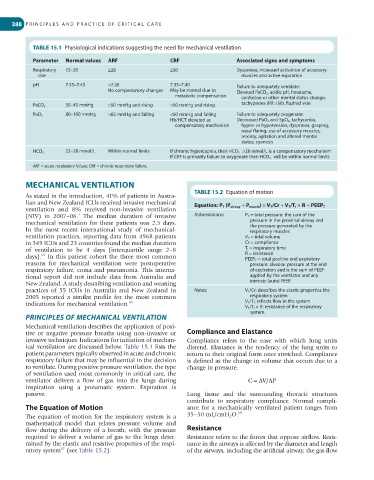
            TABLE 15.1  Physiological indications suggesting the need for mechanical ventilation

            Parameter  Normal values  ARF                CRF                  Associated signs and symptoms
            Respiratory   12–20     ≥28                  ≥30                  Dyspnoea, increased activation of accessory
             rate                                                               muscles and active expiration
            pH         7.35–7.45    <7.30                7.35–7.40            Failure to adequately ventilate:
                                    No compensatory changes  May be normal due to   Elevated PaCO 2 , acidic pH, headache,
                                                          metabolic compensation  confusion or other mental status change,
            PaCO 2     35–45 mmHg   >50 mmHg and rising  >50 mmHg and rising    tachypnoea (RR >30), flushed skin
                       80–100 mmHg  <65 mmHg and falling  <50 mmHg and falling  Failure to adequately oxygenate:
            PaO 2
                                                         Hb/HCT elevated as   Decreased PaO 2  and SpO 2 , tachycardia,
                                                          compensatory mechanism  hyper- or hypotension, dyspnoea, gasping,
                                                                                nasal flaring, use of accessory muscles,
                                                                                anxiety, agitation and altered mental
                                                                                status, cyanosis
                                                                               −
               −       22–28 mmol/L  Within normal limits  If chronic hypercapnia, then HCO 3  >28 mmol/L is a compensatory mechanism
            HCO 3
                                                         If CRF is primarily failure to oxygenate then HCO 3  will be within normal limits
                                                                                          −
            ARF = acute respiratory failure; CRF = chronic respiratory failure.
         MECHANICAL VENTILATION
                                                                 TABLE 15.2  Equation of motion
         As stated in the introduction, 41% of patients in Austra-
         lian and New Zealand ICUs received invasive mechanical
         ventilation  and  8%  received  non-invasive  ventilation   Equation: P T  (P airway  + P muscle ) = V T /Cr + V T /T I × R + PEEP T
                           1
         (NIV)  in  2007–08.   The  median  duration  of  invasive   Abbreviations:  P T  = total pressure: the sum of the
         mechanical  ventilation  for  these  patients  was  2.5  days.            pressure in the proximal airway and
                                                                                   the pressure generated by the
         In  the  most  recent  international  study  of  mechanical-              respiratory muscles
         ventilation practices, reporting data from 4968 patients                V T  = tidal volume
         in 349 ICUs and 23 countries found the median duration                  Cr = compliance
         of  ventilation  to  be  4  days  (interquartile  range  2–8            T I  = inspiratory time
               65
         days).   In  this  patient  cohort  the  three  most  common            R = resistance
                                                                                 PEEP T  = total positive end expiratory
         reasons  for  mechanical  ventilation  were  postoperative                pressure: alveolar pressure at the end
         respiratory failure, coma and pneumonia. This interna-                    of expiration and is the sum of PEEP
         tional  report  did  not  include  data  from  Australia  and             applied by the ventilator and any
         New Zealand. A study describing ventilation and weaning                   intrinsic (auto) PEEP.
         practices  of  55  ICUs  in  Australia  and  New  Zealand  in   Notes:  V T /Cr: describes the elastic properties the
         2005  reported  a  similar  profile  for  the  most  common               respiratory system
         indications for mechanical ventilation. 66                              V T /T I : reflects flow in the system
                                                                                 V T /T I  × R: resistance of the respiratory
                                                                                   system.
         PRINCIPLES OF MECHANICAL VENTILATION
         Mechanical ventilation describes the application of posi-
         tive  or  negative  pressure  breaths  using  non-invasive  or   Compliance and Elastance
         invasive techniques. Indications for initiation of mechan-  Compliance  refers  to  the  ease  with  which  lung  units
         ical ventilation are discussed below. Table 15.1 lists the   distend.  Elastance  is  the  tendency  of  the  lung  units  to
         patient parameters typically observed in acute and chronic   return to their original form once stretched. Compliance
         respiratory failure that may be influential in the decision   is defined as the change in volume that occurs due to a
         to ventilate. During positive pressure ventilation, the type   change in pressure.
         of ventilation used most commonly in critical care, the
                                                                                         ∆
         ventilator  delivers  a  flow  of  gas  into  the  lungs  during         C = ∆ V/ P
         inspiration  using  a  pneumatic  system.  Expiration  is
         passive.                                             Lung  tissue  and  the  surrounding  thoracic  structures
                                                              contribute  to  respiratory  compliance.  Normal  compli-
         The Equation of Motion                               ance  for  a  mechanically  ventilated  patient  ranges  from
         The  equation  of  motion  for  the  respiratory  system  is  a   35–50 mL/cmH 2 O. 68
         mathematical  model  that  relates  pressure  volume  and
         flow  during  the  delivery  of  a  breath,  with  the  pressure   Resistance
         required  to  deliver  a  volume  of  gas  to  the  lungs  deter-  Resistance refers to the forces that oppose airflow. Resis-
         mined by the elastic and resistive properties of the respi-  tance in the airways is affected by the diameter and length
                     67
         ratory system  (see Table 15.2).                     of the airways, including the artificial airway, the gas flow

