


Page 413 - ACCCN's Critical Care Nursing
P. 413
390  P R I N C I P L E S   A N D   P R A C T I C E   O F   C R I T I C A L   C A R E

         BiPAP®  is  registered  to  Respironics  (Murrayville,  PA),  a
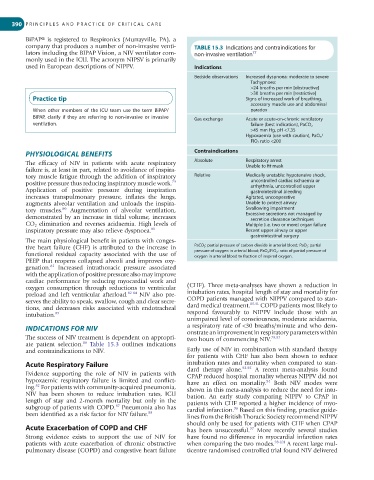
         company that produces a number of non-invasive venti-   TABLE 15.3  Indications and contraindications for
         lators including the BIPAP Vision, a NIV ventilator com-  non-invasive ventilation 77
         monly used in the ICU. The acronym NIPSV is primarily
         used in European descriptions of NIPPV.                 Indications
                                                                 Bedside observations  Increased dyspnoea: moderate to severe
                                                                                   Tachypnoea:
                                                                                   >24 breaths per min [obstructive]
                                                                                   >30 breaths per min [restrictive]
            Practice tip                                                         Signs of increased work of breathing,
                                                                                   accessory muscle use and abdominal
            When  other  members  of  the  ICU  team  use  the  term  BiPAP/       paradox
            BIPAP,  clarify  if  they  are  referring  to  non-invasive  or  invasive   Gas exchange  Acute or acute-on-chronic ventilatory
            ventilation.                                                           failure (best indication), PaCO 2
                                                                                   >45 mm Hg, pH <7.35
                                                                                 Hypoxaemia (use with caution), PaO 2 /
                                                                                   FIO 2  ratio <200
         PHYSIOLOGICAL BENEFITS                                  Contraindications
         The  efficacy  of  NIV  in  patients  with  acute  respiratory   Absolute  Respiratory arrest
         failure is, at least in part, related to avoidance of inspira-          Unable to fit mask
         tory muscle fatigue through the addition of inspiratory   Relative      Medically unstable: hypotensive shock,
         positive pressure thus reducing inspiratory muscle work.                  uncontrolled cardiac ischaemia or
                                                         79
         Application  of  positive  pressure  during  inspiration                  arrhythmia, uncontrolled upper
                                                                                   gastrointestinal bleeding
         increases  transpulmonary  pressure,  inflates  the  lungs,             Agitated, uncooperative
         augments  alveolar  ventilation  and  unloads  the  inspira-            Unable to protect airway
                     80
         tory  muscles.   Augmentation  of  alveolar  ventilation,               Swallowing impairment
         demonstrated by an increase in tidal volume, increases                  Excessive secretions not managed by
                                                                                   secretion clearance techniques
         CO 2  elimination and reverses acidaemia. High levels of                Multiple (i.e. two or more) organ failure
         inspiratory pressure may also relieve dyspnoea. 81                      Recent upper airway or upper
                                                                                   gastrointestinal surgery
         The main physiological benefit in patients with conges-
         tive  heart  failure  (CHF)  is  attributed  to  the  increase  in   PaCO 2 : partial pressure of carbon dioxide in arterial blood; PaO 2 : partial
         functional  residual  capacity  associated  with  the  use  of   pressure of oxygen in arterial blood; PaO 2 /FIO 2 : ratio of partial pressure of
                                                                 oxygen in arterial blood to fraction of inspired oxygen.
         PEEP that reopens collapsed alveoli and improves oxy-
                  82
         genation.   Increased  intrathoracic  pressure  associated
         with the application of positive pressure also may improve
         cardiac  performance  by  reducing  myocardial  work  and
         oxygen  consumption  through  reductions  to  ventricular   (CHF). Three meta-analyses have shown a reduction in
         preload and left ventricular afterload. 82-84  NIV also pre-  intubation rates, hospital length of stay and mortality for
         serves the ability to speak, swallow, cough and clear secre-  COPD patients managed with NIPPV compared to stan-
                                                                                   89-91
         tions,  and  decreases  risks  associated  with  endotracheal   dard medical treatment.   COPD patients most likely to
         intubation. 85                                       respond  favourably  to  NIPPV  include  those  with  an
                                                              unimpaired level of consciousness, moderate acidaemia,
         INDICATIONS FOR NIV                                  a respiratory rate of <30 breaths/minute and who dem-
                                                              onstrate an improvement in respiratory parameters within
         The success of NIV treatment is dependent on appropri-  two hours of commencing NIV. 79,92
                            86
         ate  patient  selection.   Table  15.3  outlines  indications
         and contraindications to NIV.                        Early use of NIV in combination with standard therapy
                                                              for  patients  with  CHF  has  also  been  shown  to  reduce
         Acute Respiratory Failure                            intubation rates and mortality when compared to stan-
                                                                                93-95
         Evidence  supporting  the  role  of  NIV  in  patients  with   dard  therapy  alone.    A  recent  meta-analysis  found
                                                              CPAP reduced hospital mortality whereas NIPPV did not
         hypoxaemic  respiratory  failure  is  limited  and  conflict-  have  an  effect  on  mortality.   Both  NIV  modes  were
                                                                                        94
             82
         ing.  For patients with community-acquired pneumonia,   shown in this meta-analysis to reduce the need for intu-
         NIV  has  been  shown  to  reduce  intubation  rates,  ICU   bation.  An  early  study  comparing  NIPPV  to  CPAP  in
         length  of  stay  and  2-month  mortality  but  only  in  the   patients with CHF reported a higher incidence of myo-
                                       87
         subgroup of patients with COPD.  Pneumonia also has   cardial infarction.  Based on this finding, practice guide-
                                                                              96
         been identified as a risk factor for NIV failure. 88  lines from the British Thoracic Society recommend NIPPV
                                                              should only be used for patients with CHF when CPAP
         Acute Exacerbation of COPD and CHF                   has  been  unsuccessful.   More  recently  several  studies
                                                                                   97
         Strong  evidence  exists  to  support  the  use  of  NIV  for   have found no difference in myocardial infarction rates
         patients  with  acute  exacerbation  of  chronic  obstructive   when comparing the two modes. 98-101  A recent large mul-
         pulmonary disease (COPD) and congestive heart failure   ticentre randomised controlled trial found NIV delivered

