


Page 414 - ACCCN's Critical Care Nursing
P. 414
Ventilation and Oxygenation Management 391

             by  either  CPAP  or  NIPPV  resulted  in  symptomatic
             improvements,  but  failed  to  demonstrate  a  mortality   TABLE 15.4  Monitoring priorities for non-invasive
                   102
             benefit.  Practice surveys indicate CPAP may be the pre-  ventilation 104
             ferred method of NIV for patients with CHF in Australia
             and internationally. 103,104                           Priority              Assessment
             NIV in Weaning                                         Patient comfort       Restlessness
                                                                                          Mask tolerance
             NIV may be used as an adjunct to weaning to reduce the                       Anxiety level
             duration of invasive ventilation and associated complica-                    Dyspnoea score
                  105
             tions.  Patients are extubated directly to NIV and then                      Pain score
             weaned  to  standard  oxygen  therapy.  This  use  of  NIV   Conscious level  Glasgow coma score
             differs from its role in preventing reintubation in patients   Work of breathing  Chest wall motion
             that develop, or who are at high risk of, postextubation                     Accessory muscle activation
                             106
             respiratory failure.  A recent systematic review and meta-                   Respiratory rate
             analysis of 12 trials of NIV as a weaning adjunct found   Gas exchange parameters
             reductions in mortality, ICU and hospital lengths of stay,                   Continuous SpO 2
                                                                                          Arterial blood gas analysis
                                               107
             duration of ventilation and rates of VAP.  Conversely the                    (Baseline and 1–2 hourly
             largest  study  of  NIV  use  in  postextubation  respiratory                  subsequently)
             failure reported worsened survival rates hypothesised as                     Patient colour
                                          108
             a  result  of  delayed  reintubation.   A  subsequent  meta-  Haemodynamic status  Continuous heart rate
             analysis suggested NIV may have a role in preventing the                     Intermittent blood pressure
             development  of  respiratory  failure  postextubation  for   Ventilator parameters  Air leak around mask
             those at risk, but should be used with caution once respi-                   Adequacy of pressure support
             ratory  failure  has  developed  and  should  not  delay  the                  (V T , pH, PaCO 2 )
             decision to reintubate. 106                                                  Adequacy peak end expiratory
                                                                                            pressure (SpO 2, PaO 2 )
             Other Indications                                      SpO 2 : saturation of peripheral oxygen; V T : tidal volume; PaCO 2 : partial
             Other indications for NIV include:                     pressure of carbon dioxide in arterial blood; PaO 2 : partial pressure of
                                                                    oxygen in arterial blood.
             ●  asthma 109
             ●  neuromuscular  disorders  (e.g.  muscular  dystrophy,
                amyotrophic lateral sclerosis)                    features, commencing with low pressure levels, holding
             ●  severe obstructive sleep apnoea                   the  mask  gently  in  position  prior  to  securing  with  the
             ●  palliation.                                       straps/headgear, and ensuring straps prevent major leaks
             INTERFACES AND SETTINGS                              but  are  not  so  tight  they  increase  discomfort.  Once
                                                                  NIV  is  commenced,  the  patient  should  be  monitored
             NIV  requires  an  interface  that  connects  the  patient  to   for  respiratory  and  haemodynamic  stability,  response
             either a ventilator, portable compressor or flow generator   to  NIV  treatment,  ongoing  tolerance,  and  presence  of
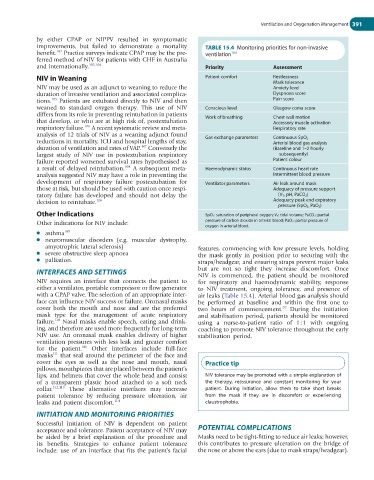
             with a CPAP valve. The selection of an appropriate inter-  air leaks (Table 15.4). Arterial blood gas analysis should
             face can influence NIV success or failure. Oronasal masks   be  performed  at  baseline  and  within  the  first  one  to
             cover  both  the  mouth  and  nose  and  are  the  preferred   two  hours  of  commencement.   During  the  initiation
                                                                                             97
             mask  type  for  the  management  of  acute  respiratory   and  stabilisation  period,  patients  should  be  monitored
                   110
             failure.  Nasal masks enable speech, eating and drink-  using  a  nurse-to-patient  ratio  of  1 : 1  with  ongoing
             ing, and therefore are used more frequently for long-term   coaching to promote NIV tolerance throughout the early
             NIV  use.  An  oronasal  mask  enables  delivery  of  higher   stabilisation  period.
             ventilation pressures with less leak and greater comfort
                            111
             for  the  patient.   Other  interfaces  include  full-face
                  111
             masks  that seal around the perimeter of the face and
             cover  the  eyes  as  well  as  the  nose  and  mouth,  nasal   Practice tip
             pillows, mouthpieces that are placed between the patient’s
             lips, and helmets that cover the whole head and consist   NIV tolerance may be promoted with a simple explanation of
             of  a  transparent  plastic  hood  attached  to  a  soft  neck   the  therapy,  reassurance  and  constant  monitoring  for  your
             collar. 112,113   These  alternative  interfaces  may  increase   patient.  During  initiation,  allow  them  to  take  short  breaks
             patient  tolerance  by  reducing  pressure  ulceration,  air   from  the  mask  if  they  are  in  discomfort  or  experiencing
             leaks and patient discomfort. 114                      claustrophobia.

             INITIATION AND MONITORING PRIORITIES
             Successful  initiation  of  NIV  is  dependent  on  patient
             acceptance and tolerance. Patient acceptance of NIV may   POTENTIAL COMPLICATIONS
             be  aided  by  a  brief  explanation  of  the  procedure  and   Masks need to be tight-fitting to reduce air leaks; however,
             its  benefits.  Strategies  to  enhance  patient  tolerance   this contributes to pressure ulceration on the bridge of
             include:  use  of  an  interface  that  fits  the  patient’s  facial   the nose or above the ears (due to mask straps/headgear).

