


Page 415 - ACCCN's Critical Care Nursing
P. 415
392  P R I N C I P L E S   A N D   P R A C T I C E   O F   C R I T I C A L   C A R E

         Air leaks may cause conjunctival irritation and the high
         flow  of  dry  medical  gas  results  in  nasal  congestion,   TABLE 15.5  Set ventilator parameters
         oral  or  nasal  dryness  and  insufflation  of  air  into  the
         stomach. Claustrophobia associated with the NIV inter-  Parameter        Description
         face  may  also  lead  to  agitation  reducing  the  efficacy
         of  NIV  treatment  due  to  poor  coordination  of  respira-  Fraction of inspired   The fraction of inspired oxygen
                                                                                   delivered on inspiration to the
                                                                  oxygen (FiO 2 )
                                                         79
         tory  cycling  between  the  patient  and  NIV  unit.                     patient.
         More  serious,  yet  infrequent,  complications  include
         aspiration  pneumonia,  haemodynamic  compromise        Tidal volume (V T )  Volume (mL) of each breath.
         associated  with  increased  intrathoracic  pressures  and   Set breath rate (f)  The clinician determined set rate of
         pneumothorax. 80                                                          breaths delivered by the ventilator
                                                                                   (bpm).
         DETECTING NIV FAILURE                                   Inspiratory trigger or   Mechanism by which the ventilator
                                                                                   senses the patient’s inspiratory effort.
                                                                  sensitivity
         Failure  to  respond  to  NIV  within  1–2  hours  of  com-               May be measured in terms of a
         mencement is demonstrated by unchanged or worsening                       change in pressure or flow.
         gas exchange, as well as ongoing or new onset of rapid   Inspiratory pressure   Clinician determined pressure that is
         shallow breathing and increased haemodynamic instabil-   (P insp , P high )  targeted during inspiration.
            111
         ity.  A decreased level of consciousness may be indicative   Inspiratory time (T insp )  The duration of inspiration (sec).
         of imminent respiratory arrest.
                                                                 Inspiratory : expiratory   The ratio of the inspiratory time to
                                                                  ratio (I : E)    expiratory time.
         INVASIVE MECHANICAL                                     Flow (V)         The speed gas travels during inspiration.
         VENTILATION                                                               (L/min).

         Critically  ill  patients  with  persistent  respiratory  insuffi-  Pressure support (PS)  The flow of gas that augments a
         ciency (hypoxaemia and/or hypercapnia), due to drugs,                     patient’s spontaneously initiated
         disease or other conditions, may require intubation and                   breath to a clinician-determined
                                                                                   pressure (cmH 2 O).
         mechanical ventilation to support oxygenation and ven-
         tilatory demands. 115,116  Clinical criteria for intubation and   Positive end-  Application of airway pressure above
         ventilation should be based on individual patient assess-  expiratory pressure   atmospheric pressure at the end of
                                                                                   expiration (cmH 2O).
                                                                  (PEEP)
         ment and patient response to measures aimed at revers-
         ing hypoxaemia.                                         Rise time        Time to achieve maximal flow at the
                                                                                   onset of inspiration for pressure-
                                                                                   targeted breaths.
         INDICATIONS                                             Expiratory sensitivity  During a spontaneous breath, the
         Indications  for  intubation  and  mechanical  ventilation                ventilator cycles from inspiration to
         include:                                                                  expiration once flow has decelerated
                                                                                   to percentage of initial peak flow.
         ●  apnoea                                               Minute volume (VE)  Generally not set directly but is
         ●  inability to protect airway; e.g. loss of gag/cough reflex;            determined by V T and f settings. Tidal
            decreased Glasgow Coma Scale (GCS) score                               volume multiplied by the respiratory
         ●  clinical  signs  indicating  respiratory  distress;  e.g.              rate over one minute (L/min).
                       117
            tachypnoea,  activation of accessory and expiratory   Airway pressure (P aw )  The pressure measured in cmH 2 O by the
                                                 118
            muscles, abnormal chest wall movements,  tachycar-                     ventilator in the proximal airway.
            dia and hypertension                                 Plateau pressure (P plat )  The pressure, measured in cmH 2 O,
         ●  inability  to  sustain  adequate  oxygenation  for  meta-              applied to the small airways and
            bolic demands; e.g. cyanosis, SpO 2  <88%, with sup-                   alveoli. P plat  is not set but can be
            plemental FiO 2  ≥0.5                                                  measured by performing an
         ●  respiratory acidosis (e.g. acute decrease in pH <7.25)                 inspiratory hold manoevre.
         ●  postoperative respiratory failure
         ●  shock.

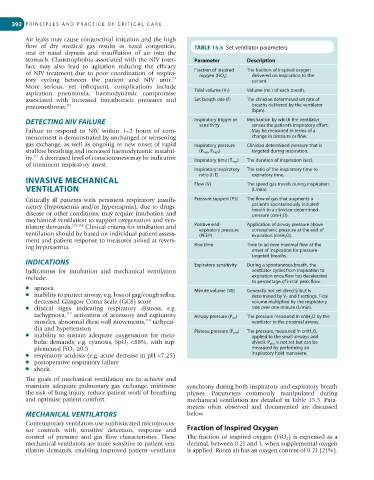
         The goals of mechanical ventilation are to achieve and
         maintain  adequate  pulmonary  gas  exchange,  minimise   synchrony during both inspiratory and expiratory breath
         the risk of lung injury, reduce patient work of breathing   phases.  Parameters  commonly  manipulated  during
         and optimise patient comfort.                        mechanical ventilation are detailed in Table 15.5. Para-
                                                              meters  often  observed  and  documented  are  discussed
         MECHANICAL VENTILATORS                               below.
         Contemporary ventilators use sophisticated microproces-
         sor  controls  with  sensitive  detection,  response  and   Fraction of Inspired Oxygen
         control  of  pressure  and  gas  flow  characteristics.  These   The fraction of inspired oxygen (FiO 2 ) is expressed as a
         mechanical ventilators are more sensitive to patient ven-  decimal, between 0.21 and 1, when supplemental oxygen
         tilatory demands, enabling improved patient–ventilator   is applied. Room air has an oxygen content of 0.21 (21%).

