


Page 461 - ACCCN's Critical Care Nursing
P. 461
438  P R I N C I P L E S   A N D   P R A C T I C E   O F   C R I T I C A L   C A R E

                                                              threshold  in  adults  especially  those  who  are  pressure-
                                                                                                   63
                   P1                                         active (i.e. ICP varies inversely with MAP).  Higher CPP
                                P2                            has been associated with increased lung water and acute
                                                              respiratory  distress  syndrome.  Furthermore,  mortality
                                       P3
                                                              rises approximately 20% for each 10 mmHg loss of CPP.
                                                              In  those  studies  where  CPP  was  maintained  above
                                                              70 mmHg,  the  reduction  in  mortality  was  as  much  as
                                                                                              64
                                                              35% for those with severe head injury.  The Brain Trauma
                                                              Foundation  recommends  a  CPP  goal  of  50–70 mmHg
            A                                                 despite  the  lack  of  definitive  data,  such  as  from  ran-
                                                              domised controlled trials and intention-to-treat clinical
                                                                   65
                             P2                               trials.  In the paediatric population a CPP >40 mmHg is
                                                              the  recommended  guideline. 66,67   Utilising  cerebral  oxy-
                                       P3                     genation monitoring in combination with pressure has
                                                              been  associated  with  better  outcomes  for  brain-injured
               P1                                             patients,  and  is  part  of  the  multimodal  assessment  for
                                                              brain injury.

                                                              ASSESSMENT OF CEREBRAL OXYGENATION
                                                              Jugular Venous Oximetry
            B
                                                              Jugular venous catheterisation is used for deriving oxygen
                                                                            68
                                                              based variables.  It facilitates the assessment of jugular
                                                              venous oxygenation (SjvO 2 ), cerebral oxygen extraction
                                                              (CEO 2 ), and arteriovenous difference in oxygen (AVDO 2 ).
                                                              All of these variables indicate changes in cerebral metabo-
                                                              lism and blood flow, and therefore the catheter generates
                                                              continuous data that reflect the balance between supply
                                                              and demand of cerebral oxygen.
            C
                                                              The catheter is inserted in the right jugular vein, as it is
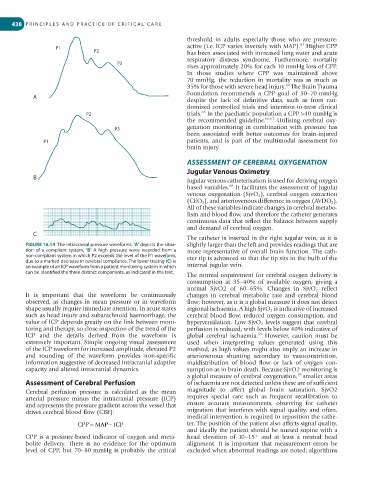
         FIGURE 16.14  The intracranial pressure waveforms. ‘A’ depicts the situa-  slightly larger than the left and provides readings that are
         tion  of  a  compliant  system,  ‘B’  A  high  pressure  wave  recorded  from  a   more representative of overall brain function. The cath-
         non-compliant system in which P2 exceeds the level of the P1 waveform,   eter tip is advanced so that the tip sits in the bulb of the
         due to a marked decrease in cerebral compliance. The lower tracing (C) is
         an example of an ICP waveform from a patient monitoring system in which   internal jugular vein.
         can be identified the three distinct components, as indicated in the text.
                                                              The normal requirement for cerebral oxygen delivery is
                                                              consumption  at  35–40%  of  available  oxygen,  giving  a
                                                              normal  SjvO2  of  60–65%.  Changes  in  SjvO 2   reflect
         It  is  important  that  the  waveform  be  continuously   changes  in  cerebral  metabolic  rate  and  cerebral  blood
         observed, as changes in mean pressure or in waveform   flow; however, as it is a global measure it does not detect
         shape usually require immediate attention. In acute states   regional ischaemia. A high SjvO 2  is indicative of increased
         such as head injury and subarachnoid haemorrhage, the   cerebral blood flow, reduced oxygen consumption, and
         value of ICP depends greatly on the link between moni-  hyperventilation. Low SjvO 2  levels suggest that cerebral
         toring and therapy, so close inspection of the trend of the   perfusion is reduced, with levels below 40% indicative of
                                                                                     69
         ICP  and  the  details  derived  from  the  waveform  is   global  cerebral  ischaemia.   However,  caution  must  be
         extremely important. Simple ongoing visual assessment   used  when  interpreting  values  generated  using  this
         of the ICP waveform for increased amplitude, elevated P2   method, as high values might also imply an increase in
         and  rounding  of  the  waveform  provides  non-specific   arteriovenous  shunting  secondary  to  vasoconstriction,
         information suggestive of decreased intracranial adaptive   maldistribution  of  blood  flow  or  lack  of  oxygen  con-
         capacity and altered intracranial dynamics.          sumption as in brain death. Because SjvO2 monitoring is
                                                                                                  70
                                                              a global measure of cerebral oxygenation,  smaller areas
         Assessment of Cerebral Perfusion                     of ischaemia are not detected unless these are of sufficient
         Cerebral  perfusion  pressure  is  calculated  as  the  mean   magnitude  to  affect  global  brain  saturation.  SjvO2
         arterial  pressure  minus  the  intracranial  pressure  (ICP)   requires  special  care  such  as  frequent  recalibration  to
         and represents the pressure gradient across the vessel that   ensure  accurate  measurements,  observing  for  catheter
         drives cerebral blood flow (CBF):                    migration that interferes with signal quality, and often,
                                                              medical intervention is required to reposition the cathe-
                                     −
                          CPP =  MAP ICP                      ter. The position of the patient also affects signal quality,
                                                              and ideally the patient should be nursed supine with a
         CPP  is  a  pressure-based  indicator  of  oxygen  and  meta-  head  elevation  of  10–15°  and  at  least  a  neutral  head
         bolite  delivery.  There  is  no  evidence  for  the  optimum   alignment.  It  is  important  that  measurement  errors  be
         level  of  CPP,  but  70–80 mmHg  is  probably  the  critical   excluded when abnormal readings are noted; algorithms

