


Page 464 - ACCCN's Critical Care Nursing
P. 464
Neurological Assessment and Monitoring 441


               Case study, Continued
               Emergency surgery                                  noradrenaline  support  for  a  CPP  of  65;  SaO 2   97%;  temperature
               Due to his continued bilateral pupil enlargement and non reac-  35.5°C; his pupils returning to a stabilised 3/3 mm (R/L), sluggish
               tivity, Daniel was transferred to the operating theatre within the   sequential reaction; he was heavily sedated, not paralysed initially,
               hour for a craniotomy and insertion of external ventricular drain   and unresponsive with a Glasgow Coma Scale score (GCS) of 3T
               (EVD)  and  evacuation  of  the  subdural  haematoma.  A  repeat  CT   (eye  opening  1,  verbal  1  [T  =  intubated],  motor  1).  The  initial
               scan revealed reduced cerebral oedema and repositioning of the   opening intracranial pressure  of 28 mmHg was  indicative of  the
               ventricular  midline  shift.  Widespread  petechial  hemorrhages   cerebral oedema from the diffuse injury. The EVD was positioned
               remained. In terms of his further injuries, a right femur external   at 15 cm above the tragus and remained opened during episodes
               fixation, right femoral artery repair, lateral right thigh fasciotomy,   of increased ICP exceeding 20 mmHg and drained 26 mL of blood-
               and right forearm fracture stabilisation by plaster cast were per-  tinged cerebral spinal fluid in the first 24 hours. He required para-
               formed  in  conjunction  with  his  neurosurgery  due  to  a  large   lysing  and  increased  sedation  to  control  his  ICP  and  CPP.  Pain
               amount of blood loss mainly from the right femur. The right peri-  stimulation  for  neurological  assessment  under  these  conditions
               nephric haematoma had stabilised and was managed conserva-  was  only  assessed  during  endotracheal  suction.  Noradrenaline
               tively. A left subclavian central venous catheter was placed and a   infusion fluctuated throughout the day and Daniel required hypo-
               radial arterial cannulation for arterial blood pressure monitoring.  tonic  saline  boluses  for  intracranial  hypertension.  Normal  saline
                                                                  was infused to maintain euovolemia.
               Daniel received a massive blood transfusion:
               ●  34 units packed red blood cells                 Days 2–7
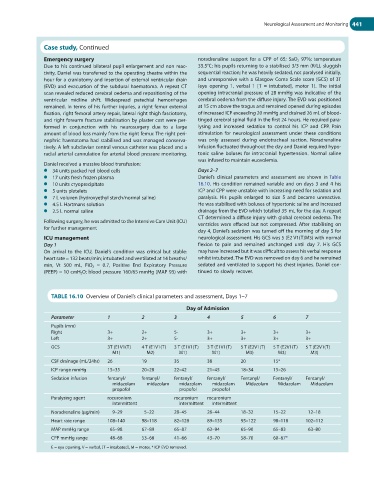
               ●  17 units fresh frozen plasma                    Daniel’s  clinical  parameters  and  assessment  are  shown  in  Table
               ●  10 units cryoprecipitate                        16.10.  His  condition  remained  variable  and  on  days  3  and  4  his
               ●  5 units platelets                               ICP and CPP were unstable with increasing need for sedation and
               ●  7 L voluven (hydroxyethyl starch/normal saline)  paralysis.  His  pupils  enlarged  to  size  5  and  became  unreactive.
               ●  4.5 L Hartmans solution                         He was stabilised with boluses of hypertonic saline and increased
               ●  2.5 L normal saline                             drainage from the EVD which totalled 35  mL for the day. A repeat
                                                                  CT determined a diffuse injury with global cerebral oedema. The
               Following surgery, he was admitted to the Intensive Care Unit (ICU)   ventricles were effaced but not compressed. After stabilising on
               for further management                             day 4, Daniel’s sedation was turned off the morning of day 5 for
               ICU management                                     neurological assessment. His GCS was 5 (E2 V1(T)M3) with normal
               Day 1                                              flexion  to  pain  and  remained  unchanged  until  day  7.  His  GCS
               On  arrival  to  the  ICU,  Daniel’s  condition  was  critical  but  stable:   may have increased but it was difficult to assess his verbal response
               heart rate = 132 beats/min; intubated and ventilated at 14 breaths/  whilst intubated. The EVD was removed on day 6 and he remained
               min,  Vt  500  mL,  FiO 2   =  0.7,  Positive  End  Expiratory  Pressure   sedated and ventilated to support his chest injuries. Daniel con-
               (PEEP) = 10 cmH 2 O; blood pressure 160/65 mmHg (MAP 93) with   tinued to slowly recover.


                  TABLE 16.10  Overview of Daniel’s clinical parameters and assessment, Days 1–7
                                                              Day of Admission
                  Parameter         1          2          3          4          5         6          7
                  Pupils (mm)
                  Right             3+         2+         5-         3+         3+        3+         3+
                  Left              3+         2+         5-         3+         3+        3+         3+
                  GCS               3T (E1V1(T)  4 T (E1V1(T)  3 T (E1V1(T)  3 T (E1V1(T)  5 T (E2V1(T)  5 T (E2V1(T)  5 T (E2V1(T)
                                      M1)        M2)        M1)       M1)        M3)        M3)        M3)
                  CSF drainage (mL/24hr)  26   19         35         38         20        15*
                  ICP range mmHg    15–35      20–28      22–42      21–45      18–34     15–26
                  Sedation infusion  fentanyl/  fentanyl/  fentanyl/  fentanyl/  Fentanyl/  Fentanyl/  Fentanyl/
                                      midazolam  midazolam  midazolam  midazolam  Midazolam  Midazolam  Midazolam
                                      propofol              propofol  propofol
                  Paralysing agent  rocuronium            rocuronium  rocuronium
                                      intermittent          intermittent  intermittent
                  Noradrenaline (µg/min)  9–29  5–22      28–45      26–44      18–32     15–22       12–18
                  Heart rate range  108–140    98–118     82–128     89–135     95–122    98–118     102–112
                  MAP mmHg range     65–98     67–89      65–87      63–94      65–90     65–83       63–80
                  CPP mmHg range     48–68     53–68      41–66      43–70      58–70     60–67*
                  E = eye opening, V = verbal, [T = intubated], M = motor, * ICP EVD removed.

