


Page 458 - ACCCN's Critical Care Nursing
P. 458
Neurological Assessment and Monitoring 435


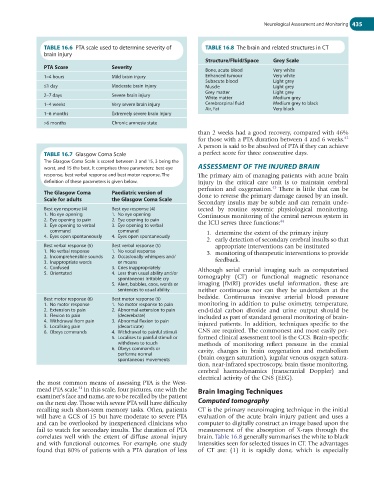
               TABLE 16.6  PTA scale used to determine severity of   TABLE 16.8  The brain and related structures in CT
               brain injury
                                                                    Structure/Fluid/Space  Grey Scale
               PTA Score              Severity                      Bone, acute blood     Very white
               1–4 hours              Mild brain injury             Enhanced tumour       Very white
                                                                    Subacute blood        Light grey
               ≤1 day                 Moderate brain injury         Muscle                Light grey
                                                                    Grey matter           Light grey
               2–7 days               Severe brain injury           White matter          Medium grey
               1–4 weeks              Very severe brain injury      Cerebrospinal fluid   Medium grey to black
                                                                    Air, Fat              Very black
               1–6 months             Extremely severe brain injury
               >6 months              Chronic amnesia state
                                                                  than 2 weeks had a good recovery, compared with 46%
                                                                                                                  42
                                                                  for those with a PTA duration between 4 and 6 weeks.
                                                                  A person is said to be absolved of PTA if they can achieve
               TABLE 16.7  Glasgow Coma Scale                     a perfect score for three consecutive days.
               The Glasgow Coma Scale is scored between 3 and 15, 3 being the
               worst, and 15 the best. It comprises three parameters: best eye   ASSESSMENT OF THE INJURED BRAIN
               response, best verbal response and best motor response. The   The primary aim of managing patients with acute brain
               definition of these parameters is given below.     injury  in  the  critical  care  unit  is  to  maintain  cerebral
                                                                                          43
                                                                  perfusion and oxygenation.  There is little that can be
               The Glasgow Coma       Paediatric version of
               Scale for adults       the Glasgow Coma Scale      done to reverse the primary damage caused by an insult.
                                                                  Secondary insults may be subtle and can remain unde-
               Best eye response (4)  Best eye response (4)       tected  by  routine  systemic  physiological  monitoring.
               1.  No eye opening     1.  No eye opening          Continuous monitoring of the central nervous system in
               2.  Eye opening to pain  2.  Eye opening to pain                              44
               3.  Eye opening to verbal   3.  Eye opening to verbal   the ICU serves three functions:
                 command                command                      1.  determine the extent of the primary injury
               4.  Eyes open spontaneously  4.  Eyes open spontaneously
                                                                     2.  early detection of secondary cerebral insults so that
               Best verbal response (5)  Best verbal response (5)      appropriate interventions can be instituted
               1.  No verbal response  1.  No vocal response         3.  monitoring of therapeutic interventions to provide
               2.  Incomprehensible sounds  2.  Occasionally whimpers and/
               3.  Inappropriate words  or moans                       feedback.
               4.  Confused           3.  Cries inappropriately   Although  serial  cranial  imaging  such  as  computerised
               5.  Orientated         4.  Less than usual ability and/or
                                        spontaneous irritable cry  tomography  (CT)  or  functional  magnetic  resonance
                                      5.  Alert, babbles, coos, words or   imaging  (fMRI)  provides  useful  information,  these  are
                                        sentences to usual ability  neither  continuous  nor  can  they  be  undertaken  at  the
               Best motor response (6)  Best motor response (6)   bedside.  Continuous  invasive  arterial  blood  pressure
               1.  No motor response  1.  No motor response to pain  monitoring in addition to pulse oximetry, temperature,
               2.  Extension to pain  2.  Abnormal extension to pain   end-tidal  carbon  dioxide  and  urine  output  should  be
               3.  Flexion to pain      (decerebrate)             included as part of standard general monitoring of brain-
               4.  Withdrawal from pain  3.  Abnormal flexion to pain
               5.  Localising pain      (decorticate)             injured patients. In addition, techniques specific to the
               6.  Obeys commands     4.  Withdrawal to painful stimuli  CNS are required. The commonest and most easily per-
                                      5.  Localises to painful stimuli or   formed clinical assessment tool is the GCS. Brain-specific
                                        withdraws to touch        methods  of  monitoring  reflect  pressure  in  the  cranial
                                      6.  Obeys commands or       cavity,  changes  in  brain  oxygenation  and  metabolism
                                        performs normal
                                        spontaneous movements     (brain oxygen saturation), jugular venous oxygen satura-
                                                                  tion, near-infrared spectroscopy, brain tissue monitoring,
                                                                  cerebral  haemodynamics  (transcranial  Doppler)  and
                                                                  electrical activity of the CNS (EEG).
             the most common means of assessing PTA is the West-
                           41
             mead PTA scale.  In this scale, four pictures, one with the   Brain Imaging Techniques
             examiner’s face and name, are to be recalled by the patient
             on the next day. Those with severe PTA will have difficulty   Computed tomography
             recalling such short-term memory tasks. Often, patients   CT is the primary neuroimaging technique in the initial
             will have a GCS of 15 but have moderate to severe PTA   evaluation  of  the  acute  brain  injury  patient  and  uses  a
             and can be overlooked by inexperienced clinicians who   computer to digitally construct an image based upon the
             fail to watch for secondary insults. The duration of PTA   measurement  of  the  absorption  of  X-rays  through  the
             correlates  well  with  the  extent  of  diffuse  axonal  injury   brain. Table 16.8 generally summarises the white to black
             and  with  functional  outcomes.  For  example,  one  study   intensities seen for selected tissues in CT. The advantages
             found that 80% of patients with a PTA duration of less   of  CT  are:  (1)  it  is  rapidly  done,  which  is  especially

