


Page 459 - ACCCN's Critical Care Nursing
P. 459
436  P R I N C I P L E S   A N D   P R A C T I C E   O F   C R I T I C A L   C A R E


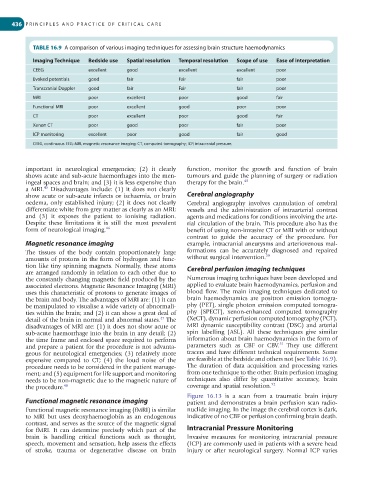
            TABLE 16.9  A comparison of various imaging techniques for assessing brain structure haemodynamics

            Imaging Technique  Bedside use  Spatial resolution  Temporal resolution  Scope of use  Ease of interpretation
            CEEG              excellent    good            excellent          excellent    poor
            Evoked potentials  good        fair            Fair               fair         poor
            Transcranial Doppler  good     fair            Fair               fair         poor
            MRI               poor         excellent       poor               good         fair
            Functional MRI    poor         excellent       good               poor         poor
            CT                poor         excellent       poor               good         fair
            Xenon CT          poor         good            poor               fair         poor
            ICP monitoring    excellent    poor            good               fair         good
            CEEG, continuous EEG; MRI, magnetic resonance imaging; CT, computed tomography; ICP, intracranial pressure.


         important  in  neurological  emergencies;  (2)  it  clearly   function,  monitor  the  growth  and  function  of  brain
         shows acute and sub-acute haemorrhages into the men-  tumours and guide the planning of surgery or radiation
         ingeal spaces and brain; and (3) it is less expensive than   therapy for the brain. 49
               45
         a  MRI.   Disadvantages  include:  (1)  it  does  not  clearly
         show acute or sub-acute infarcts or ischaemia, or brain   Cerebral angiography
         oedema, only established injury; (2) it does not clearly   Cerebral  angiography  involves  cannulation  of  cerebral
         differentiate white from grey matter as clearly as an MRI;   vessels  and  the  administration  of  intraarterial  contrast
         and  (3)  it  exposes  the  patient  to  ionising  radiation.   agents and medications for conditions involving the arte-
         Despite  these  limitations  it  is  still  the  most  prevalent   rial circulation of the brain. This procedure also has the
         form of neurological imaging. 46                     benefit of using non-invasive CT or MRI with or without
                                                              contrast  to  guide  the  accuracy  of  the  procedure.  For
         Magnetic resonance imaging                           example, intracranial aneurysms and arteriovenous mal-
         The  tissues  of  the  body  contain  proportionately  large   formations  can  be  accurately  diagnosed  and  repaired
         amounts of protons in the form of hydrogen and func-  without surgical intervention. 50
         tion like tiny spinning magnets. Normally, these atoms   Cerebral perfusion imaging techniques
         are arranged randomly in relation to each other due to
         the constantly changing magnetic field produced by the   Numerous imaging techniques have been developed and
         associated electrons. Magnetic Resonance Imaging (MRI)   applied to evaluate brain haemodynamics, perfusion and
         uses this characteristic of protons to generate images of   blood flow. The main imaging techniques dedicated to
         the brain and body. The advantages of MRI are: (1) it can   brain  haemodynamics  are  positron  emission  tomogra-
         be manipulated to visualise a wide variety of abnormali-  phy (PET), single photon emission computed tomogra-
         ties within the brain; and (2) it can show a great deal of   phy  (SPECT),  xenon-enhanced  computed  tomography
                                                     47
         detail of the brain in normal and abnormal states.  The   (XeCT), dynamic perfusion computed tomography (PCT),
         disadvantages of MRI are: (1) it does not show acute or   MRI dynamic susceptibility contrast (DSC) and arterial
         sub-acute haemorrhage into the brain in any detail; (2)   spin  labelling  (ASL).  All  these  techniques  give  similar
         the time frame and enclosed space required to perform   information about brain haemodynamics in the form of
                                                                                            51
         and prepare a patient for the procedure is not advanta-  parameters  such  as  CBF  or  CBV.   They  use  different
         geous for neurological emergencies; (3) relatively more   tracers and have different technical requirements. Some
         expensive  compared  to  CT;  (4)  the  loud  noise  of  the   are feasible at the bedside and others not (see Table 16.9).
         procedure needs to be considered in the patient manage-  The  duration  of  data  acquisition  and  processing  varies
         ment; and (5) equipment for life support and monitoring   from one technique to the other. Brain perfusion imaging
         needs to be non-magnetic due to the magnetic nature of   techniques  also  differ  by  quantitative  accuracy,  brain
         the procedure. 48                                    coverage and spatial resolution. 52
                                                              Figure  16.13  is  a  scan  from  a  traumatic  brain  injury
         Functional magnetic resonance imaging                patient and demonstrates a brain perfusion scan radio-
         Functional magnetic resonance imaging (fMRI) is similar   nuclide imaging. In the image the cerebral cortex is dark,
         to  MRI  but  uses  deoxyhaemoglobin  as  an  endogenous   indicative of no CBF or perfusion confirming brain death.
         contrast, and serves as the source of the magnetic signal
         for  fMRI.  It  can  determine  precisely  which  part  of  the   Intracranial Pressure Monitoring
         brain  is  handling  critical  functions  such  as  thought,   Invasive  measures  for  monitoring  intracranial  pressure
         speech, movement and sensation, help assess the effects   (ICP) are commonly used in patients with a severe head
         of  stroke,  trauma  or  degenerative  disease  on  brain   injury  or  after  neurological  surgery.  Normal  ICP  varies

