


Page 470 - ACCCN's Critical Care Nursing
P. 470
Neurological Alterations and Management  447

             Autonomic Nerve Dysfunction                          parenchyma.  Accordingly,  reduction  of  ICP  is  usually
             Dysfunctions  of  the  autonomic  nervous  system  (ANS)    argued for restoration of previously compromised cere-
             or autonomic dysreflexia are recognised by the symptoms   bral perfusion for improvement of cerebral metabolism.
             that result from failure or imbalance of the sympathetic     Although  uncontrolled  ICP  elevation  has  been  shown
             or parasympathetic components of the ANS such as (i)   to  be  responsible  for  reduced  oxygen  delivery,  non-
             increased (>120/min) or decreased (<50/min) heart rate,   ischaemic  impairment  of  oxidative  metabolism  and
             (ii)  increased  respiratory  rate  (>24/min),  (iii)  raised   mitochondrial  damage  has  only  recently  been  recog-
             temperature (>38.5°C), (iv) increased (>160 mmHg) or   nised  as  a  prominent  source  of  energy  crisis  triggered
             decreased  (<85 mmHg)  systolic  blood  pressure,  (v)   by  brain  injury  in  the  presence  of  adequate  cerebral
                                                                            12
             increased muscle tone, (vi) decerebrate (extensor) or decor-  blood flow.  Accumulating evidence has shown that the
             ticate (flexor) posturing, and (vii) profuse sweating. For   mitochondrion has a pivotal role in post traumatic neu-
             example, in spinal injury the presence of a noxious sti-  ronal  death  by  integrating  numerous  noxious  signals
             mulus can be transmitted from the periphery to the spinal   responsible  for  both  structural  and  functional  damage
             cord and activates dysfunctional sympathetic response.  on  one  hand  and  by  amplifying  these  signals  through
                                                                  activation  of  several  cellular  signalling  events  leading
             There is strong evidence for numerous interactions among   to  cell  death.  In  addition,  more  complex  processes
             the  central  nervous  system  (CNS),  peripheral  nervous   with  the  alteration  of  cerebral  perfusion,  such  as
             system (both sympathetic and parasympathetic branches),   cerebral  hypoperfusion,  ischaemia,  reperfusion  injury,
             the  endocrine  system,  and  the  immune  system,  hence   inflammation  and  oedema  result  in  increased  intracra-
                                                        10
             ANS dysfunction is related to that complex triad.  Auto-  nial  pressure  (ICP).
             nomic  nerve  (AN)  dysfunction  ranges  from  alterations
             in  the  sympathetic–parasympathetic  balance  to  almost   Cerebral Ischaemia
             complete cessation as occurs in spinal cord injury. As the
             ANS controls organ function AN dysfunction is related to   Ischaemia is the inadequate delivery of oxygen, the inad-
             all-organ  alteration  and  failure.  The  immune  system  is   equate removal of carbon dioxide from the cell, and an
             connected to the nervous system through the ANS with   increase  in  the  production  of  intracellular  lactic  acid.
             many of the patients with infections, systemic inflamma-  Ischaemia can be caused by an increase in nutrient utilisa-
             tory response and multi-organ failure exhibiting AN dys-  tion  by  the  brain  in  a  hyperactive  state,  a  decrease  in
             function.  AN  dysfunction  is  closely  related  to  systemic   delivery related to either cerebral or systemic complica-
                                                                                                                  13
             inflammation hence those with conditions with increased   tions, and/or a mismatch between delivery and demand.
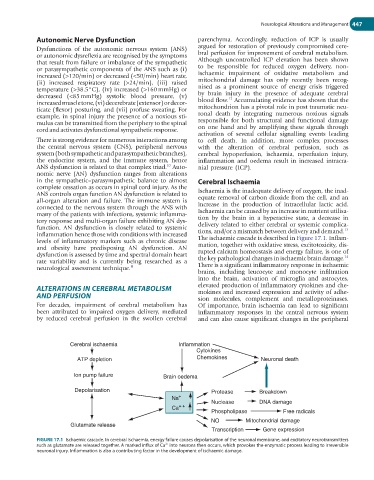
             levels of inflammatory markers such as chronic disease   The ischaemic cascade is described in Figure 17.1. Inflam-
             and  obesity  have  predisposing  AN  dysfunction.  AN    mation, together with oxidative stress, excitotoxicity, dis-
             dysfunction is assessed by time and spectral domain heart   rupted calcium homeostasis and energy failure, is one of
                                                                                                                  14
             rate  variability  and  is  currently  being  researched  as  a     the key pathological changes in ischaemic brain damage.
             neurological assessment technique. 11                There is a significant inflammatory response in ischaemic
                                                                  brains,  including  leucocyte  and  monocyte  infiltration
                                                                  into  the  brain,  activation  of  microglia  and  astrocytes,
             ALTERATIONS IN CEREBRAL METABOLISM                   elevated production of inflammatory cytokines and che-
                                                                  mokines and increased expression and activity of adhe-
             AND PERFUSION                                        sion  molecules,  complement  and  metalloproteinases.
             For  decades,  impairment  of  cerebral  metabolism  has   Of  importance,  brain  ischaemia  can  lead  to  significant
             been  attributed  to  impaired  oxygen  delivery,  mediated   inflammatory  responses  in  the  central  nervous  system
             by  reduced  cerebral  perfusion  in  the  swollen  cerebral   and can also cause significant changes in the peripheral


                        Cerebral ischaemia                 Inflammation
                                                                 Cytokines
                          ATP depletion                          Chemokines           Neuronal death

                         Ion pump failure             Brain oedema

                         Depolarisation                               Protease        Breakdown
                                                         Na +
                                                                      Nuclease        DNA damage
                                                         Ca + +
                                                                      Phospholipase           Free radicals
                                                                      NO         Mitochondrial damage
                        Glutamate release
                                                                      Transcription    Gene expression
             FIGURE 17.1  Ischaemic cascade. In cerebral ischaemia, energy failure causes depolarisation of the neuronal membrane, and excitatory neurotransmitters
             such as glutamate are released together. A marked influx of Ca  into neurons then occurs, which provokes the enzymatic process leading to irreversible
                                                       2+
             neuronal injury. Inflammation is also a contributing factor in the development of ischaemic damage.

