


Page 474 - ACCCN's Critical Care Nursing
P. 474
Neurological Alterations and Management  451


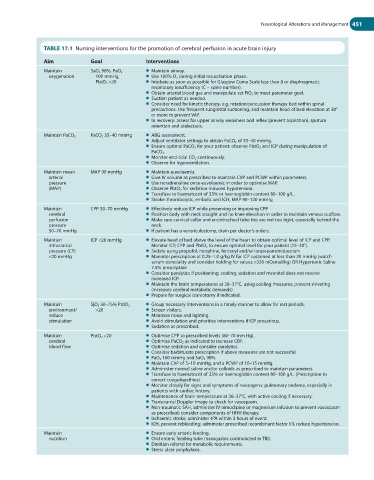
               TABLE 17.1  Nursing interventions for the promotion of cerebral perfusion in acute brain injury

               Aim             Goal              Interventions
               Maintain        SaO 2  98%, PaO 2    ●  Maintain airway.
                 oxygenation    100 mmHg,        ●  Use 100% O 2  during initial resuscitation phase.
                                PbtO 2  >20      ●  Intubate as soon as possible for Glasgow Coma Scale less than 8 or diaphragmatic
                                                   respiratory insufficiency (C – spine number).
                                                 ●  Obtain arterial blood gas and manipulate set FiO 2  to meet parameter goal.
                                                 ●  Suction patient as needed.
                                                 ●  Consider need for kinetic therapy, e.g. rotation/percussion therapy bed within spinal
                                                   precautions. Use frequent subglottal suctioning, and maintain head of bed elevation at 30°
                                                   or more to prevent VAP.
                                                 ●  In recovery: assess for upper airway weakness and reflex (prevent aspiration), sputum
                                                   retention and atelectasis.
                               PaCO 2  35–40 mmHg  ●  ABG assessment.
               Maintain PaCO 2
                                                 ●  Adjust ventilator settings to obtain PaCO 2  of 35–40 mmHg.
                                                 ●  Ensure optimal PaCO 2  for your patient: observe PbtO 2  and ICP during manipulation of
                                                   PaCO 2 .
                                                 ●  Monitor end-tidal CO 2  continuously.
                                                 ●  Observe for hypoventilation.
               Maintain mean   MAP 90 mmHg       ●  Maintain euvolaemia.
                 arterial                        ●  Give IV volume as prescribed to maintain CVP and PCWP within parameters.
                 pressure                        ●  Use noradrenaline once euvolaemic in order to optimise MAP.
                 (MAP)                           ●  Observe PbtO 2 for sedation-induced hypotension.
                                                 ●  Transfuse to haematocrit of 33% or haemoglobin content 80–100 g/L.
                                                 ●  Stroke: thrombolytic, embolic and ICH, MAP 90–120 mmHg
               Maintain        CPP 50–70 mmHg    ●  Effectively reduce ICP while preserving or improving CPP
                 cerebral                        ●  Position body with neck straight and no knee elevation in order to maintain venous outflow.
                 perfusion                       ●  Make sure cervical collar and endotracheal tube ties are not too tight, especially behind the
                 pressure                          neck.
                 50–70 mmHg                      ●  If patient has a ventriculostomy, drain per doctor’s orders.
               Maintain        ICP <20 mmHg      ●  Elevate head of bed above the level of the heart to obtain optimal level of ICP and CPP.
                 intracranial                      Monitor ICP, CPP and PbtO 2  to ensure optimal level for your patient (15–30°).
                 pressure (CP)                   ●  Sedate using propofol, morphine, fentanyl and/or lorazepam/midazolam
                 <20 mmHg                        ●  Mannitol prescription at 0.25–1.0 g/kg IV for ICP sustained at less than 20 mmHg (watch
                                                   serum osmolality and consider holding for values >320 mOsmol/kg) OR Hypertonic Saline
                                                   7.5% prescription
                                                 ●  Consider paralytics if positioning, cooling, sedation and mannitol does not resolve
                                                   increased ICP.
                                                 ●  Maintain the brain temperatures at 36–37°C, using cooling measures; prevent shivering
                                                   (increases cerebral metabolic demands)
                                                 ●  Prepare for surgical craniotomy if indicated.
               Maintain        SjO 2 50–75% PbtO 2    ●  Group necessary interventions in a timely manner to allow for rest periods.
                 environment/   >20              ●  Screen visitors.
                 reduce                          ●  Minimise noise and lighting.
                 stimulation                     ●  Avoid stimulation and prioritise interventions if ICP precarious.
                                                 ●  Sedation as prescribed.
               Maintain        PbtO 2  <20       ●  Optimise CPP to prescribed levels (60–70 mm Hg).
                 cerebral                        ●  Optimise PaCO 2  as indicated to increase CBF.
                 blood flow                      ●  Optimise sedation and consider paralytics.
                                                 ●  Consider barbiturate prescription if above measures are not successful.
                                                 ●  PaO 2  100 mmHg and SaO 2  98%.
                                                 ●  Maintain CVP of 5–10 mmHg, and a PCWP of 10–15 mmHg.
                                                 ●  Administer normal saline and/or colloids as prescribed to maintain parameters.
                                                 ●  Transfuse to haematocrit of 33% or haemoglobin content 80–100 g/L. (Prescription to
                                                   correct coagulopathies).
                                                 ●  Monitor closely for signs and symptoms of neurogenic pulmonary oedema, especially in
                                                   patients with cardiac history.
                                                 ●  Maintenance of brain temperature at 36–37°C, with active cooling if necessary.
                                                 ●  Transcranial Doppler image to check for vasospasm.
                                                 ●  Non-traumatic SAH, administer IV nimodipine or magnesium infusion to prevent vasospasm
                                                   as prescribed; consider components of HHH therapy.
                                                 ●  Ischaemic stroke, administer tPA within 3 hours of event.
                                                 ●  ICH, prevent rebleeding; administer prescribed recombinant factor VII, reduce hypertension.
               Maintain                          ●  Ensure early enteric feeding.
                 nutrition                       ●  Oral enteric feeding tube (nasogastric contradicted in TBI).
                                                 ●  Dietitian referral for metabolic requirements.
                                                 ●  Stress ulcer prophylaxis.

