


Page 488 - ACCCN's Critical Care Nursing
P. 488
Neurological Alterations and Management  465

             a significant reduction in the number of cases of menin-  development  of  subdural  empyema,  brain  abscess  and
                           97
             gococcal disease.  Nationally in 2008 only 15 serogroup   acute  hydrocephalus  may  require  surgical  intervention.
             C infections were identified and serogroup B accounted   Bacterial meningitis with accompanying bacteraemia can
             for 88% of all infections. New Zealand has one of the   lead to a marked systemic inflammatory response with
             highest rates of meningococcal B disease in the developed   septic shock, respiratory distress syndrome and dissemi-
             world  but  the  incidence  has  declined.  There  were  132   nated intravascular coagulation.
             cases of meningococcal disease notified in 2009, which
             equates  to  a  rate  of  3.8  per  100,000  population.  The   Collaborative care
             number of confirmed cases was 117, giving a confirma-
             tion rate of 88.6% which is the third-equal-highest con-  Neurological derangement often coexists with circulatory
             firmation rate since 1991. Five deaths occurred in 2009,   insufficiency,  impaired  respiration,  metabolic  derange-
             giving a case-fatality rate of 3.8%. Since 1991 a total of   ment  and  seizures.  Protecting  the  patient  from  injury
             265  deaths  have  been  recorded,  an  overall  case-fatality   secondary to raised ICP and seizure activity is essential.
             rate  of  4.2%.  The  policy  of  giving  antibiotics  prior  to   Prevention in relation to complications associated with
             hospital admission, implemented in 1995, reduced the   immobility,  such  as  decubitus  and  pneumonia,  is
             case-fatality rate for those receiving antibiotics. In addi-  required.  It  is  important  to  institute  droplet  infection
             tion this rate has reduced from 470 cases in 2001, prior   control precautions in those attending the patient until
             to the immunisation for meningococcal B commencing   24 hours after the initiation of antibiotic therapy (oral
                    98
             in 2004.  The incidence of meningococcal disease varies   and nasal discharge is considered infectious). See Online
             seasonally,  rising  in  June  and  peaking  in  October  each   resources  for  infection  control  protocols  relating  specifi-
             year. The highest incidence of meningococcal disease was   cally to meningitis.
             for children aged 4 years and under. A secondary peak in
             the incidence of meningococcal disease is seen in adoles-  Encephalitis
                                   99
             cents  and  young  adults.   However,  during  the  H1N1
             influenza  epidemic  there  were  several  cases  of  H1N1   Encephalitis implies inflammation of the brain substance
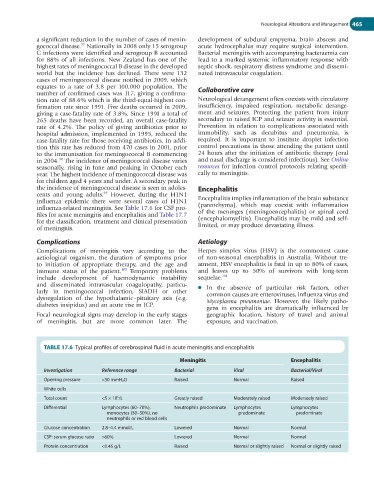
             influenza-related meningitis. See Table 17.6 for CSF pro-  (parenchyma),  which  may  coexist  with  inflammation
             files for acute meningitis and encephalitis and Table 17.7   of  the  meninges  (meningoencephalitis)  or  spinal  cord
             for the classification, treatment and clinical presentation   (encephalomyelitis). Encephalitis may be mild and self-
             of meningitis.                                       limited, or may produce devastating illness.
             Complications                                        Aetiology
             Complications  of  meningitis  vary  according  to  the    Herpes  simplex  virus  (HSV)  is  the  commonest  cause
             aetiological  organism,  the  duration  of  symptoms  prior     of  non-seasonal  encephalitis  in  Australia.  Without  tre-
             to  initiation  of  appropriate  therapy,  and  the  age  and   atment, HSV encephalitis is fatal in up to 80% of cases,
                                         100
             immune  status  of  the  patient.   Temporary  problems   and  leaves  up  to  50%  of  survivors  with  long-term
             include  development  of  haemodynamic  instability    sequelae. 101
             and  disseminated  intravascular  coagulopathy,  particu-  ●  In  the  absence  of  particular  risk  factors,  other
             larly  in  meningococcal  infection,  SIADH  or  other    common causes are enteroviruses, influenza virus and
             dysregulation  of  the  hypothalamic–pituitary  axis  (e.g.   Mycoplasma  pneumoniae.  However,  the  likely  patho-
             diabetes insipidus) and an acute rise in ICP.
                                                                     gens  in  encephalitis  are  dramatically  influenced  by
             Focal neurological signs may develop in the early stages   geographic  location,  history  of  travel  and  animal
             of  meningitis,  but  are  more  common  later.  The    exposure,  and  vaccination.


               TABLE 17.6  Typical profiles of cerebrospinal fluid in acute meningitis and encephalitis

                                                            Meningitis                          Encephalitis
               Investigation      Reference range         Bacterial          Viral              Bacterial/Viral
               Opening pressure   <30 mmH 2 O             Raised             Normal             Raised
               White cells
                                       6
               Total count        <5 × 10 /L              Greatly raised     Moderately raised  Moderately raised
               Differential       Lymphocytes (60–70%),   Neutrophils predominate  Lymphocytes   Lymphocytes
                                    monocytes (30–50%), no                     predominate        predominate
                                    neutrophils or red blood cells
               Glucose concentration  2.8–4.4 mmol/L      Lowered            Normal             Normal
               CSF: serum glucose ratio  >60%             Lowered            Normal             Normal
               Protein concentration  <0.45 g/L           Raised             Normal or slightly raised  Normal or slightly raised

