


Page 486 - ACCCN's Critical Care Nursing
P. 486
Neurological Alterations and Management  463

             and haemorrhagic stroke. Smoking is the strongest risk   by  uncontrolled  hypertension.  Secondary  intracerebral
             factor for aneurysmal SAH. Atrial fibrillation, endocardi-  haemorrhage is associated with arteriovenous malforma-
             tis and medications containing supplemental oestrogen   tions (AVMs), intracranial aneurysms, or certain medica-
             are  risk  factors  for  embolic  stroke.  Seizures  develop  in   tions (e.g. anticoagulants and amphetamines). Symptoms
             approximately 10% of cases, usually appearing in the first   are produced when an aneurysm or arteriovenous mal-
             24 hours and more likely to be focal than generalised.   formation (AVM) enlarges and presses on nearby cranial
             Most patients with aphasia will have a cerebral infarction   nerves  or  brain  tissue  or,  more  dramatically,  when  a
             in the distribution of the left middle cerebral artery. 87  blood vessel, aneurysm or AVM ruptures, causing intra-
                                                                  cerebral or subarachnoid haemorrhage. When an aneu-
             Ischaemic Stroke                                     rysm  ruptures,  arterial  pressure  forces  blood  into  the
                                                                  subarachnoid  space  between  the  arachnoid  mater  and
             Ischemic  stroke  compromises  blood  flow  and  energy
             supply to the brain, which triggers mechanisms that lead   the surface of the brain. Free blood then travels through
             to cell death. Infarction occurs rapidly in the region of   the fissures into the basal cisterns and across the surface
             most  severe  ischaemia  (termed  ischaemic  penumbra)   of the brain. When clotted, this blood can interfere with
             and expands at the expense of the surrounding hypoxic   the  circulation  and  reabsorption  of  cerebrospinal  fluid
             tissue, from the centre to the periphery. Therapeutic strat-  (CSF), potentially causing obstructive hydrocephalus and
             egies in acute ischaemic stroke are based on the concept   raised  intracranial  pressure.  The  commonest  cause  is  a
             of arresting the transition of the penumbral region into   leaking aneurysm in the area of the circle of Willis or a
             infarction,  thereby  limiting  ultimate  infarct  size  and   congenital AVM of the brain. Blood in the subarachnoid
             improving  neurological  and  functional  outcome.  Isch-  space is a powerful meningeal irritant, and it is this irrita-
             aemic stroke can be further categorised as middle cerebral   tion that causes most of the initial signs and symptoms
             artery occlusion, acute basilar occlusion, and cerebellar   of SAH.
             infarcts. 88                                         In intracerebral haemorrhage the bleeding is usually arte-
                                                                  rial  and  occurs  most  commonly  in  the  cerebral  lobes,
             The management of an ischaemic stroke comprises four
             primary goals: restoration of cerebral blood flow (reper-  basal ganglia, thalamus, brainstem (mostly the pons) and
             fusion),  prevention  of  recurrent  thrombosis,  neuropro-  cerebellum. Occasionally, the bleeding ruptures the wall
             tection, and supportive care. The timing of each element   of the lateral ventricle and causes intraventricular haem-
                                                                                           89
             of  clinical  management  needs  to  be  implemented  in  a   orrhage, which is often fatal.
             decisive manner. Refer to Table 17.4 for classification and   Normal brain metabolism is disrupted by the brain being
             treatment  strategies  and  to  Online  resources  for  specific   exposed  to  blood.  The  sudden  entry  of  blood  into  the
             ischaemic stroke protocols.                          subarachnoid space or brain parenchyma results in a rise
                                                                  in ICP, which then leads to compression and ischaemia
             Haemorrhagic Stroke                                  resulting from the reduced perfusion pressure and vaso-
                                                                  spasm that often accompany intracerebral and subarach-
             Haemorrhagic  strokes  are  caused  by  bleeding  into  the   noid  haemorrhage.  Depending  on  the  severity,  clinical
                                                             89
             brain tissue, the ventricles or the subarachnoid space.    findings include severe headache, nuchal rigidity, photo-
             Primary intracerebral haemorrhage from a spontaneous   phobia,  nausea  and  vomiting,  hypertension,  ECG
             rupture  of  small  vessels  accounts  for  approximately    changes,  pyrexia,  cranial  nerve  deficits,  visual  changes,
             80%  of  haemorrhagic  strokes  and  is  primarily  caused     sensory  or  motor  deficits,  fixed  and  dilated  pupils,  sei-
                                                                  zures, herniation and sudden death.
                                                                  The  Factor  Seven  for  Acute  Hemorrhagic  Stroke  (FAST)
                                                                  multicentre  international  clinical  trial  recently  reported
                                                                  that  haemostatic  therapy  with  recombinant  activated
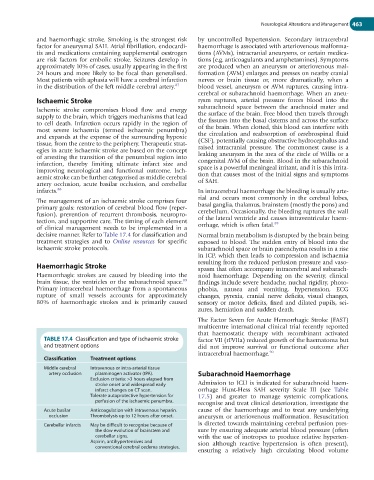
               TABLE 17.4  Classification and type of ischaemic stroke   factor VII (rFVIIa) reduced growth of the haematoma but
               and treatment options                              did  not  improve  survival  or  functional  outcome  after
                                                                  intracerebral haemorrhage. 90
               Classification  Treatment options
               Middle cerebral   Intravenous or intra-arterial tissue
                 artery occlusion  plasminogen activator (tPA).   Subarachnoid Haemorrhage
                               Exclusion criteria: >3 hours elapsed from
                                stroke onset and widespread early   Admission to ICU is indicated for subarachnoid haem-
                                infarct changes on CT scan.       orrhage  Hunt-Hess  SAH  severity  Scale  III  (see  Table
                               Tolerate autoprotective hypertension for   17.5)  and  greater  to  manage  systemic  complications,
                                perfusion of the ischaemic penumbra.  recognise and treat clinical deterioration, investigate the
               Acute basilar   Anticoagulation with intravenous heparin.  cause  of  the  haemorrhage  and  to  treat  any  underlying
                 occlusion     Thrombolysis up to 12 hours after onset.  aneurysm or arteriovenous malformation. Resuscitation
               Cerebellar infarcts  May be difficult to recognise because of   is directed towards maintaining cerebral perfusion pres-
                                the slow evolution of brainstem and   sure by ensuring adequate arterial blood pressure (often
                                cerebellar signs.                 with the use of inotropes to produce relative hyperten-
                               Aspirin, antihypertensives and     sion  although  reactive  hypertension  is  often  present),
                                conventional cerebral oedema strategies.
                                                                  ensuring  a  relatively  high  circulating  blood  volume

