


Page 483 - ACCCN's Critical Care Nursing
P. 483
460  P R I N C I P L E S   A N D   P R A C T I C E   O F   C R I T I C A L   C A R E


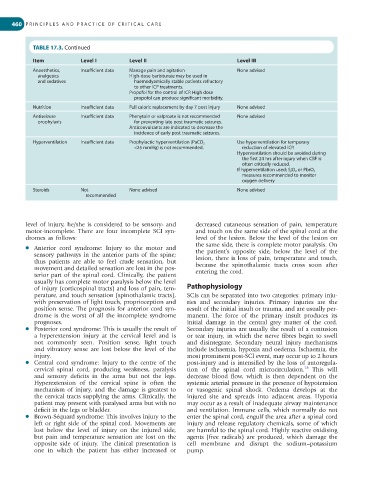
            TABLE 17.3, Continued

            Item           Level I         Level II                            Level III
            Anaesthetics,   Insufficient data  Manage pain and agitation       None advised
             analgesics                    High-dose barbiturate may be used in
             and sedatives                   haemodyamically stable patients refractory
                                             to other ICP treatments.
                                           Propofol for the control of ICP. High dose
                                             propofol can produce significant morbidity.
            Nutrition      Insufficient data  Full caloric replacement by day 7 post injury  None advised
            Antiseizure    Insufficient data  Phenytoin or valproate is not recommended   None advised
             prophylaxis                     for preventing late post traumatic seizures.
                                           Anticonvulsants are indicated to decrease the
                                             incidence of early post traumatic seizures.
            Hyperventilation  Insufficient data  Prophylactic hyperventilation (PaCO 2    Use hyperventilation for temporary
                                             <25 mmHg) is not recommended.      reduction of elevated ICP.
                                                                               Hyperventilation should be avoided during
                                                                                the first 24 hrs after injury when CBF is
                                                                                often critically reduced.
                                                                               If hyperventilation used; SjO 2 or PbrO 2
                                                                                measures recommended to monitor
                                                                                oxygen delivery
            Steroids       Not             None advised                        None advised
                             recommended


         level of injury, he/she is considered to be sensory- and   decreased  cutaneous  sensation  of  pain,  temperature
         motor-incomplete.  There  are  four  incomplete  SCI  syn-  and touch on the same side of the spinal cord at the
         dromes  as  follows:                                    level of the lesion. Below the level of the lesion on
                                                                 the same side, there is complete motor paralysis. On
         ●  Anterior  cord  syndrome:  Injury  to  the  motor  and   the  patient’s  opposite  side,  below  the  level  of  the
            sensory  pathways  in  the  anterior  parts  of  the  spine;   lesion, there is loss of pain, temperature and touch,
            thus  patients  are  able  to  feel  crude  sensation,  but   because  the  spinothalamic  tracts  cross  soon  after
            movement and detailed sensation are lost in the pos-  entering the cord.
            terior  part  of  the  spinal  cord.  Clinically,  the  patient
            usually has complete motor paralysis below the level
            of injury (corticospinal tracts) and loss of pain, tem-  Pathophysiology
            perature, and touch sensation (spinothalamic tracts),   SCIs can be separated into two categories: primary inju-
            with preservation of light touch, proprioception and   ries  and  secondary  injuries.  Primary  injuries  are  the
            position  sense.  The  prognosis  for  anterior  cord  syn-  result of the initial insult or trauma, and are usually per-
            drome  is  the  worst  of  all  the  incomplete  syndrome   manent.  The  force  of  the  primary  insult  produces  its
            prognoses.                                        initial  damage  in  the  central  grey  matter  of  the  cord.
         ●  Posterior cord syndrome: This is usually the result of   Secondary injuries are usually the result of a contusion
            a  hyperextension  injury  at  the  cervical  level  and  is    or  tear  injury,  in  which  the  nerve  fibres  begin  to  swell
            not  commonly  seen.  Position  sense,  light  touch     and  disintegrate.  Secondary  neural  injury  mechanisms
            and  vibratory  sense  are  lost  below  the  level  of  the   include ischaemia, hypoxia and oedema. Ischaemia, the
            injury.                                           most prominent post-SCI event, may occur up to 2 hours
         ●  Central  cord  syndrome:  Injury  to  the  centre  of  the   post-injury and is intensified by the loss of autoregula-
            cervical  spinal  cord,  producing  weakness,  paralysis   tion  of  the  spinal  cord  microcirculation.   This  will
                                                                                                     78
            and  sensory  deficits  in  the  arms  but  not  the  legs.   decrease  blood  flow,  which  is  then  dependent  on  the
            Hyperextension  of  the  cervical  spine  is  often  the   systemic arterial pressure in the presence of hypotension
            mechanism  of  injury,  and  the  damage  is  greatest  to   or  vasogenic  spinal  shock.  Oedema  develops  at  the
            the cervical tracts supplying the arms. Clinically, the   injured  site  and  spreads  into  adjacent  areas.  Hypoxia
            patient may present with paralysed arms but with no   may occur as a result of inadequate airway maintenance
            deficit in the legs or bladder.                   and  ventilation.  Immune  cells,  which  normally  do  not
         ●  Brown-Séquard syndrome: This involves injury to the   enter the spinal cord, engulf the area after a spinal cord
            left  or  right  side  of  the  spinal  cord.  Movements  are   injury and release regulatory chemicals, some of which
            lost  below  the  level  of  injury  on  the  injured  side,     are harmful to the spinal cord. Highly reactive oxidising
            but  pain  and  temperature  sensation  are  lost  on  the   agents  (free  radicals)  are  produced,  which  damage  the
            opposite  side  of  injury.  The  clinical  presentation  is   cell  membrane  and  disrupt  the  sodium–potassium
            one  in  which  the  patient  has  either  increased  or   pump.

