


Page 487 - ACCCN's Critical Care Nursing
P. 487
464  P R I N C I P L E S   A N D   P R A C T I C E   O F   C R I T I C A L   C A R E

                                                              Cerebral Venous Thrombosis
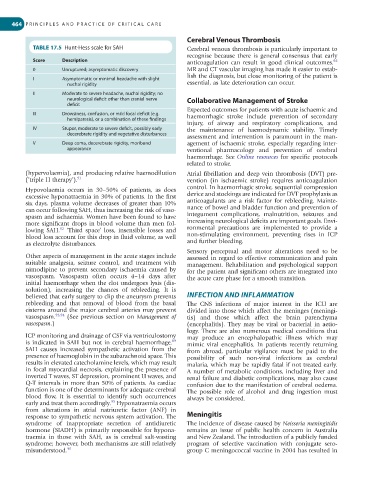
            TABLE 17.5  Hunt-Hess scale for SAH               Cerebral venous thrombosis is particularly important to
                                                              recognise  because  there  is  general  consensus  that  early
            Score    Description                              anticoagulation  can  result  in  good  clinical  outcomes.
                                                                                                              96
            0        Unruptured; asymptomatic discovery       MR and CT vascular imaging has made it easier to estab-
                                                              lish the diagnosis, but close monitoring of the patient is
            I        Asymptomatic or minimal headache with slight
                       nuchal rigidity                        essential, as late deterioration can occur.
            II       Moderate to severe headache, nuchal rigidity; no
                       neurological deficit other than cranial nerve   Collaborative Management of Stroke
                       deficit
                                                              Expected outcomes for patients with acute ischaemic and
            III      Drowsiness, confusion, or mild focal deficit (e.g.   haemorrhagic  stroke  include  prevention  of  secondary
                       hemiparesis), or a combination of these findings
                                                              injury,  of  airway  and  respiratory  complications,  and
            IV       Stupor, moderate to severe deficit, possibly early   the  maintenance  of  haemodynamic  stability.  Timely
                       decerebrate rigidity and vegetative disturbances
                                                              assessment and intervention is paramount in the man-
            V        Deep coma, decerebrate rigidity, moribund   agement of ischaemic stroke, especially regarding inter-
                       appearance                             ventional  pharmacology  and  prevention  of  cerebral
                                                              haemorrhage. See Online  resources for specific protocols
                                                              related to stroke.
         (hypervolaemia), and producing relative haemodilution   Atrial fibrillation and deep vein thrombosis (DVT) pre-
         (’triple H therapy’). 91                             vention  (in  ischaemic  stroke)  requires  anticoagulation
         Hypovolaemia  occurs  in  30–50%  of  patients,  as  does   control. In haemorrhagic stroke, sequential compression
         excessive hyponatraemia in 30% of patients. In the first   device and stockings are indicated for DVT prophylaxis as
         six days, plasma volume decreases of greater than 10%   anticoagulants  are  a  risk  factor  for  rebleeding.  Mainte-
         can occur following SAH, thus increasing the risk of vaso-  nance of bowel and bladder function and prevention of
         spasm and ischaemia. Women have been found to have   integument  complications,  malnutrition,  seizures  and
         more significant drops in blood volume than men fol-  increasing neurological deficits are important goals. Envi-
                     92
         lowing  SAH.   ‘Third  space’  loss,  insensible  losses  and   ronmental  precautions  are  implemented  to  provide  a
         blood loss account for this drop in fluid volume, as well   non-stimulating  environment,  preventing  rises  in  ICP
         as electrolyte disturbances.                         and further bleeding.
                                                              Sensory  perceptual  and  motor  alterations  need  to  be
         Other aspects of management in the acute stages include   assessed in regard to effective communication and pain
         suitable  analgesia,  seizure  control,  and  treatment  with   management.  Rehabilitation  and  psychological  support
         nimodipine  to  prevent  secondary  ischaemia  caused  by   for the patient and significant others are integrated into
         vasospasm.  Vasospasm  often  occurs  4–14  days  after   the acute care phase for a smooth transition.
         initial haemorrhage when the clot undergoes lysis (dis-
         solution),  increasing  the  chances  of  rebleeding.  It  is
         believed that early surgery to clip the aneurysm prevents   INFECTION AND INFLAMMATION
         rebleeding  and  that  removal  of  blood  from  the  basal   The  CNS  infections  of  major  interest  in  the  ICU  are
         cisterns around the major cerebral arteries may prevent   divided into those which affect the meninges (meningi-
         vasospasm. 93,94  (See previous section on Management  of   tis)  and  those  which  affect  the  brain  parenchyma
         vasospasm.)                                          (encephalitis).  They  may  be  viral  or  bacterial  in  aetio-
                                                              logy.  There  are  also  numerous  medical  conditions  that
         ICP monitoring and drainage of CSF via ventricul ostomy   may  produce  an  encephalopathic  illness  which  may
                                                         89
         is indicated in SAH but not in cerebral haemorrhage.    mimic  viral  encephalitis.  In  patients  recently  returning
         SAH  causes  increased  sympathetic  activation  from  the   from  abroad,  particular  vigilance  must  be  paid  to  the
         presence of haemoglobin in the subarachnoid space. This   possibility  of  such  non-viral  infections  as  cerebral
         results in elevated catecholamine levels, which may result   malaria, which may be rapidly fatal if not treated early.
         in focal myocardial necrosis, expla ining the presence of   A number of metabolic conditions, including liver and
         inverted T waves, ST dep ression, prominent U waves, and   renal failure and diabetic complications, may also cause
         Q-T intervals in more than 50% of pati ents. As cardiac   confusion due to the manifestation of cerebral oedema.
         function is one of the determinants for adequate cerebral   The  possible  role  of  alcohol  and  drug  ingestion  must
         blood  flow,  it  is  essential  to  identify  such  occurrences   always be considered.
                                     95
         early and treat them acco rdingly.  Hyponatraemia occurs
         from  alte rations  in  atrial  natriuretic  factor  (ANF)  in
         response to sympathetic nervous system activation. The   Meningitis
         syndrome  of  inappropriate  secretion  of  antidiuretic   The incidence of disease caused by Neisseria meningitidis
         hormone (SIADH) is primarily responsible for hypona-  remains  an  issue  of  public  health  concern  in  Australia
         traemia  in  those  with  SAH,  as  is  cerebral  salt-wasting   and New Zealand. The introduction of a publicly funded
         syndrome; however, both mechanisms are still relatively   program  of  selective  vaccination  with  conjugate  sero-
         misunderstood. 90                                    group C meningococcal vaccine in 2004 has resulted in

