


Page 505 - ACCCN's Critical Care Nursing
P. 505
482  P R I N C I P L E S   A N D   P R A C T I C E   O F   C R I T I C A L   C A R E

         Along  with  blood  pressure,  the  sodium  content  of  the   also increases the reabsorption of salt and water in the
         extracellular fluid is critical in maintaining fluid balance,   tubule and stimulates the release of renin.
         as it constitutes the major electrolyte and osmotic agent
         of  the  glomerular  filtrate.  It  is  imperative  that  sodium   Antidiuretic Hormone
         intake  and  loss  is  equally  balanced,  as  excessive  losses   The  antidiuretic  hormone  (ADH)  is  excreted  from  the
         will result in associated fluid loss and excessive intake will   pituitary gland under regulation of hypothalamic osmo-
         result in fluid retention. If sodium balance is not main-  receptors (thirst centre), and reduces kidney diuresis (the
         tained, other compensations such as a rise in blood pres-  excretion of water). By enhancing the kidney’s ability to
         sure may result to restore fluid balance. As blood pressure   concentrate urine, it ensures that the excretory functions
         rises, the excretion of sodium also increases by way of the   of waste products and electrolytes continue while limit-
         production of additional glomerular filtrate. In this way,   ing  fluid  loss.  ADH  is  essential  to  surviving  limited
         water and sodium balance are inextricably linked. 10  periods  of  fluid  deprivation  and  fine-tuning  the  urine
                                                              volume production on a continuous basis.
         HORMONAL AND NEURAL REGULATION
         OF RENAL FUNCTION                                    Renin–Angiotensin–Aldosterone

         Various feedback mechanisms exist that assist in precisely   System (RAAS)
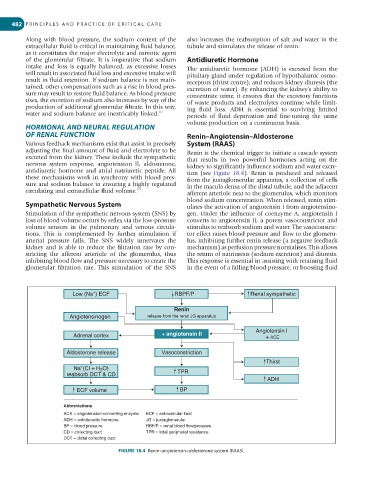
         adjusting the final amount of fluid and electrolyte to be   Renin is the chemical trigger to initiate a cascade system
         excreted from the kidney. These include the sympathetic   that  results  in  two  powerful  hormones  acting  on  the
         nervous  system  response,  angiotension  II,  aldosterone,   kidney to significantly influence sodium and water excre-
         antidiuretic  hormone  and  atrial  natriuretic  peptide.  All   tion  (see  Figure  18.4).  Renin  is  produced  and  released
         these mechanisms work in synchrony with blood pres-  from the juxtaglomerular apparatus, a collection of cells
         sure and sodium balance in ensuring a highly regulated   in the macula densa of the distal tubule, and the adjacent
         circulating and extracellular fluid volume. 10       afferent arteriole next to the glomerulus, which monitors
                                                              blood sodium concentration. When released, renin stim-
         Sympathetic Nervous System                           ulates the activation of angiotensin I from angiotensino-
         Stimulation of the sympathetic nervous system (SNS) by   gen. Under the influence of coenzyme A, angiotensin I
         loss of blood volume occurs by reflex via the low-pressure   converts to angiotensin II, a potent vasoconstrictor and
         volume  sensors  in  the  pulmonary  and  venous  circula-  stimulus to reabsorb sodium and water. The vasoconstric-
         tions.  This  is  complemented  by  further  stimulation  if   tor effect raises blood pressure and flow to the glomeru-
         arterial  pressure  falls.  The  SNS  widely  innervates  the   lus, inhibiting further renin release (a negative feedback
         kidney and is able to reduce the filtration rate by con-  mechanism) as perfusion pressure normalises. This allows
         stricting  the  afferent  arteriole  of  the  glomerulus,  thus   the return of natriuresis (sodium excretion) and diuresis.
         inhibiting blood flow and pressure necessary to create the   This response is essential in assisting with retaining fluid
         glomerular  filtration  rate.  This  stimulation  of  the  SNS   in the event of a falling blood pressure, or boosting fluid


                               +
                         Low (Na ) ECF                    RBPF/P                   Renal sympathetic
                                                          Renin
                        Angiotensinogen          release from the renal JG apparatus

                                                                                     Angiotensin I
                         Adrenal cortex               + angiotensin II                  + ACE

                       Aldosterone release            Vasoconstriction
                                                                                        Thirst
                           +
                         Na (Cl + H O)
                                  2
                       reabsorb DCT & CD                   TPR
                                                                                        ADH
                          ECF volume                        BP

                      Abbreviations
                      ACE = angiotension-converting enzyme  ECF = extracellular fluid
                      ADH = antidiurectic hormone  JG = juxtaglomerular
                      BP = blood pressure        RBF/P = renal blood flow/pressure
                      CD = collecting duct       TPR = total peripheral resistance
                      DCT = distal collecting duct
                                        FIGURE 18.4  Renin–angiotensin–aldosterone system (RAAS).

