


Page 508 - ACCCN's Critical Care Nursing
P. 508
Support of Renal Function 485

             diabetes,  advanced  age,  investigations  requiring  radio-  before death in a response known as apoptosis (cell self-
                                                                       21
             opaque dye administration, potent and nephrotoxic drug   death)  (see Chapter 21). The response is aimed at organ
             administration  or  major  surgery  with  an  inflammatory   survival,  with  some  individual  cells  ‘sacrificing’  them-
             state due to an underlying infection. This is the context   selves during a period of crisis. This protective response
             of critical illness and ARF where, despite modulation of   reduces oxygen demand by initiating cell death in some
             the  cause  and  support  with  artificial  renal  replacement   tubules, while others differentiate and/or proliferate for
             therapies, mortality ranges from 28–90% depending on   repair, and allows continuation of some normal function.
             diagnostic criteria or definition. 3,24,25           If the causative process abates, remaining cells regenerate
                                                                  by differentiation and proliferation, tissue repair occurs
             This type of kidney damage is of particular importance,   with restoration of normal epithelium in some tubules
             as ATN is abrupt in onset and causes a rapid cessation of   and nephron function returns.
             normal nephron function, a picture typical of any critical
             illness and failure of other body organs. As this failure is   During this period cellular ‘debris’ collects in the tubule
             commonly mediated by a loss in total or regional blood   loops, causing obstruction of tubular flow, with backleak
                             26
             flow to the kidney,  it is more pronounced in the kidney   of filtrate occurring through the ‘patchy’ exposed tubular
             medulla or outer regions sensitive to reduced blood flow.   membrane  surface.  An  inflammatory  process  is  also
             The cause of this loss in blood flow may be multifactorial   stimulated  due  to  release  of  cell  adhesion  factors  and
                                                                                   27
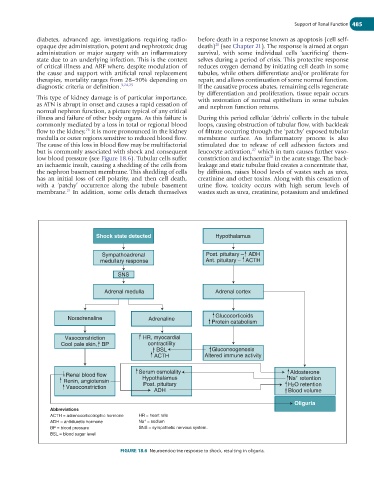
             but is commonly associated with shock and consequent   leucocyte activation,  which in turn causes further vaso-
                                                                                         28
             low blood pressure (see Figure 18.6). Tubular cells suffer   constriction and ischaemia  in the acute stage. The back-
             an ischaemic insult, causing a shedding of the cells from   leakage and static tubular fluid creates a concentrate that,
             the nephron basement membrane. This shedding of cells   by diffusion, raises blood levels of wastes such as urea,
             has  an  initial  loss  of  cell  polarity,  and  then  cell  death,   creatinine and other toxins. Along with this cessation of
             with  a  ‘patchy’  occurrence  along  the  tubule  basement   urine  flow,  toxicity  occurs  with  high  serum  levels  of
                       21
             membrane.  In addition, some cells detach themselves   wastes such as urea, creatinine, potassium and undefined


                                Shock state detected                    Hypothalamus


                                  Sympathoadrenal                   Post. pituitary –   ADH
                                  medullary response                Ant. pituitary –   ACTH

                                        SNS


                                   Adrenal medulla                     Adrenal cortex


                       Noradrenaline              Adrenaline            Glucocorticoids
                                                                      Protein catabolism

                      Vasoconstriction          HR, myocardial
                     Cool pale skin,   BP        contractility
                                                    BSL               Gluconeogenesis
                                                   ACTH             Altered immune activity

                                              Serum osmolality                                  Aldosterone
                       Renal blood flow                                                           +
                      Renin, angiotensin        Hypothalamus                                   Na  retention
                                                Post. pituitary
                       Vasoconstriction                                                        H2O retention
                                                   ADH                                         Blood volume
                                                                                                 Oliguria
                 Abbreviations
                 ACTH = adrenocorticotrophic hormone  HR = heart rate
                                                +
                 ADH = antidiuretic hormone   Na  = sodium
                 BP = blood pressure          SNS = sympathetic nervous system.
                 BSL = blood sugar level

                                        FIGURE 18.6  Neuroendocrine response to shock, resulting in oliguria.

