


Page 510 - ACCCN's Critical Care Nursing
P. 510
Support of Renal Function 487


                                                 GFR criteria*    Urine output criteria

                               Risk      Increased s. creat    1.5 or  UO <0.5 mL/kg/h
                                              GFR decrease >25%     6 h
                                                                                            High
                                                                                         sensitivity
                                 Injury    Increased s. creat    2 or  UO <0.5 mL/kg/h
                                              GFR decrease >50%     12 h

                                           Increased s. creat    3 or  UO <0.3 mL/kg/h
                                    Failure    GFR decrease 75%     24 h or
                                              OR s. creat  4 mg/dL  Anuria    12 h  Oliguria
                                                 Acute rise  0.5 mg/dL
                                                                                       High
                                                                                     specificity
                                       Loss       Persistent ARF** = complete loss
                                                     of kidney function >4 weeks


                                          ESKD       End-stage kidney disease
                                                           (>3 months)


                                                                                                                 32
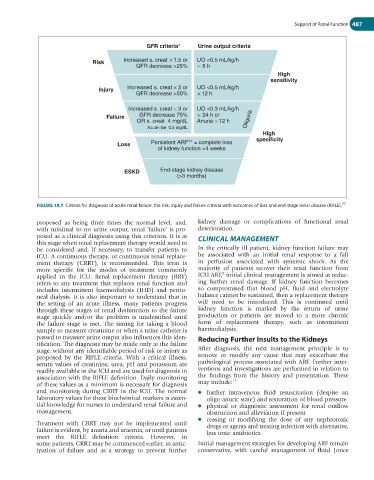
             FIGURE 18.7  Criteria for diagnosis of acute renal failure: the risk, injury and failure criteria with outcomes of loss and end-stage renal disease (RIFLE).

             proposed  as  being  three  times  the  normal  level,  and,   kidney  damage  or  complications  of  functional  renal
             with minimal to no urine output, renal ‘failure’ is pro-  deterioration.
             posed as a clinical diagnosis using this criterion. It is at   CLINICAL MANAGEMENT
             this stage when renal replacement therapy would need to
             be  considered  and,  if  necessary,  to  transfer  patients  to   In the critically ill patient, kidney function failure may
             ICU. A continuous therapy, or continuous renal replace-  be  associated  with  an  initial  renal  response  to  a  fall
             ment  therapy  (CRRT),  is  recommended.  This  term  is   in  perfusion  associated  with  systemic  shock.  As  the
             more  specific  for  the  modes  of  treatment  commonly   majority  of  patients  recover  their  renal  function  from
                                                                          8
             applied  in  the  ICU.  Renal  replacement  therapy  (RRT)   ICU ARF,  initial clinical management is aimed at reduc-
             refers to any treatment that replaces renal function and   ing  further  renal  damage.  If  kidney  function  becomes
             includes  intermittent  haemodialysis  (IHD)  and  perito-  so  compromised  that  blood  pH,  fluid  and  electrolyte
             neal dialysis. It is also important to understand that in   balance cannot be sustained, then a replacement therapy
             the  setting  of  an  acute  illness,  many  patients  progress   will  need  to  be  introduced.  This  is  continued  until
             through these stages of renal dysfunction to the failure   kidney  function  is  marked  by  the  return  of  urine
             stage  quickly  and/or  the  problem  is  unidentified  until   production  or  patients  are  moved  to  a  more  chronic
             the  failure  stage  is  met.  The  timing  for  taking  a  blood   form  of  replacement  therapy,  such  as  intermittent
             sample to measure creatinine or when a urine catheter is   haemodialysis.
             passed to measure urine output also influences this iden-  Reducing Further Insults to the Kidneys
             tification. The diagnosis may be made only at the failure
             stage, without any identifiable period of risk or injury as   After  diagnosis,  the  next  management  principle  is  to
             proposed  by  the  RIFLE  criteria.  With  a  critical  illness,   remove  or  modify  any  cause  that  may  exacerbate  the
             serum values of creatinine, urea, pH and potassium are   pathological process associated with ARF. Further inter-
             readily available in the ICU and are used for diagnosis in   ventions and investigations are performed in relation to
             association with the RIFLE definition. Daily monitoring   the  findings  from  the  history  and  presentation.  These
                                                                             13
             of these values as a minimum is necessary for diagnosis   may include:
             and  monitoring  during  CRRT  in  the  ICU.  The  normal   ●  further  intravenous  fluid  resuscitation  (despite  an
             laboratory values for these biochemical markers is essen-  oligo-anuric state) and restoration of blood pressure
             tial knowledge for nurses to understand renal failure and   ●  physical  or  diagnostic  assessment  for  renal  outflow
             management.                                             obstruction and alleviation if present
                                                                  ●  ceasing  or  modifying  the  dose  of  any  nephrotoxic
             Treatment  with  CRRT  may  not  be  implemented  until   drugs or agents and treating infection with alternative,
             failure is evident, by anuria and uraemia, or until patients   less toxic antibiotics.
             meet  the  RIFLE  definition  criteria.  However,  in
             some patients, CRRT may be commenced earlier, in antic-  Initial management strategies for developing ARF remain
             ipation  of  failure  and  as  a  strategy  to  prevent  further   conservative,  with  careful  management  of  fluid  (once

