


Page 506 - ACCCN's Critical Care Nursing
P. 506
Support of Renal Function 483

                                                                               +
             excretion as blood pressure rises. It also responds effec-  ammonia (NH 3 ) in the renal tubule to form ammonium
                                                                      +
             tively to a rise in sodium intake by reducing angiotensin   (NH 4 ),  which  is  unable  to  be  reabsorbed.  Coinciden-
                                                                              +
             II formation and allowing a larger natriuresis, resulting   tally,  raised  H   excretion  increases  the  reabsorption  of
             in maintenance of sodium balance, a key to tissue fluid   sodium,  which  increases  the  alkalytic  ion,  bicarbonate
                                                                        −
             distribution and balance. 10                         (HCO 3 ).  Conversely,  during  alkalosis  the  reabsorption
                                                                  of hydrogen ions is increased. These changes in secretion
             Aldosterone  is  a  mineralocorticoid  excreted  from  the
             adrenal cortex in response to angiotensin II. Aldosterone   of hydrogen ion concentration in the renal filtrate alter
             increases the reabsorption of sodium, and hence water,   the pH of the urine down to a maximum level of 4. The
                                                                               +
             in the cortical collecting tubules and increases the rate of   buffering  of  H   with  ammonia  reduces  the  acidifying
             potassium excretion. This has a dual effect of regulating   effect of the hydrogen ions, particularly as some ammo-
             sodium balance and extracellular fluid volume. As fluid   nium  combines  with  chloride  to  form  ammonium
                                                                         10
             volume accumulates, the rise in glomerular filtration rate   chloride.
             self-limits the volume effect by increasing both diuresis
             and natriuresis.                                     Role as an Endocrine Organ
                                                                  The  kidney  has  two  homeostatic  roles  as  an  endocrine
             Atrial Natriuretic Peptide                           organ.  Although  neither  have  effects  relevant  to  acute
             Atrial  natriuretic  peptide  (ANP)  is  a  hormone  released   illness,  patients  with  chronic  renal  dysfunction  often
                                                                  need  supplementation  to  overcome  the  loss  of  renal
             from the atria of the heart in response to atrial stretching   endocrine support. Erythropoietin is important in stimu-
             during periods of increased circulating fluid volume. ANP   lating the generation of new red blood cells and is released
             is  therefore  often  described  as  having  an  antagonising   from the kidney in response to a sustained drop in arte-
             effect  to  the  RAAS  (which  acts  primarily  to  preserve   rial  blood  oxygen  levels.  Calcitriol  helps  regulate  the
             sodium and water). These natriuretic, and hence diuretic,   absorption of calcium from the gut, which in turn pro-
             effects are mild and self-limiting, and occur in response   motes bone resorption of calcium and the reabsorption
             to mild rises in GFR and reductions in sodium reabsorp-  of calcium in the kidney. The kidney also acts to convert
             tion. As blood pressure falls, the drop in GFR compen-  vitamin D to its active form, which is necessary for the
             sates for the effect of ANP, ensuring that excessive loss of   maintenance of body calcium levels. 10
             sodium and water does not occur. 10

             Regulation of Acid–base and                          PATHOPHYSIOLOGY AND
             Electrolyte Balance                                  CLASSIFICATION OF RENAL FAILURE

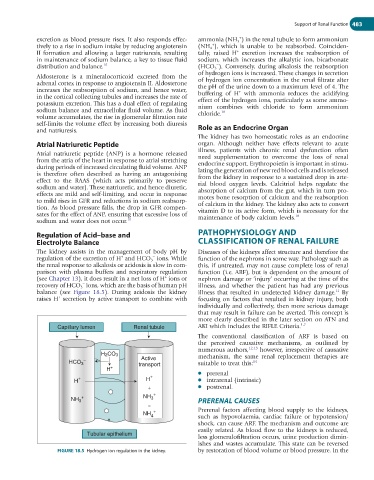
             The  kidney  assists  in  the  management  of  body  pH  by   Diseases of the kidneys affect structure and therefore the
                                                   −
                                         +
             regulation of the excretion of H  and HCO 3  ions. While   function of the nephrons in some way. Pathology such as
             the renal response to alkalosis or acidosis is slow in com-  this, if untreated, may not cause complete loss of renal
             parison  with  plasma  buffers  and  respiratory  regulation   function (i.e. ARF), but is dependent on the amount of
                                                       +
             (see Chapter 13), it does result in a net loss of H  ions or   nephron damage or ‘injury’ occurring at the time of the
                            −
             recovery of HCO 3  ions, which are the basis of human pH   illness,  and  whether  the  patient  has  had  any  previous
                                                                                                               11
             balance  (see  Figure  18.5).  During  acidosis  the  kidney   illness  that  resulted  in  undetected  kidney  damage.   By
                    +
             raises H  secretion by active transport to combine with   focusing on factors that resulted in kidney injury, both
                                                                  individually and collectively, then more serious damage
                                                                  that may result in failure can be averted. This concept is
                                                                  more clearly described in the later section on ATN and
                    Capillary lumen          Renal tubule         AKI which includes the RIFLE Criteria. 1,2
                                                                  The  conventional  classification  of  ARF  is  based  on
                                                                  the  perceived  causative  mechanisms,  as  outlined  by
                                                                  numerous authors, 12,13  however, irrespective of causative
                                  H2CO3                           mechanism,  the  same  renal  replacement  therapies  are
                                               Active
                        HCO 3 –               transport           suitable to treat this: 14
                                    H +                           ●  prerenal
                         H +                     H +              ●  intrarenal (intrinsic)
                                                 +                ●  postrenal.
                                                   +
                            +                   NH 3
                        NH 3                                      PRERENAL CAUSES
                                                 =
                                                NH 4 +            Prerenal  factors  affecting  blood  supply  to  the  kidneys,
                                                                  such  as  hypovolaemia,  cardiac  failure  or  hypotension/
                                                                  shock, can cause ARF. The mechanism and outcome are
                                                                  easily related. As blood flow to the kidneys is reduced,
                             Tubular epithelium
                                                                  less glomerulofiltration occurs, urine production dimin-
                                                                  ishes and wastes accumulate. This state can be reversed
                    FIGURE 18.5  Hydrogen ion regulation in the kidney.   by restoration of blood volume or blood pressure. In the

