


Page 503 - ACCCN's Critical Care Nursing
P. 503
480  P R I N C I P L E S   A N D   P R A C T I C E   O F   C R I T I C A L   C A R E

         RELATED ANATOMY AND                                    Organs and structures of the urinary system
         PHYSIOLOGY

         The renal system has a number of functions, including        Adrenal
         regulation  and  maintenance  of  fluid  and  electrolyte    glands
         balance, clearance of metabolic and other waste products,   Right                           Kidney
         an  indirect  role  in  the  maintenance  of  blood  pressure,   renal
         acid–base balance, and an endocrine function. In critical   artery
         care, an appreciation of the renal system’s fluid manage-
         ment, blood pressure, electrolyte and acid–base functions
         is essential.
         Regulation and maintenance of the extracellular fluid and   Right
         electrolyte  constituents  is  principally  via  the  process  of   renal
         filtration and reabsorption. The kidneys receive approxi-  vein                          Aorta
         mately  25%  of  the  cardiac  output  each  minute,  and
         excrete  approximately  180 L/day  of  glomerular  filtrate.   Vena cava                    Ureter
         Fortunately,  tubular  reabsorption  accounts  for  approxi-
         mately 178.5 L/day of the original filtrate, allowing for
         a  modest  daily  fluid  intake  of  1.5 L  to  achieve  fluid
         balance. During this process of filtration and reabsorp-     Bladder
         tion, metabolic byproducts, electrolyte and other wastes
         (including many drugs) are also excreted and maintained
         in balance. As with all body organ systems, an adequate
         blood  pressure  and  supply  of  oxygen  to  the  kidneys  is
         paramount  in  maintaining  the  fluid  and  electrolyte
         regulatory role.

         ANATOMY OF KIDNEYS, NEPHRON AND
         URINARY DRAINAGE SYSTEM
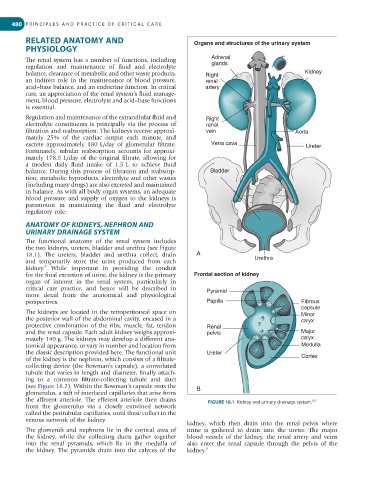
         The  functional  anatomy  of  the  renal  system  includes
         the two kidneys, ureters, bladder and urethra (see Figure
         18.1).  The  ureters,  bladder  and  urethra  collect,  drain   A          Urethra
         and  temporarily  store  the  urine  produced  from  each
                9
         kidney.   While  important  in  providing  the  conduit
         for the final excretion of urine, the kidney is the primary   Frontal section of kidney
         organ  of  interest  in  the  renal  system,  particularly  in
         critical  care  practice,  and  hence  will  be  described  in   Pyramid
         more  detail  from  the  anatomical  and  physiological
         perspectives.                                               Papilla                        Fibrous
                                                                                                    capsule
         The kidneys are located in the retroperitoneal space on                                    Minor
         the posterior wall of the abdominal cavity, encased in a                                   calyx
         protective  combination  of  the  ribs,  muscle,  fat,  tendon   Renal
         and the renal capsule. Each adult kidney weighs approxi-    pelvis                         Major
         mately 140 g. The kidneys may develop a different ana-                                     calyx
         tomical appearance, or vary in number and location from                                    Medulla
         the classic description provided here. The functional unit   Ureter
         of the kidney is the nephron, which consists of a filtrate-                                Cortex
         collecting device (the Bowman’s capsule), a convoluted
         tubule that varies in length and diameter, finally attach-
         ing  to  a  common  filtrate-collecting  tubule  and  duct
         (see Figure 18.2). Within the Bowman’s capsule rests the   B
         glomerulus, a tuft of interlaced capillaries that arise from
         the  afferent  arteriole.  The  efferent  arteriole  then  drains   FIGURE 18.1  Kidney and urinary drainage system.
                                                                                                       107
         from  the  glomerulus  via  a  closely  entwined  network
         called the peritubular capillaries, until these collect in the
         venous network of the kidney.
                                                              kidney,  which  then  drain  into  the  renal  pelvis  where
         The  glomeruli  and  nephrons  lie  in  the  cortical  area  of   urine  is  gathered  to  drain  into  the  ureter.  The  major
         the  kidney,  while  the  collecting  ducts  gather  together   blood  vessels  of  the  kidney,  the  renal  artery  and  veins
         into  the  renal  pyramids,  which  lie  in  the  medulla  of   also  enter  the  renal  capsule  through  the  pelvis  of  the
         the  kidney.  The  pyramids  drain  into  the  calyces  of  the   kidney. 9

