


Page 523 - ACCCN's Critical Care Nursing
P. 523
500  P R I N C I P L E S   A N D   P R A C T I C E   O F   C R I T I C A L   C A R E


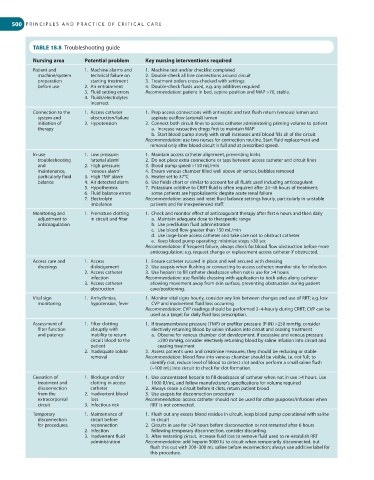
            TABLE 18.8  Troubleshooting guide

            Nursing area     Potential problem   Key nursing interventions required
            Patient and      1.  Machine alarms and   1.  Machine test and/or checklist completed
             machine/system    technical failure on   2.  Double-check all line connections around circuit
             preparation       starting treatment  3.  Treatment orders cross-checked with settings
             before use      2.  Air entrainment  4.  Double-check fluids used, e.g. any additives required
                             3.  Fluid setting errors  Recommendation: patient in bed, supine position and MAP >70, stable.
                             4.  Fluids/electrolytes
                               incorrect
            Connection to the   1.  Access catheter   1.  Prep access connections with antiseptic and test flush return (venous) lumen and
             system and        obstruction/failure  aspirate outflow (arterial) lumen
             initiation of   2.  Hypotension     2.  Connect both circuit lines to access catheter administering priming volume to patient
             therapy                               a.  Increase vasoactive drugs first to maintain MAP
                                                   b.  Start blood pump slowly with small increases until blood fills all of the circuit
                                                 Recommendation: use two nurses for connection routine. Start fluid replacement and
                                                  removal only after blood circuit is full and at prescribed speed.
            In-use           1.  Low pressure:   1.  Maintain access catheter alignment, preventing kinks
             troubleshooting   ‘arterial alarm’  2.  Do not place extra connections or taps between access catheter and circuit lines
             and             2.  High pressure:   3.  Blood pump speed >150 mL/min
             maintenance,      ‘venous alarm’    4.  Ensure venous chamber filled well above air sensor, bubbles removed
             particularly fluid   3.  High TMP alarm  5.  Heater set to 37°C
             balance         4.  Air detected alarm  6.  Use fluids chart or similar to account for all fluids used including anticoagulant
                             5.  Hypothermia     7.  Potassium additive to CRRT fluid is often required after 24–48 hours of treatment;
                             6.  Fluid balance errors  some patients are hypokalaemic despite acute renal failure
                             7.  Electrolyte     Recommendation: assess and reset fluid balance settings hourly, particularly in unstable
                               imbalance          patients and for inexperienced staff.
            Monitoring and   1.  Premature clotting   1.  Check and monitor effect of anticoagulant therapy after first 6 hours and then daily
             adjustment to     in circuit and filter  a.  Maintain adequate dose to therapeutic range
             anticoagulation                       b.  Use predilution fluid administration
                                                   c.  Use blood flow greater than 150 mL/min
                                                   d.  Use large-bore access catheter and take care not to obstruct catheter
                                                   e.  Keep blood pump operating: minimise stops >30 sec
                                                 Recommendation: if frequent failure, always check for blood flow obstruction before more
                                                  anticoagulation; e.g. request change or replacement access catheter if obstructed.
            Access care and   1.  Access         1.  Ensure catheter sutured in place and well secured with dressing
             dressings         dislodgement      2.  Use asepsis when flushing or connecting to access catheter; monitor site for infection
                             2.  Access catheter   3.  Use heparin to fill catheter deadspace when not is use for >4 hours
                               infection         Recommendation: use flexible dressing with application to both sides along catheter
                             3.  Access catheter   allowing movement away from skin surface, preventing obstruction during patient
                               obstruction        care/positioning.
            Vital sign       1.  Arrhythmias,    1.  Monitor vital signs hourly, consider any link between changes and use of RRT; e.g. low
             monitoring        hypotension, fever  CVP and inadvertent fluid loss occurring
                                                 Recommendation: CVP readings should be performed 2–4-hourly during CRRT; CVP can be
                                                  used as a target for daily fluid loss prescription.
            Assessment of    1.  Filter clotting   1.  If transmembrane pressure (TMP) or prefilter pressure (P-IN) >250 mmHg, consider
             filter function   abruptly with       electively returning blood by saline infusion into circuit and ceasing treatment
             and patency       inability to return   a.  Observe for venous chamber clot development. If excessive and venous pressure
                               circuit blood to the   >200 mmHg, consider electively returning blood by saline infusion into circuit and
                               patient               ceasing treatment
                             2.  Inadequate solute   2.  Assess patient’s urea and creatinine measures; they should be reducing or stable
                               removal           Recommendation: blood flow into venous chamber should be visible, i.e. not full; to
                                                  identify clot, reduce level of blood to detect clot and/or perform a small saline flush
                                                  (~100 mL) into circuit to check for clot formation.
            Cessation of     1.  Blockage and/or   1.  Use concentrated heparin to fill deadspace of catheter when not in use >4 hours. Use
             treatment and     clotting in access   1000 IU/mL and follow manufacturer’s specifications for volume required
             disconnection     catheter          2.  Always cease a circuit before it clots, return patient blood
             from the        2.  Inadvertent blood   3.  Use asepsis for disconnection procedure
             extracorporeal    loss              Recommendation: access catheter should not be used for other purposes/infusions when
             circuit         3.  Infectious risk  RRT is not connected.
            Temporary        1.  Maintenance of   1.  Flush out any excess blood residue in circuit, keep blood pump operational with saline
             disconnection     circuit before      in circuit
             for procedures    reconnection      2.  Circuits in use for >24 hours before disconnection or not restarted after 6 hours
                             2.  Infection         following temporary disconnection, consider discarding
                             3.  Inadvertent fluid   3.  After restarting circuit, increase fluid loss to remove fluid used to re-establish RRT
                               administration    Recommendation: add heparin 5000 IU to circuit when temporarily disconnected, but
                                                  flush this out with 200–300 mL saline before reconnection; always use additive label for
                                                  this procedure.

