


Page 522 - ACCCN's Critical Care Nursing
P. 522
Support of Renal Function 499


               TABLE 18.7  Machine design and build approaches

               Machine type  Waste collection  Membrane     Circuit         Pressure measurement  Priming preparation
               A             One 5 L bag, empty   AN69, prefitted, not   Cartridge kit-based,   In-line pressure   Fully automated
                              when full, change   changeable  multipurpose; all   transducers
                              bag                             modes
               B             1–4 bags or 20 L   Infomed Membrane   Single tubing   Isolated sideline air   Semiautomated
                              bottle with pump   not fitted, option   components   interface transducers
                              to drain direct: no   for other   partly assembled,
                              waste handling  membranes       mode specific


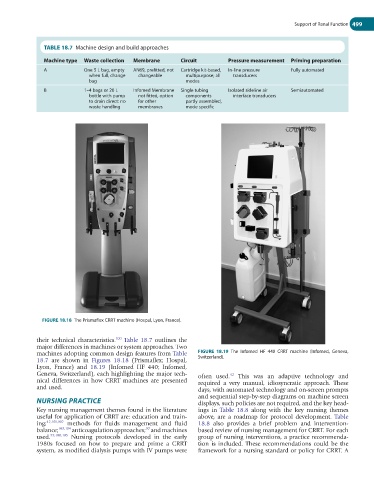
               FIGURE 18.18  The Prismaflex CRRT machine (Hospal, Lyon, France).

                                       100
             their technical characteristics.  Table 18.7 outlines the
             major differences in machines or system approaches. Two
             machines adopting common design features from Table   FIGURE  18.19  The  Infomed  HF  440  CRRT  machine  (Infomed,  Geneva,
             18.7  are  shown  in  Figures  18.18  (Prismaflex;  Hospal,   Switzerland).
             Lyon,  France)  and  18.19  (Infomed  HF  440;  Infomed,
             Geneva, Switzerland), each highlighting the major tech-  often  used.   This  was  an  adaptive  technology  and
                                                                            42
             nical  differences  in  how  CRRT  machines  are  presented   required  a  very  manual,  idiosyncratic  approach.  These
             and used.                                            days, with automated technology and on-screen prompts
                                                                  and sequential step-by-step diagrams on machine screen
             NURSING PRACTICE                                     displays, such policies are not required, and the key head-
             Key nursing management themes found in the literature   ings  in  Table  18.8  along  with  the  key  nursing  themes
             useful for application of CRRT are: education and train-  above,  are  a  roadmap  for  protocol  development.  Table
             ing; 42,101,102   methods  for  fluids  management  and  fluid   18.8  also  provides  a  brief  problem  and  intervention-
                                                 92
             balance; 103,104  anticoagulation approaches;  and machines   based review of nursing management for CRRT. For each
             used. 99,100,105   Nursing  protocols  developed  in  the  early   group of nursing interventions, a practice recommenda-
             1980s  focused  on  how  to  prepare  and  prime  a  CRRT   tion  is  included.  These  recommendations  could  be  the
             system, as modified dialysis pumps with IV pumps were   framework for a nursing standard or policy for CRRT. A

