


Page 521 - ACCCN's Critical Care Nursing
P. 521
498  P R I N C I P L E S   A N D   P R A C T I C E   O F   C R I T I C A L   C A R E


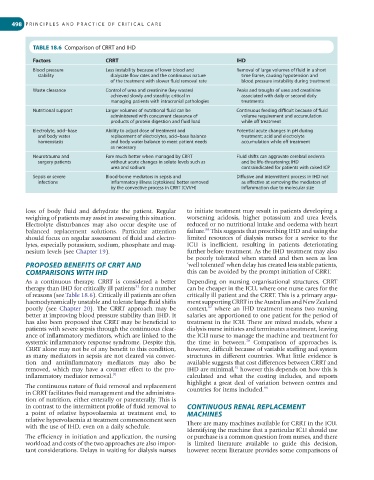
            TABLE 18.6  Comparison of CRRT and IHD

            Factors                 CRRT                                      IHD
            Blood pressure          Less instability because of lower blood and   Removal of large volumes of fluid in a short
             stability               dialysate flow rates and the continuous nature   time frame, causing hypotension and
                                     of the treatment with slower fluid removal rate  blood pressure instability during treatment
            Waste clearance         Control of urea and creatinine (key wastes)   Peaks and troughs of urea and creatinine
                                     achieved slowly and steadily; critical in   associated with daily or second daily
                                     managing patients with intracranial pathologies  treatments
            Nutritional support     Larger volumes of nutritional fluid can be   Continuous feeding difficult because of fluid
                                     administered with concurrent clearance of   volume requirement and accumulation
                                     products of protein digestion and fluid load  while off treatment
            Electrolyte, acid–base   Ability to adjust dose of treatment and   Potential acute changes in pH during
             and body water          replacement of electrolytes, acid–base balance   treatment; acid and electrolyte
             homeostasis             and body water balance to meet patient needs   accumulation while off treatment
                                     as necessary
            Neurotrauma and         Fare much better when managed by CRRT     Fluid shifts can aggravate cerebral oedema
             surgery patients        without acute changes in solute levels such as   and be life-threatening; IHD
                                     urea and sodium                            contraindicated for patients with raised ICP
            Sepsis or severe        Blood-borne mediators in sepsis and       Diffusive and intermittent process in IHD not
             infections              inflammatory illness (cytokines) better removed   as effective at removing the mediators of
                                     by the convective process in CRRT (CVVH)   inflammation due to molecular size


         loss  of  body  fluid  and  dehydrate  the  patient.  Regular   to initiate treatment may result in patients developing a
         weighing of patients may assist in assessing this situation.   worsening  acidosis,  higher  potassium  and  urea  levels,
         Electrolyte  disturbances  may  also  occur  despite  use  of   reduced or no nutritional intake and oedema with heart
                                                                    88
         balanced  replacement  solutions.  Particular  attention   failure.  This suggests that prescribing IHD and using the
         should focus on regular assessment of fluid and electro-  limited  resources  of  dialysis  nurses  for  a  service  to  the
         lytes, especially potassium, sodium, phosphate and mag-  ICU  is  inefficient,  resulting  in  patients  deteriorating
         nesium levels (see Chapter 19).                      further before treatment. As the IHD treatment may also
                                                              be poorly tolerated when started and then seen as less
         PROPOSED BENEFITS OF CRRT AND                        ‘well tolerated’ when delay has created less stable patients,
         COMPARISONS WITH IHD                                 this can be avoided by the prompt initiation of CRRT.
         As  a  continuous  therapy,  CRRT  is  considered  a  better   Depending  on  nursing  organisational  structures,  CRRT
                                             33
         therapy than IHD for critically ill patients  for a number   can be cheaper in the ICU, where one nurse cares for the
         of reasons (see Table 18.6). Critically ill patients are often   critically ill patient and the CRRT. This is a primary argu-
         haemodynamically unstable and tolerate large fluid shifts   ment supporting CRRT in the Australian and New Zealand
                                                                     42
         poorly  (see  Chapter  20).  The  CRRT  approach  may  be   context,   where  an  IHD  treatment  means  two  nursing
         better at improving blood pressure stability than IHD. It   salaries are apportioned to one patient for the period of
         has also been proposed that CRRT may be beneficial to   treatment in the ICU. There are mixed models, where a
         patients with severe sepsis through the continuous clear-  dialysis nurse initiates and terminates a treatment, leaving
         ance of inflammatory mediators, which are linked to the   the ICU nurse to manage the machine and treatment for
                                                                                  70
         systemic inflammatory response syndrome. Despite this,   the  time  in  between.   Comparison  of  approaches  is,
         CRRT alone may not be of any benefit to this condition,   however, difficult because of variable staffing and system
         as many mediators in sepsis are not cleared via convec-  structures  in  different  countries.  What  little  evidence  is
         tion  and  antiinflammatory  mediators  may  also  be   available suggests that cost differences between CRRT and
                                                                              51
         removed,  which  may  have  a  counter  effect  to  the  pro-  IHD are minimal,  however this depends on how this is
         inflammatory mediator removal. 91                    calculated  and  what  the  costing  includes,  and  reports
                                                              highlight  a  great  deal  of  variation  between  centres  and
         The continuous nature of fluid removal and replacement                        99
         in CRRT facilitates fluid management and the administra-  countries for items included.
         tion of nutrition, either enterally or parenterally. This is
         in contrast to the intermittent profile of fluid removal to   CONTINUOUS RENAL REPLACEMENT
         a  point  of  relative  hypovolaemia  at  treatment  end,  to   MACHINES
         relative hypervolaemia at treatment commencement seen
         with the use of IHD, even on a daily schedule.       There are many machines available for CRRT in the ICU.
                                                              Identifying the machine that a particular ICU should use
         The efficiency in initiation and application, the nursing   or purchase is a common question from nurses, and there
         workload and costs of the two approaches are also impor-  is  limited  literature  available  to  guide  this  decision,
         tant considerations. Delays in waiting for dialysis nurses   however recent literature provides some comparisons of

