


Page 520 - ACCCN's Critical Care Nursing
P. 520
Support of Renal Function 497

             Normal  clotting  time,  a  laboratory  test  designed  to   production from tapwater at the bedside. This approach
             measure the time taken for blood to clot under laboratory   can be cheaper, requires no bag changing or reconstitut-
                                                                             98
             conditions, is used as a reference to determine a suitable   ing by nurses,  but involves installation of a complex and
             therapeutic range of the anti-clotting drug during CRRT.   expensive  reverse  osmosis  machine,  the  cost  of  which
             Different tests are applicable to different medications and   would be offset if large volumes of fluid were then con-
             their site of action in the clotting cascade. When using   sumed from this online manufacture. This approach may
             any anti-clotting agent, a balance is required between the   alter fluid selection and use in the future, and is an essen-
             benefits  of  increased  coagulation  suppression  and  the   tial feature of chronic dialysis and use of ICU daily dialy-
             higher risk of patient systemic bleeding. In each patient   sis (EDDf) modes of therapy. 59-61
             this risk may vary, depending on illness, accompanying   Fluid balance maintenance is a key nursing responsibility
             liver failure and administration of concurrent anti-clotting   in  managing  CRRT.  Most  machines  now  available  to
             agents such as activated protein C.
                                                                  provide  CRRT  incorporate  a  mode  selection  program,
             Fluids and Fluid Balance                             including an automatic fluid balance system. This ensures

             A key component of any CRRT is the administration of a   delivery of a fluid prescription based on the input pro-
                                                                  vided by the programming nurse. As many litres of fluid
             replacement solution for the fluid removed during hae-  may be exchanged in an hour (25–35 mL/kg), the default
             mofiltration (see Table 18.4). This same physiologically   setting is usually a net machine balance, where all fluids
             balanced solution is also used as a dialysis fluid if a dialytic   administered as either dialysate or replacement are recov-
             mode is included. The solution may have a low potassium   ered or balanced. The machine cannot, however, include
             level, so this electrolyte can be removed rapidly if hyper-  fluids administered or expelled directly from the patient,
             kalaemia is part of the original indication for CRRT. Potas-  so  a  fluid  maintenance  schedule  must  be  established.
             sium  must  therefore  be  added  later  to  the  solution  to   This schedule is also based on input and output being
             ensure that hypokalaemia does not occur. In Australia and   equal. For example, if more fluid is being infused into the
             New Zealand these fluids are commercially prepared, with   patient than being lost, as would be expected in ARF, then
             the  only  major  choice  being  between  the  type  of  acid   additional fluid would need to be recovered via the CRRT
             buffer:  lactate  or  bicarbonate.  Some  small  studies  have   circuit:  that  is,  less  replacement  fluid  administered  or
             compared the use of lactate and bicarbonate fluid buffer   more waste created. Consider the calculation steps in the
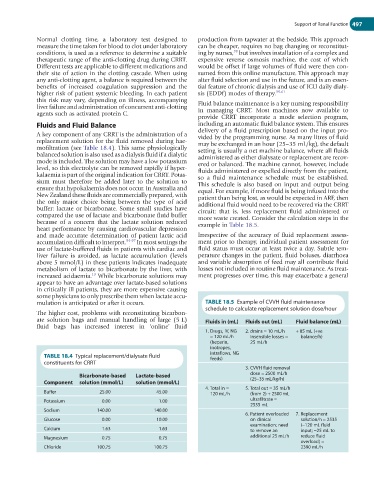
             because  of  a  concern  that  the  lactate  solution  reduced   example in Table 18.5.
             heart performance by causing cardiovascular depression
             and  made  accurate  determination  of  patient  lactic  acid   Irrespective of the accuracy of fluid replacement assess-
             accumulation difficult to interpret. 94-97  In most settings the   ment prior to therapy, individual patient assessment for
             use of lactate-buffered fluids in patients with cardiac and   fluid status must occur at least twice a day. Subtle tem-
             liver  failure  is  avoided,  as  lactate  accumulation  (levels   perature changes in the patient, fluid boluses, diarrhoea
             above 5 mmol/L) in these patients indicates inadequate   and variable absorption of feed may all contribute fluid
             metabolism  of  lactate  to  bicarbonate  by  the  liver,  with   losses not included in routine fluid maintenance. As treat-
                               13
             increased acidaemia.  While bicarbonate solutions may   ment progresses over time, this may exacerbate a general
             appear to have an advantage over lactate-based solutions
             in critically ill patients, they are more expensive causing
             some physicians to only prescribe them when lactate accu-
             mulation is anticipated or after it occurs.            TABLE 18.5  Example of CVVH fluid maintenance
                                                                    schedule to calculate replacement solution dose/hour
             The higher cost, problems with reconstituting bicarbon-
             ate  solution  bags  and  manual  handling  of  large  (5 L)   Fluids in (mL)  Fluids out (mL)  Fluid balance (mL)
             fluid  bags  has  increased  interest  in  ‘online’  fluid
                                                                    1. Drugs, IV, NG   2. drains = 10 mL/h   + 85 mL (+ve
                                                                      = 120 mL/h   insensible losses =   balance/h)
                                                                      (heparin,    25 mL/h
                                                                      inotropes,
               TABLE 18.4  Typical replacement/dialysate fluid        intraflows, NG
                                                                      feeds)
               constituents for CRRT
                                                                                 3. CVVH fluid removal
                           Bicarbonate-based   Lactate-based                       dose = 2500 mL/h
               Component   solution (mmol/L)  solution (mmol/L)                    (25–35 mL/kg/h)
                                                                    4. Total in =   5. Total out = 35 mL/h
               Buffer             25.00             45.00             120 mL/h     (from 2) + 2500 mL
               Potassium          0.00               1.00                          ultrafiltrate =
                                                                                   2535 mL
               Sodium            140.00            140.00
                                                                                 6. Patient overloaded   7. Replacement
               Glucose            0.00              10.00                          on clinical     solution/h = 2535
                                                                                   examination; need   (−120 mL fluid
               Calcium            1.63               1.63                          to remove an    input; −25 mL to
               Magnesium          0.75               0.75                          additional 25 mL/h  reduce fluid
                                                                                                   overload) =
               Chloride          100.75            100.75                                          2390 mL/h

