


Page 518 - ACCCN's Critical Care Nursing
P. 518
Support of Renal Function 495


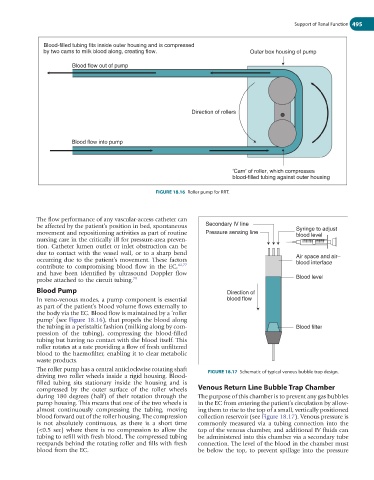
               Blood-filled tubing fits inside outer housing and is compressed
               by two cams to milk blood along, creating flow.                     Outer box housing of pump

                         Blood flow out of pump


                                                                Direction of rollers


                        Blood flow into pump


                                                                             ‘Cam’ of roller, which compresses
                                                                             blood-filled tubing against outer housing
                                                    FIGURE 18.16  Roller pump for RRT.


             The flow performance of any vascular-access catheter can
             be affected by the patient’s position in bed, spontaneous   Secondary IV line        Syringe to adjust
             movement and repositioning activities as part of routine   Pressure sensing line     blood level
             nursing care in the critically ill for pressure-area preven-
             tion. Catheter lumen outlet or inlet obstruction can be
             due to contact with the vessel wall, or to a sharp bend
             occurring due to the patient’s movement. These factors                               Air space and air–
                                                                                                  blood interface
             contribute  to  compromising  blood  flow  in  the  EC, 42,77
             and  have  been  identified  by  ultrasound  Doppler  flow
             probe attached to the circuit tubing. 79                                             Blood level
             Blood Pump                                                    Direction of
             In veno-venous modes, a pump component is essential           blood flow
             as part of the patient’s blood volume flows externally to
             the body via the EC. Blood flow is maintained by a ‘roller
             pump’ (see Figure 18.16), that propels the blood along
             the tubing in a peristaltic fashion (milking along by com-                           Blood filter
             pression  of  the  tubing),  compressing  the  blood-filled
             tubing but having no contact with the blood itself. This
             roller rotates at a rate providing a flow of fresh unfiltered
             blood to the haemofilter, enabling it to clear metabolic
             waste products.
             The roller pump has a central anticlockwise rotating shaft   FIGURE 18.17  Schematic of typical venous bubble trap design.
             driving two roller wheels inside a rigid housing. Blood-
             filled  tubing  sits  stationary  inside  the  housing  and  is
             compressed  by  the  outer  surface  of  the  roller  wheels   Venous Return Line Bubble Trap Chamber
             during 180 degrees (half) of their rotation through the   The purpose of this chamber is to prevent any gas bubbles
             pump housing. This means that one of the two wheels is   in the EC from entering the patient’s circulation by allow-
             almost  continuously  compressing  the  tubing,  moving   ing them to rise to the top of a small, vertically positioned
             blood forward out of the roller housing. The compression   collection reservoir (see Figure 18.17). Venous pressure is
             is  not  absolutely  continuous,  as  there  is  a  short  time   commonly  measured  via  a  tubing  connection  into  the
             (<0.5  sec)  where  there  is  no  compression  to  allow  the   top of the venous chamber, and additional IV fluids can
             tubing to refill with fresh blood. The compressed tubing   be administered into this chamber via a secondary tube
             reexpands behind the rotating roller and fills with fresh   connection. The level of the blood in the chamber must
             blood from the EC.                                   be  below  the  top,  to  prevent  spillage  into  the  pressure

