


Page 537 - ACCCN's Critical Care Nursing
P. 537
514  P R I N C I P L E S   A N D   P R A C T I C E   O F   C R I T I C A L   C A R E


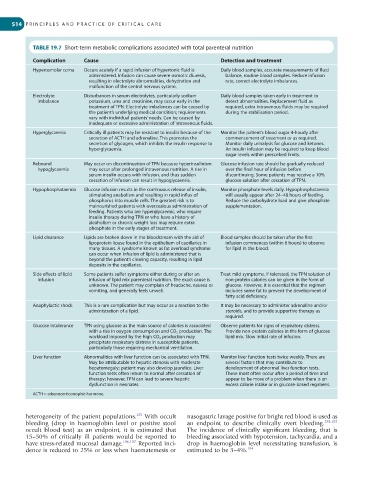
            TABLE 19.7  Short-term metabolic complications associated with total parenteral nutrition

            Complication     Cause                                       Detection and treatment
            Hyperosmolar coma  Occurs acutely if a rapid infusion of hypertonic fluid is   Daily blood samples, accurate measurements of fluid
                              administered. Infusion can cause severe osmotic diuresis,   balance, routine blood samples. Reduce infusion
                              resulting in electrolyte abnormalities, dehydration and   rate, correct electrolyte imbalances.
                              malfunction of the central nervous system.
            Electrolyte      Disturbances in serum electrolytes, particularly sodium   Daily blood samples taken early in treatment to
             imbalance        potassium, urea and creatinine, may occur early in the   detect abnormalities. Replacement fluid as
                              treatment of TPN. Electrolyte imbalances can be caused by   required, extra intravenous fluids may be required
                              the patient’s underlying medical condition; requirements   during the stabilisation period.
                              vary with individual patients’ needs. Can be caused by
                              inadequate or excessive administration of intravenous fluids.
            Hyperglycaemia   Critically ill patients may be resistant to insulin because of the   Monitor the patient’s blood sugar 4-hourly after
                              secretion of ACTH and adrenaline. This promotes the   commencement of treatment or as required.
                              secretion of glycogen, which inhibits the insulin response to   Monitor daily urinalysis for glucose and ketones.
                              hyperglycaemia.                              An insulin infusion may be required to keep blood
                                                                           sugar levels within prescribed limits.
            Rebound          May occur on discontinuation of TPN because hyperinsulinism   Glucose infusion rate should be gradually reduced
             hypoglycaemia    may occur after prolonged intravenous nutrition. A rise in   over the final hour of infusion before
                              serum insulin occurs with infusion, and thus sudden   discontinuing. Some patients may receive a 10%
                              cessation of infusion can result in hypoglycaemia.  glucose solution after cessation of TPN.
            Hypophosphataemia  Glucose infusion results in the continuous release of insulin,   Monitor phosphate levels daily. Hypophosphataemia
                              stimulating anabolism and resulting in rapid influx of   will usually appear after 24–48 hours of feeding.
                              phosphorus into muscle cells. The greatest risk is to   Reduce the carbohydrate load and give phosphate
                              malnourished patients with overzealous administration of   supplementation.
                              feeding. Patients who are hyperglycaemic, who require
                              insulin therapy during TPN or who have a history of
                              alcoholism or chronic weight loss may require extra
                              phosphate in the early stages of treatment.
            Lipid clearance  Lipids are broken down in the bloodstream with the aid of   Blood samples should be taken after the first
                              lipoprotein lipase found in the epithelium of capillaries in   infusion commences (within 6 hours) to observe
                              many tissues. A syndrome known as fat overload syndrome   for lipid in the blood.
                              can occur when infusion of lipid is administered that is
                              beyond the patient’s clearing capacity, resulting in lipid
                              deposits in the capillaries.
            Side effects of lipid   Some patients suffer symptoms either during or after an   Treat mild symptoms. If tolerated, the TPN solution of
             infusion         infusion of lipid mix parenteral nutrition. The exact cause is   non-protein calories can be given in the form of
                              unknown. The patient may complain of headache, nausea or   glucose. However, it is essential that the regimen
                              vomiting, and generally feels unwell.        includes some fat to prevent the development of
                                                                           fatty acid deficiency.
            Anaphylactic shock  This is a rare complication but may occur as a reaction to the   It may be necessary to administer adrenaline and/or
                              administration of a lipid.                   steroids, and to provide supportive therapy as
                                                                           required.
            Glucose intolerance  TPN using glucose as the main source of calories is associated   Observe patients for signs of respiratory distress.
                              with a rise in oxygen consumption and CO 2  production. The   Provide non-protein calories in the form of glucose
                              workload imposed by the high CO 2 production may   lipid mix. Slow initial rate of infusion.
                              precipitate respiratory distress in susceptible patients,
                              particularly those requiring mechanical ventilation.
            Liver function  Abnormalities with liver function can be associated with TPN.   Monitor liver function tests twice weekly. There are
                              May be attributable to hepatic stenosis with moderate   several factors that may contribute to
                              hepatomegaly; patient may also develop jaundice. Liver   development of abnormal liver function tests.
                              function tests often return to normal after cessation of   These most often occur after a period of time and
                              therapy; however, TPN can lead to severe hepatic   appear to be more of a problem when there is an
                              dysfunction in neonates.                     excess calorie intake or in glucose-based regimens.
            ACTH = adrenocorticotrophic hormone.


         heterogeneity of the patient populations. 195  With occult   nasogastric lavage positive for bright red blood is used as
         bleeding  (drop  in  haemoglobin  level  or  positive  stool   an  endpoint  to  describe  clinically  overt  bleeding. 198,199
         occult  blood  test)  as  an  endpoint,  it  is  estimated  that   The  incidence  of  clinically  significant  bleeding,  that  is
         15–50%  of  critically  ill  patients  would  be  reported  to   bleeding associated with hypotension, tachycardia, and a
         have stress-related mucosal damage. 196,197  Reported inci-  drop  in  haemoglobin  level  necessitating  transfusion,  is
         dence is reduced to 25% or less when haematemesis or   estimated to be 3–4%. 194

