


Page 538 - ACCCN's Critical Care Nursing
P. 538
Gastrointestinal, Liver and Nutritional Alterations 515


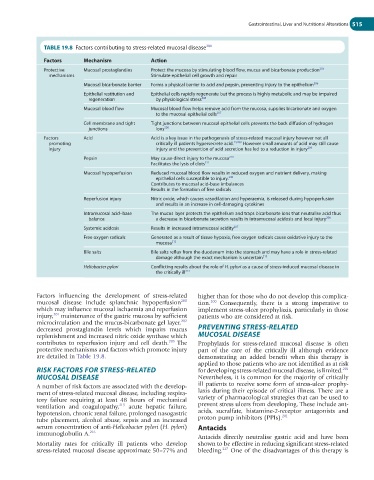
               TABLE 19.8  Factors contributing to stress-related mucosal disease 204

               Factors      Mechanism             Action
               Protective   Mucosal prostaglandins  Protect the mucosa by stimulating blood flow, mucus and bicarbonate production 205
                 mechanisms                       Stimulate epithelial cell growth and repair
                            Mucosal bicarbonate barrier  Forms a physical barrier to acid and pepsin, preventing injury to the epithelium 206
                            Epithelial restitution and   Epithelial cells rapidly regenerate but the process is highly metabolic and may be impaired
                              regeneration          by physiological stress 206
                            Mucosal blood flow    Mucosal blood flow helps remove acid from the mucosa, supplies bicarbonate and oxygen
                                                    to the mucosal epithelial cells 207
                            Cell membrane and tight   Tight junctions between mucosal epithelial cells prevents the back diffusion of hydrogen
                              junctions             ions 208
               Factors      Acid                  Acid is a key issue in the pathogenesis of stress-related mucosal injury however not all
                 promoting                          critically ill patients hypersecrete acid. 14,208  However small amounts of acid may still cause
                 injury                             injury and the prevention of acid secretion has led to a reduction in injury 209
                            Pepsin                May cause direct injury to the mucosa 210
                                                  Facilitates the lysis of clots 211
                            Mucosal hypoperfusion  Reduced mucosal blood flow results in reduced oxygen and nutrient delivery, making
                                                    epithelial cells susceptible to injury. 208
                                                  Contributes to mucosal acid-base imbalances
                                                  Results in the formation of free radicals
                            Reperfusion injury    Nitric oxide, which causes vasodilation and hyperaemia, is released during hypoperfusion
                                                    and results in an increase in cell-damaging cytokines
                            Intramucosal acid–base   The mucus layer protects the epithelium and traps bicarbonate ions that neutralise acid thus
                              balance               a decrease in bicarbonate secretion results in intramucosal acidosis and local injury 206
                            Systemic acidosis     Results in increased intramucosal acidity 207
                            Free oxygen radicals  Generated as a result of tissue hypoxia, free oxygen radicals cause oxidative injury to the
                                                    mucosa 212
                            Bile salts            Bile salts reflux from the duodenum into the stomach and may have a role in stress-related
                                                    damage although the exact mechanism is uncertain 213
                            Heliobacter pylori    Conflicting results about the role of H. pylori as a cause of stress-induced mucosal disease in
                                                    the critically ill 214


             Factors  influencing  the  development  of  stress-related   higher than for those who do not develop this complica-
                                                            200
                                                                      200
             mucosal  disease  include  splanchnic  hypoperfusion    tion.   Consequently,  there  is  a  strong  imperative  to
             which may influence mucosal ischaemia and reperfusion   implement stress-ulcer prophylaxis, particularly in those
                   201
             injury,  maintenance of the gastric mucosa by sufficient   patients who are considered at risk.
                                                            202
             microcirculation and the mucus-bicarbonate gel layer,
             decreased  prostaglandin  levels  which  impairs  mucus   PREVENTING STRESS-RELATED
             replenishment and increased nitric oxide synthase which   MUCOSAL DISEASE
                                                        203
             contributes  to  reperfusion  injury  and  cell  death.   The   Prophylaxis  for  stress-related  mucosal  disease  is  often
             protective mechanisms and factors which promote injury   part  of  the  care  of  the  critically  ill  although  evidence
             are detailed in Table 19.8.                          demonstrating  an  added  benefit  when  this  therapy  is
                                                                  applied to those patients who are not identified as at risk
             RISK FACTORS FOR STRESS-RELATED                      for developing stress-related mucosal disease, is limited.
                                                                                                                 201
             MUCOSAL DISEASE                                      Nevertheless, it is common for the majority of critically
             A number of risk factors are associated with the develop-  ill patients to receive some form of stress-ulcer prophy-
             ment of stress-related mucosal disease, including respira-  laxis during their episode of critical illness. There are a
             tory  failure  requiring  at  least  48  hours  of  mechanical   variety of pharmacological strategies that can be used to
                                        215
             ventilation  and  coagulopathy,   acute  hepatic  failure,   prevent stress ulcers from developing. These include ant-
             hypotension, chronic renal failure, prolonged nasogastric   acids,  sucralfate,  histamine-2-receptor  antagonists  and
                                                                                             201
             tube placement, alcohol abuse, sepsis and an increased   proton pump inhibitors (PPIs).
             serum concentration of anti-Helicobacter pylori (H. pylori)   Antacids
             immunoglobulin A. 216
                                                                  Antacids  directly  neutralise  gastric  acid  and  have  been
             Mortality  rates  for  critically  ill  patients  who  develop   shown to be effective in reducing significant stress-related
             stress-related mucosal disease approximate 50–77% and   bleeding.  One of the disadvantages of this therapy is
                                                                          217

