


Page 541 - ACCCN's Critical Care Nursing
P. 541
518  P R I N C I P L E S   A N D   P R A C T I C E   O F   C R I T I C A L   C A R E

         that  ‘hyperacute’,  ‘acute’  and  ‘sub-acute’  liver  failure
                               251
         should  be  used  instead.   In  this  classification,  hyper-  TABLE 19.9  West Haven grading of hepatic
         acute  refers  to  patients  who  develop  encephalopathy   encephalopathy 258,261
         within 7 days of the onset of jaundice, acute liver failure
         should be used in patients between 8–28 days from jaun-  Grade    Characteristics
         dice to encephalopathy and sub-acute liver failure when
         encephalopathy occurs within 5–12 weeks of the onset    I         Trivial lack of awareness
                                                                           Euphoria or anxiety
                    251
         of jaundice.  This has not received universal acceptance          Shortened attention span
         with  the  terms  fulminant  and  sub-fulminant  hepatic          Impaired performance of simple tests e.g. addition
         failure still used in clinical practice.                II        Lethargy or apathy
         ALF  without  preexisting  liver  disease  can  result  from      Subtle personality changes
         drug  reactions,  toxins  or  viral  infection,  or  from  the    Inappropriate behaviour
         effect  on  inflammatory  mediators  released  in  response   III  Somnolence to semi-stupor, but unresponsive to
         to tissue injury. Liver failure can also occur as an acute          verbal stimuli
         decompensation  of  chronic  liver  disease  (acute-on-           Confusion
                                                                           Gross disorientation
         chronic liver failure: AoCLF) or as an end-stage decom-
         pensation  in  chronic  liver  failure.  AoCLF  can  be   IV      Coma: unresponsive to verbal or painful stimuli
         precipitated  by  bacterial  or  viral  infection,  bleeding  or
         intoxication, and results in the same clinical syndrome
         as seen in ALF. 234
         End-stage decompensation of chronic liver failure repre-
         sents irreversible deterioration with inadequate residual   which  leads  to  the  development  of  cerebral  oedema.
         function to maintain homeostasis, and liver transplanta-  Ammonia levels also seem to be related to the disruption
         tion is the only viable treatment (see later in the chapter).   of  neurotransmission,  resulting  in  decreased  cerebral
                                                                      234,236,256
         However, in AoCLF, the function of the residual liver cell   function.    In  addition,  reactive  oxidative  species
         mass may be adequate to maintain hepatic homeostasis   causing  oxidative  stress  and  inflammatory  cytokine
         if the precipitating event can be treated. 234,236   release have been suggested, and the exact pathophysio-
                                                                                           257
                                                              logy is yet to be fully elucidated.
         Liver dysfunction is also a common consequence of criti-
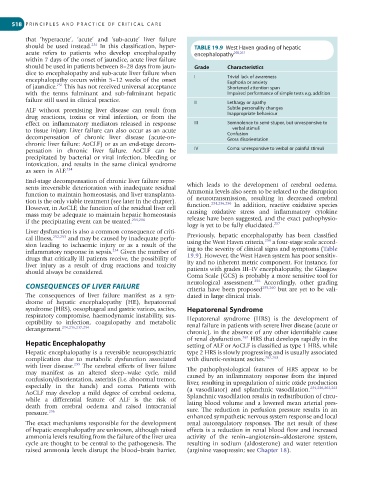
         cal illness, 252,253  and may be caused by inadequate perfu-  Previously,  hepatic  encephalopathy  has  been  classified
                                                                                        258
         sion  leading  to  ischaemic  injury  or  as  a  result  of  the   using the West Haven criteria,   a four-stage scale accord-
         inflammatory response in sepsis.  Given the number of   ing to the severity of clinical signs and symptoms (Table
                                      234
         drugs that critically ill patients receive, the possibility of   19.9). However, the West Haven system has poor sensitiv-
         liver  injury  as  a  result  of  drug  reactions  and  toxicity   ity and no inherent metric component. For instance, for
         should always be considered.                         patients with grades III–IV encephalopathy, the Glasgow
                                                              Coma Scale (GCS) is probably a more sensitive tool for
         CONSEQUENCES OF LIVER FAILURE                        neurological  assessment. 256   Accordingly,  other  grading
                                                                                       259,260
                                                              criteria have been proposed
                                                                                            but are yet to be vali-
         The  consequences  of  liver  failure  manifest  as  a  syn-  dated in large clinical trials.
         drome  of  hepatic  encephalopathy  (HE),  hepatorenal
         syndrome (HRS), oesophageal and gastric varices, ascites,    Hepatorenal Syndrome
         respiratory compromise, haemodynamic instability, sus-  Hepatorenal  syndrome  (HRS)  is  the  development  of
         ceptibility  to  infection,  coagulopathy  and  metabolic   renal failure in patients with severe liver disease (acute or
         derangement. 234,236,237,254
                                                              chronic), in the absence of any other identifiable cause
                                                              of renal dysfunction. 262  HRS that develops rapidly in the
         Hepatic Encephalopathy                               setting of ALF or AoCLF is classified as type 1 HRS, while
         Hepatic encephalopathy is a reversible neuropsychiatric   type 2 HRS is slowly progressing and is usually associated
         complication  due  to  metabolic  dysfunction  associated   with diuretic-resistant ascites. 262,263
         with  liver  disease. 255   The  cerebral  effects  of  liver  failure
         may  manifest  as  an  altered  sleep–wake  cycle,  mild   The  pathophysiological  features  of  HRS  appear  to  be
         confusion/disorientation, asterixis (i.e. abnormal tremor,   caused  by  an  inflammatory  response  from  the  injured
         especially  in  the  hands)  and  coma.  Patients  with   liver, resulting in upregulation of nitric oxide production
                                                                                                      234,236,262,263
         AoCLF may develop a mild degree of cerebral oedema,   (a  vasodilator)  and  splanchnic  vasodilation.
         while  a  differential  feature  of  ALF  is  the  risk  of    Splanchnic vasodilation results in redistribution of circu-
         death  from  cerebral  oedema  and  raised  intracranial   lating blood volume and a lowered mean arterial pres-
         pressure. 256                                        sure.  The  reduction  in  perfusion  pressure  results  in  an
                                                              enhanced sympathetic nervous system response and local
         The exact mechanisms responsible for the development   renal  autoregulatory  responses.  The  net  result  of  these
         of hepatic encephalopathy are unknown, although raised   effects is a reduction in renal blood flow and increased
         ammonia levels resulting from the failure of the liver urea   activity  of  the  renin–angiotensin–aldosterone  system,
         cycle are thought to be central to the pathogenesis. The   resulting  in  sodium  (aldosterone)  and  water  retention
         raised  ammonia  levels  disrupt  the  blood–brain  barrier,   (arginine vasopressin; see Chapter 18).

