


Page 564 - ACCCN's Critical Care Nursing
P. 564
Management of Shock 541

                                                                  shock.  Therapy  is  targeted  to  maintain  oxygen  delivery
               TABLE 20.2  Lactate production 9                   (DO 2 )  to  vital  organs  to  prevent  ischaemia  and  cell
                                                                  death. 25,26   Ideally,  organ  systems  and  tissues  should  be
                                                                                       25
               Lactate production                                 monitored individually,  however global measures such
                                                                  as  perfusion  pressure,  cardiac  output  (CO)  and  DO 2 ,
               Product of carbohydrate   Glucose, glycolysis; pyruvate,
                 metabolism (1400–       lactate                  are commonly used as surrogates to assist in treatment
                                                                                 19
                 4500 mmol/day)                                   decision  making.   Patient  assessment  and  haemody-
                                                                  namic  monitoring,  including  calculation  of  CO,  are
               Rise in lactate levels
                                                                  used  to  differentiate  shock  states  and  assess  progress
               Tissue hypoxia          Hypodynamic shock          in relation to treatment. 26–28  CO is seen by many clini-
                                       Organ ischaemia            cians  as  an  important  assessment  of  shocked  patients
               Hypermetabolism         Increased aerobic glycolysis  as  it  is  a  major  determinant  of  DO 2 . 25,26   Critically  ill
                                       Increased protein catabolism  patients  are  frequently  assessed  clinically,  although
                                       Haematological malignancies  cardiac  output  estimations  from  physical  examination
               Decreased clearance of lactate  Liver failure      are  generally  unreliable  and  patient  status  may  change
                                                                         29
                                       Shock                      quickly.   Therefore  invasive  techniques  are  most  com-
                                                                  monly  used  in  critical  care  to  measure  CO  (see  also
               Inhibition of pyruvate   Thiamine deficiency
                 dehydrogenase         Endotoxin                  Chapter  9).
               Activation of inflammatory cells
               Phagocytosis            Wounds (e.g. trauma/burns)  NON-INVASIVE ASSESSMENT
                                       Liver
                                       Gastrointestinal           Perfusion status is determined clinically using gross organ
                                       Lungs (e.g. ARDS)          function such as mental status, urine output and periph-
                                                                                        6
               Major source in sepsis                             eral  warmth  and  colour.   Basic  physical  assessment  of
                                                                  cardiovascular, central nervous system and renal function
               Phagocytes              Lungs                      are  essential  when  assessing  a  patient  at  risk  of  shock.
                                       Wounds                     Subtle changes in urine output, heart rate and capillary
                                       Liver: neutrophil sequestration
                                         increased, glucose uptake   refill  are  all  signs  of  physiological  compensation  in
                                         increased                response to altered tissue perfusion associated with shock.
                                       Gut: prone to hypoxia,     Regular tracking of these vital signs and trend monitoring
                                         phagocytes               through  careful  documentation  can  alert  clinicians  to
                                                                  impending deterioration in the shock state. Level of con-
                                                                  sciousness may deteriorate; an early sign may be anxiety,
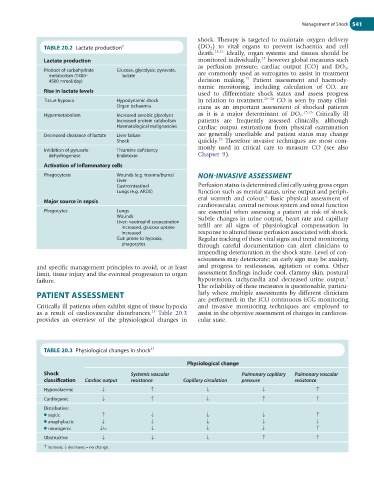
             and specific management principles to avoid, or at least   and  progress  to  restlessness,  agitation  or  coma.  Other
             limit, tissue injury and the eventual progression to organ   assessment findings include cool, clammy skin, postural
                                                                                                                  3
             failure.                                             hypotension,  tachycardia  and  decreased  urine  output.
                                                                  The reliability of these measures is questionable, particu-
             PATIENT ASSESSMENT                                   larly where multiple assessments by different clinicians
                                                                  are performed; in the ICU continuous ECG monitoring
             Critically ill patients often exhibit signs of tissue hypoxia   and  invasive  monitoring  techniques  are  employed  to
                                                   25
             as  a  result  of  cardiovascular  disturbances.   Table  20.3   assist in the objective assessment of changes in cardiovas-
             provides  an  overview  of  the  physiological  changes  in   cular state.


               TABLE 20.3  Physiological changes in shock 37
                                                              Physiological change
               Shock                        Systemic vascular                   Pulmonary capillary   Pulmonary vascular
               classification  Cardiac output  resistance    Capillary circulation  pressure     resistance
               Hypovolaemic       ↓               ↑                  ↓                 ↓                 ↑
               Cardiogenic        ↓               ↑                  ↓                 ↑                 ↑
               Distributive:
               ● septic           ↑               ↓                  ↓                 ↓                 ↑
               ● anaphylactic     ↓               ↓                  ↓                 ↓                 ↓
               ● neurogenic       ↓/=             ↓                  ↓                 ↓                 ↑
               Obstructive        ↓               ↓                  ↓                 ↑                 ↑
               ↑ increase; ↓ decrease; = no change.

