


Page 566 - ACCCN's Critical Care Nursing
P. 566
Management of Shock 543


               TABLE 20.4  Signs and symptoms of hypovolaemic shock 3

               Parameter                Mild (15–30% loss)           Moderate (30–40%)              Severe (>40%)
               Blood pressure           No change                    Lowered                        Hypotensive
               Pulse (beats/min)        ≥100 beats/min               ≥120 beats/min                 ≥140 beats/min
               Respirations             >20/min                      >30/min                        >40/min
               Neurological             Normal to slightly anxious   Mildly anxious to confused     Confused, lethargic
               Urine output             >30 mL per hour              20–30 mL per hour              5–15, negligible
               Capillary refill         Normal                       Reduced >4 sec                 Reduced >4 sec


             the reduced circulating volume, widespread vasoconstric-
             tion occurs in most body systems apart from the heart
             and CNS; SVR rises markedly in an attempt to retain a                    Hypothermia
             viable circulatory system (this accounts for many of the                 Temp <35°C
             signs and symptoms associated with circulatory compen-
             sation).  However,  as  tissues  are  starved  of  oxygen  and   Acidosis                 Coagulopathy
                                                                                                         INR >1.5
                                                                       pH <7.2
             nutrients over a prolonged ischaemic time, local media-   SBE >-6                          PT >18 secs
             tors are released as part of the inflammatory responses,   Lactate >4 mmol/L              APTT >45 secs
             leading to organ microvasculature vasodilation and capil-  lonised Ca <1.1 mmol/L        Fibrinogen <1.0 g/L
                                                                                                        Platelets <50
             laries  re-open  to  maintain  oxygen  delivery  and  reduce
                    41
             hypoxia.  This is a hallmark of developing MODS.
                                                                                      Physiological
                                                                                     derangements
             NURSING PRACTICE                                                         with massive
             Clinical management of hypovolaemia centres on mini-                      transfusion
             mising  fluid  loss  and  rapid  restoration  of  circulating
                         41
             blood volume  once the airway and breathing are secure.
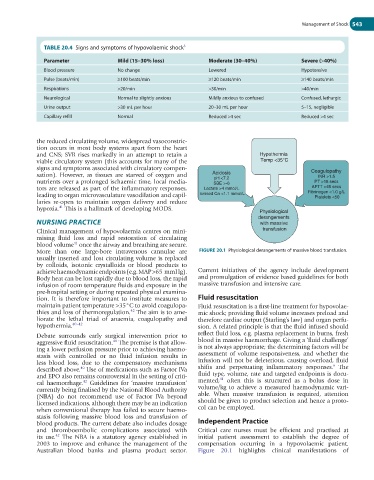
             More  than  one  large-bore  intravenous  cannulae  are   FIGURE 20.1  Physiological derangements of massive blood transfusion.
             usually inserted and lost circulating volume is replaced
             by  colloids,  isotonic  crystalloids  or  blood  products  to
             achieve haemodynamic endpoints (e.g. MAP >65 mmHg).   Current  initiatives  of  the  agency  include  development
             Body heat can be lost rapidly due to blood loss, the rapid   and promulgation of evidence based guidelines for both
             infusion of room temperature fluids and exposure in the   massive transfusion and intensive care.
             pre-hospital setting or during repeated physical examina-
             tion.  It  is  therefore  important  to  institute  measures  to   Fluid resuscitation
             maintain patient temperature >35°C to avoid coagulopa-  Fluid resuscitation is a first-line treatment for hypovolae-
             thies and loss of thermoregulation.  The aim is to ame-  mic shock; providing fluid volume increases preload and
                                            42
             liorate  the  lethal  triad  of  anaemia,  coagulopathy  and   therefore cardiac output (Starling’s law) and organ perfu-
             hypothermia. 40–42                                   sion. A related principle is that the fluid infused should
             Debate  surrounds  early  surgical  intervention  prior  to   reflect fluid loss, e.g. plasma replacement in burns, fresh
             aggressive fluid resuscitation.  The premise is that allow-  blood in massive haemorrhage. Giving a ‘fluid challenge’
                                      40
             ing a lower perfusion pressure prior to achieving haemo-  is not always appropriate; the determining factors will be
             stasis  with  controlled  or  no  fluid  infusion  results  in     assessment  of  volume  responsiveness,  and  whether  the
             less  blood  loss,  due  to  the  compensatory  mechanisms   infusion will not be deleterious, causing overload, fluid
                                                                                                              6
                           40
             described above.  Use of medications such as Factor IVa   shifts  and  perpetuating  inflammatory  responses.   The
             and EPO also remains controversial in the setting of criti-  fluid type, volume, rate and targeted endpoints is docu-
                                                                         41
                            42
             cal  haemorrhage.   Guidelines  for  ‘massive  transfusion’   mented;   often  this  is  structured  as  a  bolus  dose  in
             currently being finalised by the National Blood Authority   volume/kg  to  achieve  a  measured  haemodynamic  vari-
             (NBA)  do  not  recommend  use  of  Factor  IVa  beyond   able.  When  massive  transfusion  is  required,  attention
             licensed indications, although there may be an indication   should be given to product selection and hence a proto-
             when conventional therapy has failed to secure haemo-  col can be employed.
             stasis  following  massive  blood  loss  and  transfusion  of
             blood products. The current debate also includes dosage   Independent Practice
             and  thromboembolic  complications  associated  with    Critical  care  nurses  must  be  efficient  and  practised  at
                   42
             its  use.   The  NBA  is  a  statutory  agency  established  in   initial  patient  assessment  to  establish  the  degree  of
             2003  to  improve  and  enhance  the  management  of  the   compensation  occurring  in  a  hypovolaemic  patient.
             Australian  blood  banks  and  plasma  product  sector.   Figure  20.1  highlights  clinical  manifestations  of

