


Page 563 - ACCCN's Critical Care Nursing
P. 563
540  P R I N C I P L E S   A N D   P R A C T I C E   O F   C R I T I C A L   C A R E

                                                              tissues  while  other  areas  receive  more  blood  flow  than
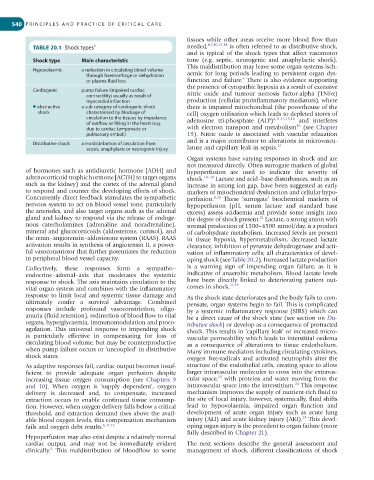
            TABLE 20.1  Shock types 5                         needed, 4,7,10,13,14  is often referred to as distributive shock,
                                                              and  is  typical  of  the  shock  types  that  affect  vasomotor
            Shock type      Main characteristic               tone  (e.g.  septic,  neurogenic  and  anaphylactic  shock).
                                                              This maldistribution may leave some organ systems isch-
            Hypovolaemic    a reduction in circulating blood volume
                             through haemorrhage or dehydration   aemic for long periods leading to persistent organ dys-
                                                                                6
                             or plasma fluid loss             function and failure.  There is also evidence supporting
                                                              the presence of cytopathic hypoxia as a result of excessive
            Cardiogenic     pump failure (impaired cardiac
                             contractility) usually as result of   nitric  oxide  and  tumour  necrosis  factor-alpha  (TNFα)
                             myocardial infarction            production (cellular proinflammatory mediators), where
            ● obstructive   a sub category of cardiogenic shock   there is impaired mitochondrial (the powerhouse of the
             shock           characterised by blockage of     cell) oxygen utilisation which leads to depleted stores of
                             circulation to the tissues by impedance   adenosine  tri-phosphate  (ATP) 4,11,13,15,16   and  interferes
                             of outflow or filling in the heart (e.g.                             16
                             due to cardiac tamponade or      with  electron  transport  and  metabolism   (see  Chapter
                             pulmonary emboli)                19).  Nitric  oxide  is  associated  with  vascular  relaxation
                                                              and is a major contributor to alterations in microvascu-
            Distributive shock  a maldistribution of circulation from                       17
                             sepsis, anaphylaxis or neurogenic injury  lature and capillary leak in sepsis.
                                                              Organ systems have varying responses in shock and are
                                                              not measured directly. Often surrogate markers of global
         of hormones such as antidiuretic hormone [ADH] and   hypoperfusion  are  used  to  indicate  the  severity  of
         adrenocorticoid trophic hormone [ACTH] to target organs   shock. 18–19  Lactate and acid–base disturbances, such as an
         such as the kidney) and the cortex of the adrenal gland   increase in strong ion gap, have been suggested as early
         to respond and counter the developing effects of shock.   markers of mitochondrial dysfunction and cellular hypo-
         Concurrently direct feedback stimulates the sympathetic   perfusion. 8,20   These  ‘surrogate’  biochemical  markers  of
         nervous system to act on blood vessel tone, particularly   hypoperfusion  (pH,  serum  lactate  and  standard  base
         the arterioles, and also target organs such as the adrenal   excess) assess acidaemia and provide some insight into
         gland and kidney to respond via the release of endoge-  the degree of shock present.  Lactate, a strong anion with
                                                                                      21
         nous  catecholamines  (adrenaline  and  noradrenaline),   normal production of 1500–4500 mmol/day, is a product
         mineral and glucocorticoids (aldosterone, cortisol), and   of carbohydrate metabolism. Increased levels are present
         the renin–angiotensin–aldosterone system (RAAS). RAAS   in  tissue  hypoxia,  hypermetabolism,  decreased  lactate
         activation results in synthesis of angiotensin II, a power-  clearance, inhibition of pyruvate dehydrogenase and acti-
         ful vasoconstrictor that further potentiates the reduction   vation of inflammatory cells; all characteristics of devel-
         in peripheral blood vessel capacity.                 oping shock (see Table 20.2). Increased lactate production
         Collectively,  these  responses  form  a  sympatho–  is  a  warning  sign  of  impending  organ  failure,  as  it  is
         endocrine–adrenal–axis  that  moderates  the  systemic   indicative of anaerobic metabolism. Blood lactate levels
         response to shock. The axis maintains circulation to the   have  been  directly  linked  to  deteriorating  patient  out-
         vital organ system and combines with the inflammatory   comes in shock. 21,22
         response to limit local and systemic tissue damage and   As the shock state deteriorates and the body fails to com-
         ultimately  confer  a  survival  advantage.  Combined   pensate, organ systems begin to fail. This is complicated
         responses  include  profound  vasoconstriction,  oligo-  by a systemic inflammatory response (SIRS) which can
         anuria (fluid retention), redirection of blood flow to vital   be a direct cause of the shock state (see section on Dis-
         organs, hyperglycaemia, immunomodulation and proco-  tributive shock) or develop as a consequence of protracted
         agulation.  This  universal  response  to  impending  shock   shock. This results in ‘capillary leak’ or increased micro-
         is  particularly  effective  in  compensating  for  loss  of     vascular permeability which leads to interstitial oedema
         circulating blood volume, but may be counterproductive   as  a  consequence  of  alterations  to  tissue  endothelium.
         when pump failure occurs or ‘uncoupled’ in distributive   Many immune mediators including circulating cytokines,
         shock states.                                        oxygen  free-radicals  and  activated  neutrophils  alter  the
         As adaptive responses fail, cardiac output becomes insuf-  structure of the endothelial cells, creating space to allow
         ficient  to  provide  adequate  organ  perfusion  despite   larger intravascular molecules to cross into the extravas-
                                                                        23
         increasing  tissue  oxygen  consumption  (see  Chapters  9   cular space,  with proteins and water moving from the
                                                                                                  24
         and  10).  When  oxygen  is  ‘supply  dependent’,  oxygen   intravascular space into the interstitium.  This response
         delivery  is  decreased  and,  to  compensate,  increased   mechanism improves the supply of nutrient-rich fluid to
         extraction  occurs  to  enable  continued  tissue  consump-  the site of local injury, however, systemically, fluid shifts
         tion. However, when oxygen delivery falls below a critical   lead  to  hypovolaemia,  impaired  organ  function  and
         threshold, and extraction demand rises above the avail-  development  of  acute  organ  injury  such  as  acute  lung
                                                                                                    24
         able blood oxygen levels, this compensation mechanism   injury (ALI) and acute kidney injury (AKI).  This devel-
         fails and oxygen debt results. 6,11,12               oping organ injury is the precedent to organ failure (more
                                                              fully described in Chapter 21).
         Hypoperfusion may also exist despite a relatively normal
         cardiac  output,  and  may  not  be  immediately  evident   The  next  sections  describe  the  general  assessment  and
                  6
         clinically.   This  maldistribution  of  bloodflow  to  some   management of shock, different classifications of shock

