


Page 565 - ACCCN's Critical Care Nursing
P. 565
542  P R I N C I P L E S   A N D   P R A C T I C E   O F   C R I T I C A L   C A R E

         Although CO estimations based on physical assessment
         findings  are  unreliable,  physical  examination  using  an   BOX 20.1  VIP acronym 37
         estimation  of  vascular  resistance  has  shown  reasonable
                 30
         accuracy.  Clinical assessment may determine CO using   ●  Ventilation,  including  airway,  added  oxygen  and
         the  rearranged  equation  of  systemic  vascular  resistance   ventilation
         (SVR = MAP − CVP/CO) where vascular resistance is mea-  ●  Infusion of appropriate volume expanders
                                                       30
         sured through peripheral skin temperature changes.  A   ●  Improved heart Pumping with drug therapy such as antiar-
         reliable  and  accurate  non-invasive  clinical  assessment   rhythmics, inotropes, diuretics, and vasodilators.
         technique  of  estimating  cardiac  output  would  be  clini-
                    27
         cally  useful   allowing  assessment  of  patients  without
         invasive monitoring, or used to verify accuracy from inva-
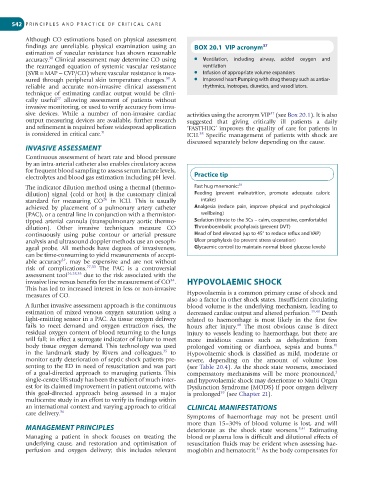
         sive  devices.  While  a  number  of  non-invasive  cardiac   activities using the acronym VIP  (see Box 20.1). It is also
                                                                                         37
         output measuring devices are available, further research   suggested  that  giving  critically  ill  patients  a  daily
         and refinement is required before widespread application   ‘FASTHUG’ improves the quality of care for patients in
         is considered in critical care. 31                   ICU.   Specific  management  of  patients  with  shock  are
                                                                  38
                                                              discussed separately below depending on the cause.
         INVASIVE ASSESSMENT
         Continuous assessment of heart rate and blood pressure
         by an intra-arterial catheter also enables circulatory access
         for frequent blood sampling to assess serum lactate levels,
         electrolytes and blood gas estimation including pH level.  Practice tip
         The indicator dilution method using a thermal (thermo-  Fast hug mnemonic: 38
         dilution)  signal  (cold  or  hot)  is  the  customary  clinical   Feeding  (prevent  malnutrition,  promote  adequate  caloric
                                   26
         standard  for  measuring  CO   in  ICU.  This  is  usually   intake)
         achieved  by  placement  of  a  pulmonary  artery  catheter   Analgesia  (reduce  pain,  improve  physical  and  psychological
         (PAC), or a central line in conjunction with a thermistor-  wellbeing)
         tipped arterial cannula (transpulmonary aortic thermo-  Sedation (titrate to the 3Cs – calm, cooperative, comfortable)
         dilution).  Other  invasive  techniques  measure  CO    Thromboembolic prophylaxis (prevent DVT)
         continuously  using  pulse  contour  or  arterial  pressure   Head of bed elevated (up to 45° to reduce reflux and VAP)
         analysis and ultrasound doppler methods use an oesoph-  Ulcer prophylaxis (to prevent stress ulceration)
         ageal  probe.  All  methods  have  degrees  of  invasiveness,   Glycaemic control (to maintain normal blood glucose levels)
         can be time-consuming to yield measurements of accept-
         able  accuracy ,  may  be  expensive  and  are  not  without
                     32
         risk  of  complications. 27,33   The  PAC  is  a  controversial
         assessment tool 26,28,33  due to the risk associated with the
         invasive line versus benefits for the measurement of CO .   HYPOVOLAEMIC SHOCK
                                                         34
         This has led to increased interest in less or non-invasive
         measures of CO.                                      Hypovolaemia is a common primary cause of shock and
                                                              also a factor in other shock states. Insufficient circulating
         A further invasive assessment approach is the continuous   blood volume is the underlying mechanism, leading to
         estimation  of  mixed  venous  oxygen  saturation  using  a   decreased cardiac output and altered perfusion. 39,40  Death
         light-emitting sensor in a PAC. As tissue oxygen delivery   related  to  haemorrhage  is  most  likely  in  the  first  few
         fails  to  meet  demand  and  oxygen  extraction  rises,  the   hours  after  injury.   The  most  obvious  cause  is  direct
                                                                               40
         residual oxygen content of blood returning to the lungs   injury  to  vessels  leading  to  haemorrhage,  but  there  are
         will fall; in effect a surrogate indicator of failure to meet   more  insidious  causes  such  as  dehydration  from
         body  tissue  oxygen  demand.  This  technology  was  used   prolonged  vomiting  or  diarrhoea,  sepsis  and  burns.
                                                                                                              41
                                                      35
         in  the  landmark  study  by  Rivers  and  colleagues.   to   Hypovolaemic  shock  is  classified  as  mild,  moderate  or
         monitor early deterioration of septic shock patients pre-  severe,  depending  on  the  amount  of  volume  loss
         senting to the ED in need of resuscitation and was part   (see Table 20.4). As the shock state worsens, associated
                                                                                                               3
         of  a  goal-directed  approach  to  managing  patients.  This   compensatory  mechanisms  will  be  more  pronounced,
         single-centre US study has been the subject of much inter-  and hypovolaemic shock may deteriorate to Multi Organ
         est for its claimed improvement in patient outcome, with   Dysfunction Syndrome (MODS) if poor oxygen delivery
         this  goal-directed  approach  being  assessed  in  a  major   is prolonged  (see Chapter 21).
                                                                         39
         multicentre study in an effort to verify its findings within
         an international context and varying approach to critical   CLINICAL MANIFESTATIONS
         care delivery. 36
                                                              Symptoms  of  haemorrhage  may  not  be  present  until
                                                              more  than  15–30%  of  blood  volume  is  lost,  and  will
         MANAGEMENT PRINCIPLES                                deteriorate  as  the  shock  state  worsens. 3,41   Estimating
         Managing  a  patient  in  shock  focuses  on  treating  the   blood or plasma loss is difficult and dilutional effects of
         underlying  cause,  and  restoration  and  optimisation  of   resuscitation fluids may be evident when assessing hae-
                                                                                     41
         perfusion  and  oxygen  delivery;  this  includes  relevant   moglobin and hematocrit.  As the body compensates for

