


Page 586 - ACCCN's Critical Care Nursing
P. 586
Multiple Organ Dysfunction Syndrome 563

             PATHOPHYSIOLOGY                                      breakdown of cellular components into apoptic bodies.
                                                                  This  normally  orderly  process  is  deranged  in  critical
             The  syndrome  of  multiple  organ  dysfunction  is  most   illness, leading to tissue or organ bed injury and MODS.
             closely  related  to  an  outcome  of  sepsis,  which  was   Proinflammatory cytokines released in sepsis may delay
             described in Chapter 20. MODS is a state characterised   apoptosis in activated macrophages and neutrophils, but
             by aberrant cellular responses involving multiple organ   in  other  tissues,  such  as  gut  endothelium,  accelerated
             systems  and  sequential  processes.  The  pathogenesis  of   apoptosis occurs. 8
             MODS  is  complex,  simultaneously  involving  every  cell
             type, neuro-hormonal axis and organ system. 7        In contrast, necrosis is a form of cell death characterised
                                                                  by cellular swelling and loss of membrane integrity as a
             In brief, hypoxic hypoxia results from altered metabolic   result  of  hypoxia  or  trauma.  Necrosis  has  been  termed
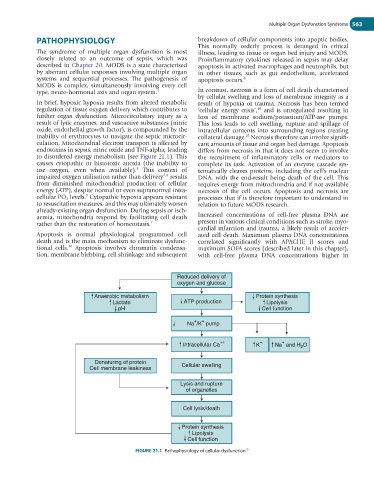
             regulation of tissue oxygen delivery which contributes to   ‘cellular  energy  crisis’,   and  is  unregulated  resulting  in
                                                                                     10
             further  organ  dysfunction.  Microcirculatory  injury  as  a   loss  of  membrane  sodium/potassium/ATP-ase  pumps.
             result of lytic enzymes, and vasoactive substances (nitric   This  loss  leads  to  cell  swelling,  rupture  and  spillage  of
             oxide, endothelial growth factor), is compounded by the   intracellular contents into surrounding regions creating
             inability of erythrocytes to navigate the septic microcir-  collateral damage.  Necrosis therefore can involve signifi-
                                                                                 10
             culation. Mitochondrial electron transport is affected by   cant amounts of tissue and organ bed damage. Apoptosis
             endotoxins in sepsis, nitric oxide and TNF-alpha, leading   differs from necrosis in that it does not seem to involve
             to disordered energy metabolism (see Figure 21.1). This   the  recruitment  of  inflammatory  cells  or  mediators  to
             causes  cytopathic  or  histotoxic  anoxia  (the  inability  to   complete its task. Activation of an enzyme cascade sys-
                                              8
             use  oxygen,  even  when  available).   This  context  of   tematically cleaves proteins, including the cell’s nuclear
                                                      7,8
             impaired oxygen utilisation rather than delivery  results   DNA,  with  the  end-result  being  death  of  the  cell.  This
             from  diminished  mitochondrial  production  of  cellular   requires energy from mitrochondria and if not available
             energy (ATP), despite normal or even supranormal intra-  necrosis  of  the  cell  occurs.  Apoptosis  and  necrosis  are
                             9
             cellular PO 2  levels.  Cytopathic hypoxia appears resistant   processes that if is therefore important to understand in
             to resuscitation measures, and this may ultimately worsen   relation to future MODS research.
             already-existing organ dysfunction. During sepsis or isch-
             aemia,  mitochondria  respond  by  facilitating  cell  death   Increased  concentrations  of  cell-free  plasma  DNA  are
             rather than the restoration of homeostasis. 7        present in various clinical conditions such as stroke, myo-
                                                                  cardial infarction and trauma, a likely result of acceler-
             Apoptosis  is  normal  physiological  programmed  cell   ated cell death. Maximum plasma DNA concentrations
             death and is the main mechanism to eliminate dysfunc-  correlated  significantly  with  APACHE  II  scores  and
                       10
             tional  cells.   Apoptosis  involves  chromatin  condensa-  maximum SOFA scores (described later in this chapter),
             tion, membrane blebbing, cell shrinkage and subsequent   with  cell-free  plasma  DNA  concentrations  higher  in


                                                           Reduced delivery of
                                                           oxygen and glucose

                                Anaerobic metabolism                                 Protein synthesis
                                      Lactate                ATP production             Lipolysis
                                        pH                                             Cell function

                                                                 +
                                                                   +
                                                              Na /K  pump
                                                                                             +
                                                             Intracellular Ca ++     K +   Na  and H O
                                                                                                   2
                                Denaturing of protein
                              Cell membrane leakiness       Cellular swelling


                                                            Lysis and rupture
                                                              of organelles


                                                             Cell lysis/death

                                                            Protein synthesis
                                                                Lipolysis
                                                              Cell function
                                             FIGURE 21.1  Pathophysiology of cellular dysfunction.
                                                                                  97

