


Page 587 - ACCCN's Critical Care Nursing
P. 587
564  P R I N C I P L E S   A N D   P R A C T I C E   O F   C R I T I C A L   C A R E


                                                                    Coagulation  Activated protein C
                                                  Endothelium        cascade                   Activated protein C

                                                      Tissue Factor
                                                                           Factor VIlla
                                                              IL-6                                     PAI-1
                                                              IL-1             Inactivation
                                                              TNF-
                                                      Monocyte              Factor Va             Inactivation
                                                        Inhibition  Protein C  Inactivation          Suppressed
                                                          Activated
                                                                                                     fibrinolysis
                                                                         THROMBIN       TAFI
                                                                  Neutrophil                   Fibrin
                                                        Inhibition  IL-6  Reduction

                                               Tissue factor             of rolling  Activated  Fibrin clot
                                                                                  protein C
                                               Inflammatory response   Thrombotic response      Fibrinolytic response
         FIGURE  21.2  Tissue  factor  pathway  (Courtesy  Eli   to Infection  to Infection        to Infection
         Lilly and Company).


         hospital non-survivors than in survivors. Using regression   and  fail,  and  the  body  is  no  longer  able  to  maintain
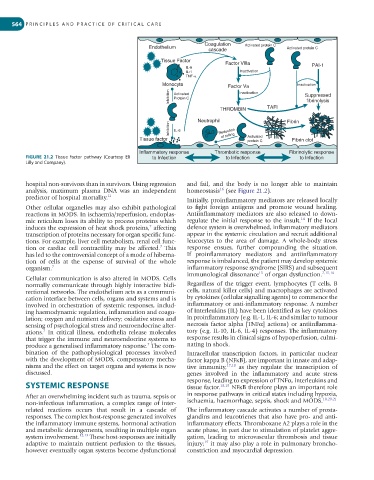
         analysis,  maximum  plasma  DNA  was  an  independent   homeostasis  (see Figure 21.2).
                                                                         16
         predictor of hospital mortality. 11
                                                              Initially, proinflammatory mediators are released locally
         Other  cellular  organelles  may  also  exhibit  pathological   to  fight  foreign  antigens  and  promote  wound  healing.
         reactions in MODS. In ischaemia/reperfusion, endoplas-  Antiinflammatory mediators are also released to down-
                                                                                                   14
         mic reticulum loses its ability to process proteins which   regulate  the  initial  response  to  the  insult.   If  the  local
                                                  7
         induces the expression of heat shock proteins,  affecting   defence system is overwhelmed, inflammatory mediators
         transcription of proteins necessary for organ specific func-  appear in the systemic circulation and recruit additional
         tions. For example, liver cell metabolism, renal cell func-  leucocytes  to  the  area  of  damage.  A  whole-body  stress
                                                     7
         tion  or  cardiac  cell  contractility  may  be  affected.   This   response  ensues,  further  compounding  the  situation.
         has led to the controversial concept of a mode of hiberna-  If  proinflammatory  mediators  and  antiinflammatory
         tion  of  cells  at  the  expense  of  survival  of  the  whole   response is imbalanced, the patient may develop systemic
         organism. 7                                          inflammatory response syndrome (SIRS) and subsequent
                                                                                      15
                                                              immunological dissonance  of organ dysfunction. 2,15,16
         Cellular communication is also altered in MODS. Cells
         normally communicate through highly interactive bidi-  Regardless  of  the  trigger  event,  lymphocytes  (T  cells,  B
         rectional networks. The endothelium acts as a communi-  cells, natural killer cells) and macrophages are activated
         cation interface between cells, organs and systems and is   by cytokines (cellular signalling agents) to commence the
         involved in orchestration of systemic responses, includ-  inflammatory or anti-inflammatory response. A number
         ing haemodynamic regulation, inflammation and coagu-  of Interleukins (IL) have been identified as key cytokines
         lation; oxygen and nutrient delivery; oxidative stress and   in proinflammatory (e.g. IL-1, IL-6; and similar to tumour
         sensing of psychological stress and neuroendocrine alter-  necrosis  factor  alpha  [TNFα]  actions)  or  antiinflamma-
         ations.   In  critical  illness,  endothelia  release  molecules   tory (e.g. IL-10, IL-6, IL-4) responses. The inflammatory
               7
         that trigger the immune and neuroendocrine systems to   response results in clinical signs of hypoperfusion, culmi-
         produce a generalised inflammatory response.  The com-  nating in shock.
                                                 7
         bination  of  the  pathophysiological  processes  involved   Intracellular  transcription  factors,  in  particular  nuclear
         with the development of MODS, compensatory mecha-    factor kappa B (NFκB), are important in innate and adap-
         nisms and the effect on target organs and systems is now   tive  immunity, 17,18   as  they  regulate  the  transcription  of
         discussed.                                           genes  involved  in  the  inflammatory  and  acute  stress
         SYSTEMIC RESPONSE                                    response, leading to expression of TNFα, interleukins and
                                                                         18,19
                                                                             NFκB therefore plays an important role
                                                              tissue factor.
         After an overwhelming incident such as trauma, sepsis or   in response pathways in critical states including hypoxia,
                                                                                                           18,20,21
         non-infectious inflammation, a complex range of inter-  ischaemia, haemorrhage, sepsis, shock and MODS.
         related  reactions  occurs  that  result  in  a  cascade  of   The inflammatory cascade activates a number of prosta-
         responses. The complex host-response generated involves   glandins and leucotrienes that also have pro- and anti-
         the inflammatory immune systems, hormonal activation   inflammatory effects. Thromboxane A2 plays a role in the
         and metabolic derangements, resulting in multiple organ   acute phase, in part due to stimulation of platelet aggre-
         system involvement. 12,13  These host-responses are initially   gation,  leading  to  microvascular  thrombosis  and  tissue
                                                                    15
         adaptive  to  maintain  nutrient  perfusion  to  the  tissues,   injury;  it may also play a role in pulmonary broncho-
         however eventually organ systems become dysfunctional   constriction and myocardial depression.

