


Page 619 - ACCCN's Critical Care Nursing
P. 619
596  S P E C I A LT Y   P R A C T I C E   I N   C R I T I C A L   C A R E

         assessment  and  management  of  presentations  (see
         Chapter 17).                                            TABLE 22.6  Acronyms outlining potential causes of
                                                                 altered level of consciousness
         OVERDOSE AND POISONING                                  Acronym  Cause         Acronym   Cause

         Poisoning is a common clinical presentation in Australia   T     Trauma        A         Alcohol and
         and New Zealand, accounting for 1–5% of admissions to                                     other toxins
         public  hospitals. 103-105   Up  to  25%  of  successful  suicides   I  Infection  E     Endocrine
                             105
         are  due  to  poisoning.   Current  clinical  management                                 Encephalopathy
         with supportive and/or symptomatic control has resulted   P      Psychogenic             Electrolyte
         in death rates as low as 0.5% for overdose admissions to         Porphyria                abnormality
                  105
         hospitals.  New Zealand has a similar poisoning pattern   S      Seizure       I         Insulin/diabetes
         to  Australia  but  much  higher  rates  of  admission  and  a   Syncope
                                               106
         lower  mortality  rate  than  many  countries.   Common          Space-occupying   O     Oxygen: hypoxia
                                                                                                   of any cause
         self-poisoning ED presentations include prescribed drugs,          lesion                Opiates
         illicit  drugs  and  ingestion  of  common  dangerous  sub-
         stances  (e.g.  detergents,  cleansers,  psychotropic  agents,                 U         Uraemia
         analgesics, insecticides, paracetamol, aspirin). 107
         A  range  of  artificial  and  naturally-occurring  substances
         can produce acute poisonings. The toxicity of a substance
         depends  on  numerous  factors,  such  as  dose,  route     resuscitation may require removal of the toxin, counterac-
         of  exposure,  and  the  victim’s  preexisting  conditions.    tion of the poisoning by an antidote if available, and the
                                                                                             108-110
         Poisoning,  whether  intentional  or  unintentional,  can   treatment or support of symptoms.
         occur  at  any  time,  and  may  involve  single  or  multiple   Note  that  many  drugs  such  as  paracetamol  may  have
         substances. 107-109                                  limited initial effects but serious, potentially fatal conse-
         The vast amount of knowledge required on all poisons   quences if not treated in a timely manner. 104,109,110  Once
         prompted the development of poison control informa-  ascertained that a patient does not have an immediate,
         tion centres to provide specific information and guidance   life-endangering problem, attention is directed towards a
         for healthcare providers and the general public, on the   more thorough assessment and identification of the toxin
         management of a poisoned patient; to collect statistics on   involved. Accurate history is often the most significant aid
         toxic substances; and to educate the public on the preven-  in directing care. If a history is unobtainable or uncertain,
                                          108
         tion or recognition of toxic exposures.  Other initiatives   there are several general guidelines available for dealing
         to  limit  the  incidence  and  severity  of  acute  poisoning   with a patient who has an altered mental state or con-
                                                                            107,108,110
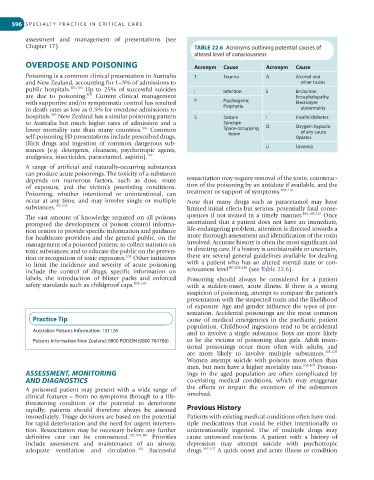
         include  the  control  of  drugs,  specific  information  on   sciousness level   (see Table 22.6).
         labels,  the  introduction  of  blister  packs  and  enforced   Poisoning  should  always  be  considered  for  a  patient
         safety standards such as childproof caps. 108-110    with  a  sudden-onset,  acute  illness.  If  there  is  a  strong
                                                              suspicion of poisoning, attempt to compare the patient’s
                                                              presentation with the suspected toxin and the likelihood
                                                              of exposure. Age and gender influence the types of pre-
                                                              sentation. Accidental poisonings are the most common
            Practice Tip                                      cause  of  medical  emergencies  in  the  paediatric  patient
                                                              population. Childhood ingestions tend to be accidental
            Australian Poisons Information: 131126
                                                              and to involve a single substance. Boys are more likely
            Poisons Information New Zealand: 0800 POISON (0800 764766)  to  be  the  victims  of  poisoning  than  girls.  Adult  inten-
                                                              tional  poisonings  occur  more  often  with  adults,  and
                                                              are  more  likely  to  involve  multiple  substances. 105-107
                                                              Women  attempt  suicide  with  poisons  more  often  than
                                                              men, but men have a higher mortality rate. 105-107  Poison-
         ASSESSMENT, MONITORING                               ings  in  the  aged  population  are  often  complicated  by
         AND DIAGNOSTICS                                      co-existing  medical  conditions,  which  may  exaggerate
         A  poisoned  patient  may  present  with  a  wide  range  of   the  effects  or  impair  the  excretion  of  the  substances
         clinical features – from no symptoms through to a life-  involved.
         threatening  condition  or  the  potential  to  deteriorate
         rapidly;  patients  should  therefore  always  be  assessed   Previous History
         immediately. Triage decisions are based on the potential   Patients with existing medical conditions often have mul-
         for rapid deterioration and the need for urgent interven-  tiple  medications  that  could  be  either  intentionally  or
         tion. Resuscitation may be necessary before any further   unintentionally  ingested.  Use  of  multiple  drugs  may
         definitive  care  can  be  commenced. 107,109,110   Priorities   cause  untoward  reactions.  A  patient  with  a  history  of
         include  assessment  and  maintenance  of  an  airway,     depression  may  attempt  suicide  with  psychotropic
                                              104
         adequate  ventilation  and  circulation.   Successful   drugs. 105-107  A quick onset and acute illness or condition

