


Page 618 - ACCCN's Critical Care Nursing
P. 618
Emergency Presentations 595

                                                                                   99
             l  Ischaemic: are precipitated by disrupted blood flow to   stroke presentation.  IV access is obtained to administer
                an area of the brain as a result of arterial occlusion.   medications, and collect blood for electrolytes, haemato-
                Acute ischaemic stroke presentations are now referred   logy  and  coagulation  studies.  A  blood  sugar  level  test
                to as a ‘brain attack’, to promote early presentation for   will rule out hypoglycaemia or hyperglycaemia as a cause
                access to time-critical treatments, 94,95  and because the   of  the  presenting  symptoms.  Abnormal  glucose  levels
                pathophysiology and current treatment of acute (isch-  adversely  affect  cerebral  metabolism. 99,94   After  obvious
                aemic) stroke mimics that of acute myocardial infarc-  alternative diagnoses are excluded, a brain CT scan deter-
                tion (‘heart attack’). From an ED perspective, serious   mines whether a stroke is haemorrhagic or ischaemic in
                long-term  disability  can  be  minimised  if  ischaemic   origin. While a new-onset ischaemic stroke may not be
                stroke  is  recognised  and  treated  promptly;  that  is,   evident for up to 24 hours, blood in the cranial cavity
                within 3 hours of symptom onset. 96,97            will be apparent immediately. Patients with any sign of
             l  Haemorrhagic strokes are caused by rupture of a blood   haemorrhage are excluded for fibrinolytic therapy. 95
                vessel, which produces bleeding into the brain paren-
                chyma.  (Chapter  17  details  the  pathophysiological   MANAGEMENT
                processes).                                       Acute  ischaemic  stroke  (‘brain  attack’)  management
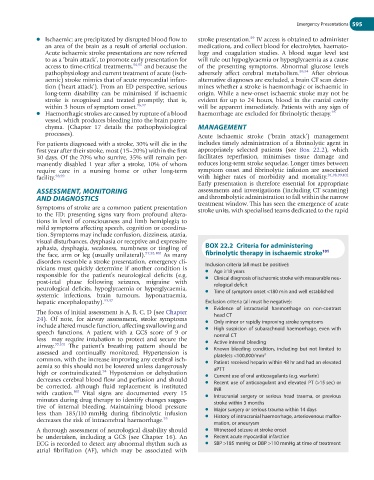
             For patients diagnosed with a stroke, 30% will die in the   includes timely administration of a fibrinolytic agent in
             first year after their stroke, most (15–20%) within the first   appropriately  selected  patients  (see  Box  22.2),  which
             30 days. Of the 70% who survive, 35% will remain per-  facilitates  reperfusion,  minimises  tissue  damage  and
             manently  disabled  1  year  after  a  stroke,  10%  of  whom   reduces long-term stroke sequelae. Longer times between
             require  care  in  a  nursing  home  or  other  long-term   symptom onset and fibrinolytic infusion are associated
             facility. 98,99                                      with  higher  rates  of  morbidity  and  mortality. 94,98,99,102
                                                                  Early  presentation  is  therefore  essential  for  appropriate
             ASSESSMENT, MONITORING                               assessments and investigations (including CT scanning)
             AND DIAGNOSTICS                                      and thrombolytic administration to fall within the narrow
             Symptoms of stroke are a common patient presentation   treatment window. This has seen the emergence of acute
                                                                  stroke units, with specialised teams dedicated to the rapid
             to  the  ED;  presenting  signs  vary  from  profound  altera-
             tions in level of consciousness and limb hemiplegia to
             mild symptoms affecting speech, cognition or coordina-
             tion. Symptoms may include confusion, dizziness, ataxia,
             visual disturbances, dysphasia or receptive and expressive
             aphasia,  dysphagia,  weakness,  numbness  or  tingling  of   BOX 22.2  Criteria for administering
             the face, arm or leg (usually unilateral). 97,98,100  As many   fibrinolytic therapy in ischaemic stroke 101
             disorders resemble a stroke presentation, emergency cli-  Inclusion criteria (all must be positive):
             nicians  must  quickly  determine  if  another  condition  is   l  Age ≥18 years
             responsible  for  the  patient’s  neurological  deficits  (e.g.     l  Clinical diagnosis of ischaemic stroke with measurable neu-
             post-ictal  phase  following  seizures,  migraine  with     rological deficit
             neurological deficits, hypoglycaemia or hyperglycaemia,     l  Time of symptom onset <180 min and well established
             systemic  infections,  brain  tumours,  hyponatraemia,
             hepatic encephalopathy). 93,97                         Exclusion criteria (all must be negative):
                                                                    l  Evidence  of  intracranial  haemorrhage  on  non-contrast
             The focus of initial assessment is A, B, C, D (see Chapter   head CT
             24).  Of  note,  for  airway  assessment,  stroke  symptoms   l  Only minor or rapidly improving stroke symptoms
             include altered muscle function, affecting swallowing and   l  High  suspicion  of  subarachnoid  haemorrhage,  even  with
             speech  functions.  A  patient  with  a  GCS  score  of  9  or    normal CT
             less    may  require  intubation  to  protect  and  secure  the   l  Active internal bleeding
             airway. 99,101   The  patient’s  breathing  pattern  should  be   l  Known  bleeding  condition,  including  but  not  limited  to
             assessed  and  continually  monitored.  Hypertension  is   platelets <100,000/mm 3
             common, with the increase improving any cerebral isch-  l  Patient received heparin within 48 hr and had an elevated
             aemia so this should not be lowered unless dangerously    aPTT
                                   94
             high  or  contraindicated.   Hypotension  or  dehydration   l  Current use of oral anticoagulants (e.g. warfarin)
             decreases cerebral blood flow and perfusion and should   l  Recent use of anticoagulant and elevated PT (>15 sec) or
             be  corrected,  although  fluid  replacement  is  instituted   INR
                         100
             with  caution.   Vital  signs  are  documented  every  15   l  Intracranial  surgery  or  serious  head  trauma,  or  previous
             minutes during drug therapy to identify changes sugges-   stroke within 3 months
             tive  of  internal  bleeding.  Maintaining  blood  pressure     l  Major surgery or serious trauma within 14 days
             less  than  185/110 mmHg  during  fibrinolytic  infusion   l  History of intracranial haemorrhage, arteriovenous malfor-
             decreases the risk of intracerebral haemorrhage. 95
                                                                       mation, or aneurysm
             A thorough assessment of neurological disability should   l  Witnessed seizure at stroke onset
             be  undertaken,  including  a  GCS  (see  Chapter  16).  An   l  Recent acute myocardial infarction
             ECG is recorded to detect any abnormal rhythm such as   l  SBP >185 mmHg or DBP >110 mmHg at time of treatment
             atrial  fibrillation  (AF),  which  may  be  associated  with

