


Page 655 - ACCCN's Critical Care Nursing
P. 655
632  S P E C I A LT Y   P R A C T I C E   I N   C R I T I C A L   C A R E

         l  Fractures of the spinal column. (see also Chapter 17).   Given the potential for extensive blood loss, as well as
            The spinal column includes all of the bony compo-  the frequent close proximity of nerves and blood vessels
            nents  in  the  cervical,  thoracic  and  lumbar  vertebral   to  bones,  neurovascular  assessment  of  the  patient  with
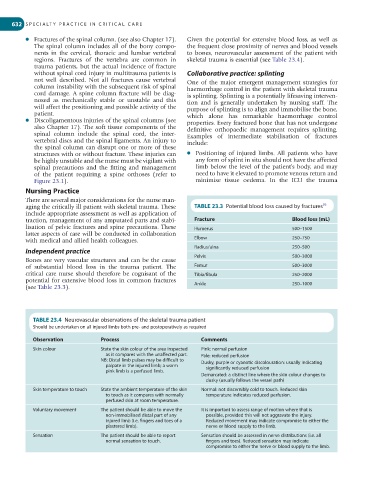
            regions.  Fractures  of  the  vertebra  are  common  in   skeletal trauma is essential (see Table 23.4).
            trauma patients, but the actual incidence of fracture
            without spinal cord injury in multitrauma patients is   Collaborative practice: splinting
            not  well  described.  Not  all  fractures  cause  vertebral   One  of  the  major  emergent  management  strategies  for
            column instability with the subsequent risk of spinal   haemorrhage control in the patient with skeletal trauma
            cord  damage.  A  spine  column  fracture  will  be  diag-  is splinting. Splinting is a potentially lifesaving interven-
            nosed  as  mechanically  stable  or  unstable  and  this     tion  and  is  generally  undertaken  by  nursing  staff.  The
            will affect the positioning and possible activity of the   purpose of splinting is to align and immobilise the bone,
            patient.                                          which  alone  has  remarkable  haemorrhage  control
         l  Discoligamentous injuries of the spinal columns (see   properties. Every fractured bone that has not undergone
            also Chapter 17). The soft tissue components of the   definitive  orthopaedic  management  requires  splinting.
            spinal  column  include  the  spinal  cord,  the  inter-  Examples  of  intermediate  stabilisation  of  fractures
            vertebral discs and the spinal ligaments. An injury to   include:
            the spinal column can disrupt one or more of these
            structures with or without fracture. These injuries can   l  Positioning  of  injured  limbs.  All  patients  who  have
            be highly unstable and the nurse must be vigilant with   any form of splint in situ should not have the affected
            spinal  precautions  and  the  fitting  and  management     limb below the level of the patient’s body, and may
            of  the  patient  requiring  a  spine  orthoses  (refer  to   need to have it elevated to promote venous return and
            Figure 23.1).                                        minimise  tissue  oedema.  In  the  ICU  the  trauma
         Nursing Practice
         There are several major considerations for the nurse man-
         aging the critically ill patient with skeletal trauma. These   TABLE 23.3  Potential blood loss caused by fractures 76
         include appropriate assessment as well as application of
         traction, management of any amputated parts and stabi-  Fracture                        Blood loss (mL)
         lisation of pelvic fractures and spine precautions. These   Humerus                     500–1500
         latter aspects of care will be conducted in collaboration
         with medical and allied health colleagues.              Elbow                           250–750
                                                                 Radius/ulna                     250–500
         Independent practice
                                                                 Pelvis                          500–3000
         Bones are very vascular structures and can be the cause
         of  substantial  blood  loss  in  the  trauma  patient.  The     Femur                  500–3000
         critical  care  nurse  should  therefore  be  cognisant  of  the   Tibia/fibula         250–2000
         potential for extensive blood loss in common fractures
         (see Table 23.3).                                       Ankle                           250–1000


            TABLE 23.4  Neurovascular observations of the skeletal trauma patient
            Should be undertaken on all injured limbs both pre- and postoperatively as required
            Observation           Process                          Comments
            Skin colour           State the skin colour of the area inspected   Pink: normal perfusion
                                    as it compares with the unaffected part.   Pale: reduced perfusion
                                  NB: Distal limb pulses may be difficult to   Dusky, purple or cyanotic discolouration: usually indicating
                                    palpate in the injured limb; a warm   significantly reduced perfusion
                                    pink limb is a perfused limb.
                                                                   Demarcated: a distinct line where the skin colour changes to
                                                                    dusky (usually follows the vessel path)
            Skin temperature to touch  State the ambient temperature of the skin   Normal: not discernibly cold to touch. Reduced skin
                                    to touch as it compares with normally   temperature indicates reduced perfusion.
                                    perfused skin at room temperature.
            Voluntary movement    The patient should be able to move the   It is important to assess range of motion where that is
                                    non-immobilised distal part of any   possible, provided this will not aggravate the injury.
                                    injured limb (i.e. fingers and toes of a   Reduced movement may indicate compromise to either the
                                    plastered limb).                nerve or blood supply to the limb.
            Sensation             The patient should be able to report   Sensation should be assessed in nerve distributions (i.e. all
                                    normal sensation to touch.      fingers and toes). Reduced sensation may indicate
                                                                    compromise to either the nerve or blood supply to the limb.

