


Page 660 - ACCCN's Critical Care Nursing
P. 660
Trauma Management 637


               TABLE 23.6  Clinical manifestations of chest trauma

               System                Manifestation                       Clinical signs and symptoms
               Respiratory           Any sign of respiratory compromise, noting   Abnormal respiratory rate (<12 or >20 breaths/min)
               l  Airways             that serial observations are an important   Abnormal chest wall movement, including asymmetrical
               l  Lungs               indicator of imminent decompensation  chest wall expansion
               l  Diaphragm                                              Reduced breath sounds
                                                                         Obstructed airway
                                                                         Hypoxia (<94%)
                                                                         Hypercarbia
                                                                         Apnoea
                                                                         Dyspnoea
                                                                         Orthopnoea
                                                                         Crepitus/surgical emphysema
               Cardiovascular        Circulatory insufficiency resulting in decreased   Abnormal heart rate (<60 or >100 beats/min)
               l  Heart               tissue perfusion                   Dysrhythmia
               l  Great vessels                                          In severe cases, Pulseless Electrical Activity (see Ch. 8)
                                                                         Pulsus alternans
                                                                         Decreased cardiac output
                                                                         Lowered blood pressure (systolic <100 mm Hg)
                                                                         Reduced peripheral perfusion
                                                                         Confusion and reduced consciousness level
               Gastrointestinal      Perforation and contamination of mediastinum  Crepitus
               l  Oesophageal rupture                                    Haemopneumothorax
                                                                         Pain
                                                                         Cough
                                                                         Stridor
                                                                         Bleeding
                                                                         Sepsis (late)
               Systemic              May occur in response to injury of a vessel that   Varied depending on location, but may include:
               l  Air embolism        traverses an air space; manifestations will   l  Focal neurological sign
                                      vary depending on location and associated   l  Cardiac deterioration
                                      injuries


                                                                  Independent practice: positioning
                                                                  Early  mobilisation  of  the  patient  with  chest  trauma  is
                                                                  vital to prevent the complications of prolonged bedrest
                                                                  and  immobility.  Patients  should  be  nursed  side-to-side
                                                                  and  in  a  variety  of  positions,  including  sitting  upright.
                                                                  The  extent  to  which  the  patient  can  be  mobilised  is
                                                                  dependent on other injuries. Patients should be mobil-
                                                                  ised to sit out of bed as soon as they are conscious and
                                                                  their injuries permit.
                                                                  Care must be taken to accommodate the increased work
                                                                  of breathing that is associated with injuries to the lungs.
                                                                  Appropriate  use  of  supplemental  oxygen  will  assist  the
                                                                  patient’s  exercise  tolerance.  Further,  if  the  patient  is
                                                                  mechanically ventilated, additional mechanical support
                                                                  (i.e.  transient  increase  in  pressure  support)  may  be
                                                                  applied  to  assist  the  patient’s  exercise  tolerance.  Being
                                                                  unable to catch their breath is a terrifying experience that
                                                                  is likely to result in increased levels of anxiety for patients,
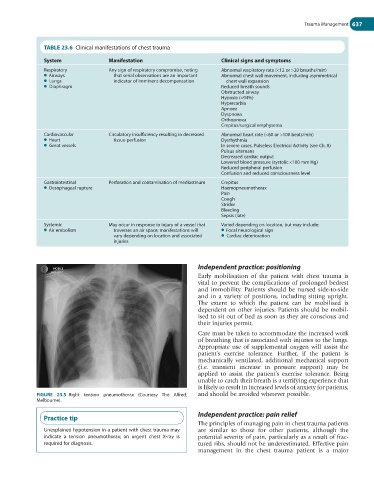
             FIGURE  23.5  Right  tension  pneumothorax  (Courtesy  The  Alfred,   and should be avoided wherever possible.
             Melbourne).

                                                                  Independent practice: pain relief
               Practice tip
                                                                  The principles of managing pain in chest trauma patients
               Unexplained hypotension in a patient with chest trauma may   are  similar  to  those  for  other  patients,  although  the
               indicate  a  tension  pneumothorax;  an  urgent  chest  X-ray  is   potential severity of pain, particularly as a result of frac-
               required for diagnosis.                            tured ribs, should not be underestimated. Effective pain
                                                                  management  in  the  chest  trauma  patient  is  a  major

