


Page 658 - ACCCN's Critical Care Nursing
P. 658
Trauma Management 635


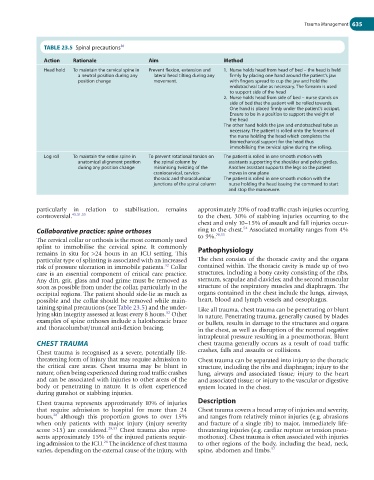
               TABLE 23.5  Spinal precautions 56

               Action    Rationale                Aim                     Method
               Head hold  To maintain the cervical spine in   Prevent flexion, extension and   1.  Nurse holds head from head of bed – the head is held
                           a neutral position during any   lateral head tilting during any   firmly by placing one hand around the patient's jaw
                           position change         movement.                with fingers spread to cup the jaw and hold the
                                                                            endotracheal tube as necessary. The forearm is used
                                                                            to support side of the head
                                                                          2.  Nurse holds head from side of bed – nurse stands on
                                                                            side of bed that the patient will be rolled towards.
                                                                            One hand is placed firmly under the patient's occiput.
                                                                            Ensure to be in a position to support the weight of
                                                                            the head
                                                                          The other hand holds the jaw and endotracheal tube as
                                                                            necessary. The patient is rolled onto the forearm of
                                                                            the nurse holding the head which completes the
                                                                            biomechanical support for the head thus
                                                                            immobilising the cervical spine during the rolling.
               Log roll  To maintain the entire spine in   To prevent rotational torsion on   The patient is rolled in one smooth motion with
                           anatomical alignment position   the spinal column by   assistants supporting the shoulder and pelvic girdles.
                           during any position change  minimising twisting of the   Another assistant supports the legs so the patient
                                                   craniocervical, cervico-  moves in one plane
                                                   thoracic and thoracolumbar   The patient is rolled in one smooth motion with the
                                                   junctions of the spinal column  nurse holding the head issuing the command to start
                                                                            and stop the manoeuvre.


             particularly  in  relation  to  stabilisation,  remains   approximately 20% of road traffic crash injuries occurring
             controversial. 45,51,55                              to  the  chest,  30%  of  stabbing  injuries  occurring  to  the
                                                                  chest and only 10–15% of assault and fall injuries occur-
                                                                                 54
             Collaborative practice: spine orthoses               ring to the chest.  Associated mortality ranges from 4%
                                                                        28,55
             The cervical collar or orthosis is the most commonly used   to 9%.
             splint  to  immobilise  the  cervical  spine.  It  commonly   Pathophysiology
             remains  in  situ  for  >24  hours  in  an  ICU  setting.  This
             particular type of splinting is associated with an increased   The chest consists of the thoracic cavity and the organs
                                                       32
             risk of pressure ulceration in immobile patients.  Collar   contained within. The thoracic cavity is made up of two
             care  is  an  essential  component  of  critical  care  practice.   structures, including a bony cavity consisting of the ribs,
             Any dirt, grit, glass and road grime must be removed as   sternum, scapulae and clavicles; and the second muscular
             soon as possible from under the collar, particularly in the   structure of the respiratory muscles and diaphragm. The
             occipital regions. The patient should side-lie as much as   organs contained in the chest include the lungs, airways,
             possible and the collar should be removed while main-  heart, blood and lymph vessels and oesophagus.
             taining spinal precautions (see Table 23.5) and the under-  Like all trauma, chest trauma can be penetrating or blunt
                                                       52
             lying skin integrity assessed at least every 8 hours.  Other   in nature. Penetrating trauma, generally caused by blades
             examples of spine orthoses include a halothoracic brace   or bullets, results in damage to the structures and organs
             and thoracolumbar/truncal anti-flexion bracing.      in the chest, as well as disruption of the normal negative
                                                                  intrapleural pressure resulting in a pneumothorax. Blunt
             CHEST TRAUMA                                         chest trauma generally occurs as a result of road traffic
             Chest trauma is recognised as a severe, potentially life-  crashes, falls and assaults or collisions.
             threatening form of injury that may require admission to   Chest trauma can be separated into injury to the thoracic
             the  critical  care  areas.  Chest  trauma  may  be  blunt  in   structure, including the ribs and diaphragm; injury to the
             nature, often being experienced during road traffic crashes   lung,  airways  and  associated  tissue;  injury  to  the  heart
             and can be associated with injuries to other areas of the   and associated tissue; or injury to the vascular or digestive
             body  or  penetrating  in  nature.  It  is  often  experienced   system located in the chest.
             during gunshot or stabbing injuries.

             Chest trauma represents approximately 10% of injuries   Description
             that  require  admission  to  hospital  for  more  than  24   Chest trauma covers a broad array of injuries and severity,
                  28
             hours,   although  this  proportion  grows  to  over  15%   and ranges from relatively minor injuries (e.g. abrasions
             when  only  patients  with  major  injury  (injury  severity   and fracture of a single rib) to major, immediately life-
             score >15) are considered. 28,53  Chest trauma also repre-  threatening injuries (e.g. cardiac rupture or tension pneu-
             sents approximately 15% of the injured patients requir-  mothorax). Chest trauma is often associated with injuries
                                   28
             ing admission to the ICU.  The incidence of chest trauma   to other regions of the body, including the head, neck,
             varies, depending on the external cause of the injury, with   spine, abdomen and limbs. 57

