


Page 662 - ACCCN's Critical Care Nursing
P. 662
Trauma Management 639

                                                                  financial  and  social  problems.  Early  referral  of  selected
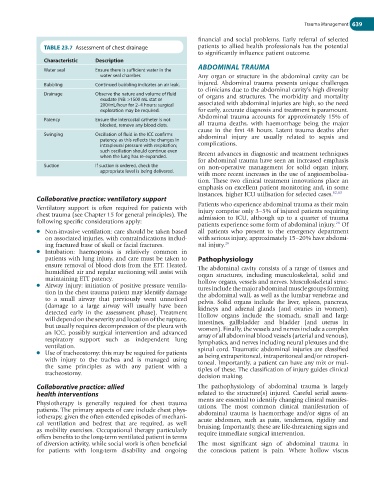
               TABLE 23.7  Assessment of chest drainage           patients to allied health professionals has the potential
                                                                  to significantly influence patient outcome.
               Characteristic   Description
                                                                  ABDOMINAL TRAUMA
               Water seal       Ensure there is sufficient water in the
                                  water seal chamber.             Any  organ  or  structure  in  the  abdominal  cavity  can  be
               Bubbling         Continued bubbling indicates an air leak.  injured.  Abdominal  trauma  presents  unique  challenges
                                                                  to clinicians due to the abdominal cavity’s high diversity
               Drainage         Observe the nature and volume of fluid   of  organs  and  structures.  The  morbidity  and  mortality
                                  exudate (NB: >1500 mL stat or
                                  200/mL/hour for 2–4 hours; surgical   associated with abdominal injuries are high, so the need
                                  exploration may be required.    for early, accurate diagnosis and treatment is paramount.
                                                                  Abdominal  trauma  accounts  for  approximately  15%  of
               Patency          Ensure the intercostal catheter is not
                                  blocked, remove any blood clots.  all  trauma  deaths,  with  haemorrhage  being  the  major
                                                                  cause  in  the  first  48  hours.  Latent  trauma  deaths  after
               Swinging         Oscillation of fluid in the ICC confirms   abdominal  injury  are  usually  related  to  sepsis  and
                                  patency, as this reflects the changes in
                                  intrapleural pressure with respiration;   complications.
                                  such oscillation should continue even   Recent advances in diagnostic and treatment techniques
                                  when the lung has re-expanded.
                                                                  for abdominal trauma have seen an increased emphasis
               Suction          If suction is ordered, check the   on  non-operative  management  for  solid  organ  injury,
                                  appropriate level is being delivered.
                                                                  with more recent increases in the use of angioembolisa-
                                                                  tion. These two clinical treatment innovations place an
                                                                  emphasis on excellent patient monitoring and, in some
                                                                  instances, higher ICU utilisation for selected cases. 62,63
             Collaborative practice: ventilatory support
             Ventilatory  support  is  often  required  for  patients  with   Patients who experience abdominal trauma as their main
             chest trauma (see Chapter 15 for general principles). The   injury comprise only 3–5% of injured patients requiring
             following specific considerations apply:             admission to  ICU,  although up  to a  quarter of  trauma
                                                                                                               28
                                                                  patients experience some form of abdominal injury.  Of
             l  Non-invasive ventilation: care should be taken based   all  patients  who  present  to  the  emergency  department
                on associated injuries, with contraindications includ-  with serious injury, approximately 15–20% have abdomi-
                ing fractured base of skull or facial fractures.  nal injury. 26
             l  Intubation:  haemoptosis  is  relatively  common  in
                patients with lung injury, and care must be taken to   Pathophysiology
                ensure removal of blood clots from the ETT. Heated,   The abdominal cavity consists of a range of tissues and
                humidified air and regular suctioning will assist with   organ  structures,  including  musculoskeletal,  solid  and
                maintaining ETT patency.                          hollow organs, vessels and nerves. Musculoskeletal struc-
             l  Airway injury: initiation of positive pressure ventila-  tures include the major abdominal muscle groups forming
                tion in the chest trauma patient may identify damage   the abdominal wall, as well as the lumbar vertebrae and
                to  a  small  airway  that  previously  went  unnoticed   pelvis.  Solid  organs  include  the  liver,  spleen,  pancreas,
                (damage  to  a  large  airway  will  usually  have  been   kidneys  and  adrenal  glands  (and  ovaries  in  women).
                detected  early  in  the  assessment  phase).  Treatment   Hollow  organs  include  the  stomach,  small  and  large
                will depend on the severity and location of the rupture,   intestines,  gallbladder  and  bladder  (and  uterus  in
                but usually requires decompression of the pleura with   women). Finally, the vessels and nerves include a complex
                an ICC, possibly surgical intervention and advanced   array of all abdominal blood vessels (arterial and venous),
                respiratory  support  such  as  independent  lung   lymphatics, and nerves including neural plexuses and the
                ventilation.                                      spinal cord. Traumatic abdominal injuries are classified
             l  Use of tracheostomy: this may be required for patients   as being extraperitoneal, intraperitoneal and/or retroperi-
                with  injury  to  the  trachea  and  is  managed  using    toneal. Importantly, a patient can have any mix or mul-
                the  same  principles  as  with  any  patient  with  a   tiples of these. The classification of injury guides clinical
                tracheostomy.
                                                                  decision making.
             Collaborative practice: allied                       The  pathophysiology  of  abdominal  trauma  is  largely
             health interventions                                 related to the structure(s) injured. Careful serial assess-

             Physiotherapy  is  generally  required  for  chest  trauma   ments are essential to identify changing clinical manifes-
                                                                  tations.  The  most  common  clinical  manifestation  of
             patients. The primary aspects of care include chest phys-  abdominal  trauma  is  haemorrhage  and/or  signs  of  an
             iotherapy, given the often extended episodes of mechani-  acute  abdomen,  such  as  pain,  tenderness,  rigidity  and
             cal  ventilation  and  bedrest  that  are  required,  as  well    bruising. Importantly, these are life-threatening signs and
             as  mobility  exercises.  Occupational  therapy  particularly   require immediate surgical intervention.
             offers benefits to the long-term ventilated patient in terms
             of diversion activity, while social work is often beneficial   The  most  significant  sign  of  abdominal  trauma  in
             for  patients  with  long-term  disability  and  ongoing   the  conscious  patient  is  pain.  Where  hollow  viscus

