


Page 685 - ACCCN's Critical Care Nursing
P. 685
662  S P E C I A LT Y   P R A C T I C E   I N   C R I T I C A L   C A R E


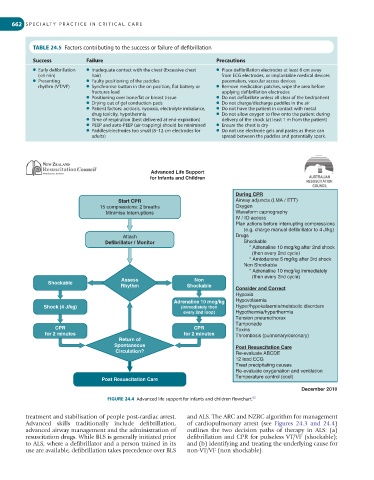
            TABLE 24.5  Factors contributing to the success or failure of defibrillation

            Success          Failure                                    Precautions
            l  Early defibrillation   l  Inadequate contact with the chest (Excessive chest   l  Place defibrillation electrodes at least 8 cm away
              (<4 min)         hair)                                      from ECG electrodes, or implantable medical devices
            l  Presenting    l  Faulty positioning of the paddles         pacemakers, vascular access devices
              rhythm (VT/VF)  l  Synchronise button in the on position, flat battery or   l  Remove medication patches, wipe the area before
                               fractures lead                             applying defibrillation electrodes
                             l  Positioning over bone/fat or breast tissue  l  Do not defibrillate unless all clear of the bed/patient
                             l  Drying out of gel conduction pads       l  Do not charge/discharge paddles in the air
                             l  Patient factors: acidosis, hypoxia, electrolyte imbalance,   l  Do not have the patient in contact with metal
                               drug toxicity, hypothermia               l  Do not allow oxygen to flow onto the patient during
                             l  Time of respiration (best delivered at end-expiration)  delivery of the shock (at least 1 m from the patient)
                             l  PEEP and auto-PEEP (air-trapping) should be minimised  l  Ensure the chest is dry
                             l  Paddles/electrodes too small (8–12 cm electrodes for   l  Do not use electrode gels and pastes as these can
                               adults)                                    spread between the paddles and potentially spark.


                                                  Advanced Life Support
                                                  for Infants and Children

                                                                              During CPR
                                        Start CPR                             Airway adjuncts (LMA / ETT)
                                  15 compressions: 2 breaths                  Oxygen
                                    Minimise Interruptions                    Waveform capnography
                                                                              IV / IO access
                                                                              Plan actions before interrupting compressions
                                                                                    (e.g. charge manual defibrillator to 4 J/kg)
                                         Attach                               Drugs
                                   Defibrillator / Monitor                          Shockable
                                                                                        * Adrenaline 10 mcg/kg after 2nd shock
                                                                                          (then every 2nd cycle)
                                                                                        * Amiodarone 5 mg/kg after 3rd shock
                                                                                    Non Shockable
                                                                                        * Adrenaline 10 mcg/kg immediately
                                                                                          (then every 2nd cycle)
                                         Assess                  Non
                 Shockable
                                         Rhythm               Shockable       Consider and Correct
                                                                              Hypoxia
                                                          Adrenaline 10 mcg/kg  Hypovolaemia
               Shock (4 J/kg)                               (immediately then  Hyper/hypokalaemia/metabolic disorders
                                                             every 2nd loop)  Hypothermia/hyperthermia
                                                                              Tension pneumothorax
                                                                              Tamponade
                   CPR                                          CPR           Toxins
                for 2 minutes                                for 2 minutes    Thrombosis (pulmonary/coronary)
                                        Return of
                                      Spontaneous                             Post Resuscitation Care
                                       Circulation?                           Re-evaluate ABCDE
                                                                              12 lead ECG
                                                                              Treat precipitating causes
                                                                              Re-evaluate oxygenation and ventilation
                                                                              Temperature control (cool)
                                  Post Resuscitation Care
                                                                                                    December 2010
                                                                                    62
                                    FIGURE 24.4  Advanced life support for infants and children flowchart.
         treatment and stabilisation of people post-cardiac arrest.   and ALS. The ARC and NZRC algorithm for management
         Advanced  skills  traditionally  include  defibrillation,   of  cardiopulmonary  arrest  (see  Figures  24.3  and  24.4)
         advanced airway management and the administration of   outlines  the  two  decision  paths  of  therapy  in  ALS:  (a)
         resuscitation drugs. While BLS is generally initiated prior   defibrillation and CPR for pulseless VT/VF (shockable);
         to ALS, where a defibrillator and a person trained in its   and (b) identifying and treating the underlying cause for
         use are available, defibrillation takes precedence over BLS   non-VT/VF (non shockable).

