


Page 687 - ACCCN's Critical Care Nursing
P. 687
664  S P E C I A LT Y   P R A C T I C E   I N   C R I T I C A L   C A R E


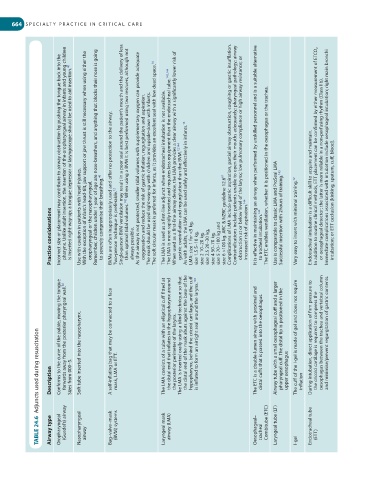
                  Practice considerations Incorrect size or placement may contribute to airway obstruction by pushing the tongue back into the  pharynx. Unlike adult insertion, the insertion of the oropharyngeal airway in infants and young children  is inserted right-way-up; a tongue depressor or laryngoscope should be used to aid insertion. 40 Use with caution in patients with head injuries. With the exception of infant’s head-tilt, jaw support or jaw thrust is still necessary when


              Adjuncts used during resuscitation  Description Conforms to the curve of the palate, moving the tongue  forwards away from the posterior pharyngeal wall. 40  Sizes from 000–5. Soft tube inserted into the nasopharynx.  A self-inflating bag that may be connected to a face   mask, LMA or ETT.  The LMA consists of a tube with an elliptical cuff fitted at  the distal end that inflates in the hypopharynx around  the posterior perimeter of the larynx. The LMA is inserted orall


              TABLE 24.6   Airway type  Oropharyngeal   (Guedel’s) airway  Nasopharyngeal   airway  Bag–valve–mask   (BVM) systems  Laryngeal mask   airway (LMA)  Oesophageal–  tracheal   Combitube (ETC)  Laryngeal tube (LT)  I-gel  Endotracheal tube   (ETT)

