


Page 688 - ACCCN's Critical Care Nursing
P. 688
Resuscitation 665


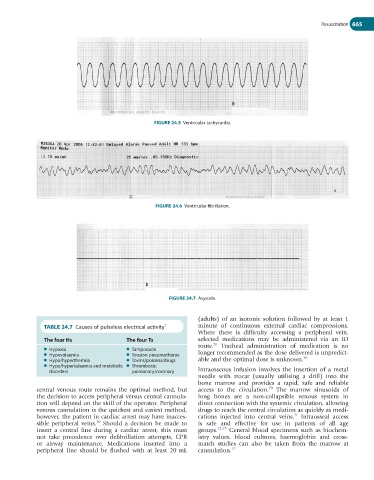
                                                   FIGURE 24.5  Ventricular tachycardia.


                                                    FIGURE 24.6  Ventricular fibrillation.


                                                        FIGURE 24.7  Asystole.


                                                                  (adults)  of  an  isotonic  solution  followed  by  at  least  1
               TABLE 24.7  Causes of pulseless electrical activity 7  minute  of  continuous  external  cardiac  compressions.
                                                                  Where  there  is  difficulty  accessing  a  peripheral  vein,
               The four Hs                The four Ts             selected  medications  may  be  administered  via  an  IO
                                                                       20
                                                                  route.   Tracheal  administration  of  medication  is  no
               l  Hypoxia                 l  Tamponade
               l  Hypovolaemia            l  Tension pneumothorax  longer recommended as the dose delivered is unpredict-
               l  Hypo/hyperthermia       l  Toxins/poisons/drugs  able and the optimal dose is unknown. 20
               l  Hypo/hyperkalaemia and metabolic  l  Thrombosis:
                 disorders                  pulmonary/coronary    Intraosseous  infusion  involves  the  insertion  of  a  metal
                                                                  needle  with  trocar  (usually  utilising  a  drill)  into  the
                                                                  bone  marrow  and  provides  a  rapid,  safe  and  reliable
                                                                                         70
             central  venous  route  remains  the  optimal  method,  but   access  to  the  circulation.   The  marrow  sinusoids  of
             the decision to access peripheral versus central cannula-  long  bones  are  a  non-collapsible  venous  system  in
             tion will depend on the skill of the operator. Peripheral   direct connection with the systemic circulation, allowing
             venous cannulation is the quickest and easiest method,   drugs to reach the central circulation as quickly as medi-
                                                                                                 71
             however, the patient in cardiac arrest may have inacces-  cations  injected  into  central  veins.   Intraosseal  access
                                 20
             sible  peripheral  veins.   Should  a  decision  be  made  to   is  safe  and  effective  for  use  in  patients  of  all  age
             insert  a  central  line  during  a  cardiac  arrest,  this  must     groups. 72,73   General  blood  specimens  such  as  biochem-
             not  take  precedence  over  defibrillation  attempts,  CPR     istry  values,  blood  cultures,  haemoglobin  and  cross-
             or  airway  maintenance.  Medications  inserted  into  a   match  studies  can  also  be  taken  from  the  marrow  at
             peripheral  line  should  be  flushed  with  at  least  20 mL   cannulation. 17

