


Page 711 - ACCCN's Critical Care Nursing
P. 711
688  S P E C I A LT Y   P R A C T I C E   I N   C R I T I C A L   C A R E


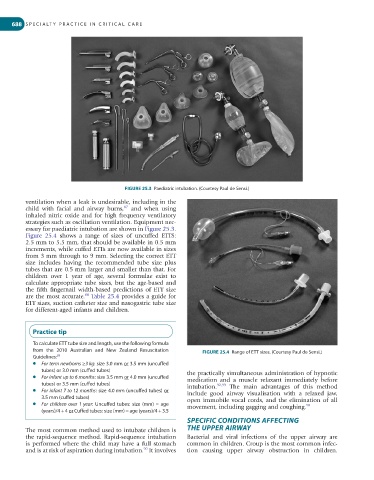
                                          FIGURE 25.3  Paediatric intubation. (Courtesy Paul de Sensi.)
         ventilation when a leak is undesirable, including in the
                                          87
         child  with  facial  and  airway  burns,   and  when  using
         inhaled  nitric  oxide  and  for  high  frequency  ventilatory
         strategies such as oscillation ventilation. Equipment nec-
         essary for paediatric intubation are shown in Figure 25.3.
         Figure  25.4  shows  a  range  of  sizes  of  uncuffed  ETTS:
         2.5 mm to 5.5 mm, that should be available in 0.5 mm
         increments, while cuffed ETTs are now available in sizes
         from 3 mm through to 9 mm. Selecting the correct ETT
         size  includes  having  the  recommended  tube  size  plus
         tubes that are 0.5 mm larger and smaller than that. For
         children  over  1  year  of  age,  several  formulae  exist  to
         calculate  appropriate  tube  sizes,  but  the  age-based  and
         the  fifth  fingernail  width-based  predictions  of  ETT  size
                             88
         are the most accurate.  Table 25.4 provides a guide for
         ETT sizes, suction catheter size and nasogastric tube size
         for different-aged infants and children.


            Practice tip
            To calculate ETT tube size and length, use the following formula
            from  the  2010  Australian  and  New  Zealand  Resuscitation   FIGURE 25.4  Range of ETT sizes. (Courtesy Paul de Sensi.)
            Guidelines: 89
            l  For term newborns ≥3 kg: size 3.0 mm or 3.5 mm (uncuffed
               tubes) or 3.0 mm (cuffed tubes)                the practically simultaneous administration of hypnotic
            l  For infant up to 6 months: size 3.5 mm or 4.0 mm (uncuffed   medication  and  a  muscle  relaxant  immediately  before
               tubes) or 3.5 mm (cuffed tubes)                intubation. 92,93   The  main  advantages  of  this  method
            l  For infant 7 to 12 months: size 4.0 mm (uncuffed tubes) or   include  good  airway  visualisation  with  a  relaxed  jaw,
               3.5 mm (cuffed tubes)                          open immobile vocal cords, and the elimination of all
            l  For children over 1 year:  Uncuffed  tubes:  size  (mm)  =  age   movement, including gagging and coughing. 90
               (years)/4 + 4 or Cuffed tubes: size (mm) = age (years)/4 + 3.5
                                                              SPECIFIC CONDITIONS AFFECTING
         The most common method used to intubate children is   THE UPPER AIRWAY
         the  rapid-sequence  method.  Rapid-sequence  intubation   Bacterial  and  viral  infections  of  the  upper  airway  are
         is  performed  where  the  child  may  have  a  full  stomach   common in children. Croup is the most common infec-
                                                90
         and is at risk of aspiration during intubation.  It involves   tion  causing  upper  airway  obstruction  in  children.

