


Page 712 - ACCCN's Critical Care Nursing
P. 712
Paediatric Considerations in Critical Care  689


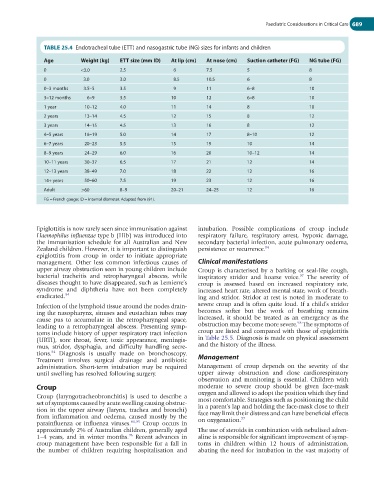
               TABLE 25.4  Endotracheal tube (ETT) and nasogastric tube (NG) sizes for infants and children

               Age          Weight (kg)  ETT size (mm ID)  At lip (cm)  At nose (cm)  Suction catheter (FG)  NG tube (FG)
               0            <3.0        2.5               6          7.5          5                   8
               0            3.0         3.0               8.5        10.5         6                   8
               0–3 months   3.5–5       3.5               9          11           6–8                 10
               3–12 months    6–9       3.5              10          12           6–8                 10
               1 year        10–12      4.0              11          14           8                   10
               2 years       13–14      4.5              12          15           8                   12
               3 years       14–15      4.5              13          16           8                   12
               4–5 years     16–19      5.0              14          17           8–10                12
               6–7 years     20–23      5.5              15          19           10                  14
               8–9 years     24–29      6.0              16          20           10–12               14
               10–11 years   30–37      6.5              17         21            12                  14
               12–13 years   38–49      7.0              18         22            12                  16
               14+ years     50–60      7.5              19         23            12                  16
               Adult        >60         8–9              20–21      24–25         12                  16
               FG = French gauge; ID = internal diameter. Adapted from (91).


             Epiglottitis is now rarely seen since immunisation against   intubation.  Possible  complications  of  croup  include
             Haemophilus influenzae type b (Hib) was introduced into   respiratory  failure,  respiratory  arrest,  hypoxic  damage,
             the  immunisation  schedule  for  all  Australian  and  New   secondary bacterial infection, acute pulmonary oedema,
             Zealand children. However, it is important to distinguish   persistence or recurrence. 84
             epiglottitis  from  croup  in  order  to  initiate  appropriate
             management.  Other  less  common  infectious  causes  of   Clinical manifestations
             upper airway obstruction seen in young children include   Croup  is  characterised  by  a  barking  or  seal-like  cough,
             bacterial  tracheitis  and  retropharyngeal  abscess,  while   inspiratory  stridor  and  hoarse  voice.   The  severity  of
                                                                                                   97
             diseases thought to have disappeared, such as Lemierre’s   croup  is  assessed  based  on  increased  respiratory  rate,
             syndrome  and  diphtheria  have  not  been  completely   increased heart rate, altered mental state, work of breath-
             eradicated. 94                                       ing  and  stridor.  Stridor  at  rest  is  noted  in  moderate  to
             Infection of the lymphoid tissue around the nodes drain-  severe croup and is often quite loud. If a child’s stridor
             ing the nasopharynx, sinuses and eustachian tubes may   becomes  softer  but  the  work  of  breathing  remains
             cause  pus  to  accumulate  in  the  retropharyngeal  space,   increased,  it  should  be  treated  as  an  emergency  as  the
                                                                                                  98
             leading  to  a  retropharyngeal  abscess.  Presenting  symp-  obstruction may become more severe.  The symptoms of
             toms include history of upper respiratory tract infection   croup are listed and compared with those of epiglottitis
             (URTI),  sore  throat,  fever,  toxic  appearance,  meningis-  in Table 25.5. Diagnosis is made on physical assessment
             mus,  stridor,  dysphagia,  and  difficulty  handling  secre-  and the history of the illness.
                  94
             tions.   Diagnosis  is  usually  made  on  bronchoscopy.
             Treatment  involves  surgical  drainage  and  antibiotic   Management
             administration.  Short-term  intubation  may  be  required   Management  of  croup  depends  on  the  severity  of  the
             until swelling has resolved following surgery.       upper  airway  obstruction  and  close  cardiorespiratory
                                                                  observation  and  monitoring  is  essential.  Children  with
             Croup                                                moderate  to  severe  croup  should  be  given  face-mask
             Croup  (laryngotracheobronchitis)  is  used  to  describe  a   oxygen and allowed to adopt the position which they find
                                                                  most comfortable. Strategies such as positioning the child
             set of symptoms caused by acute swelling causing obstruc-  in a parent’s lap and holding the face-mask close to their
             tion  in  the  upper  airway  (larynx,  trachea  and  bronchi)   face may limit their distress and can have beneficial effects
             from  inflammation  and  oedema,  caused  mostly  by  the   on oxygenation. 97
             parainfluenza  or  influenza  viruses. 84,95   Croup  occurs  in
             approximately 2% of Australian children, generally aged   The use of steroids in combination with nebulised adren-
                                           96
             1–4  years,  and  in  winter  months.   Recent  advances  in   aline is responsible for significant improvement of symp-
             croup  management  have  been  responsible  for  a  fall  in     toms  in  children  within  12  hours  of  administration,
             the  number  of  children  requiring  hospitalisation  and   abating the need for intubation in the vast majority of

