


Page 715 - ACCCN's Critical Care Nursing
P. 715
692  S P E C I A LT Y   P R A C T I C E   I N   C R I T I C A L   C A R E

         Asthma                                               increasing, 126  is higher in boys 129,130  and in urban areas,
         Asthma is a disease of the lower respiratory tract charac-  but its mortality has declined over the past two decades,
                                                                                                  126
         terised  by  mucosal  and  immune  system  dysfunction.   from 1–2/100,000 down to 0.8/100,000.
         There  is  a  complex  interaction  between  bronchial  wall
         cells,  inflammatory  mediators  and  the  nervous  system.   Clinical manifestations
         The  chronic  inflammatory  process  causes  narrowing  of   ICU  admission  is  required  when  children  present  with
         bronchial airways, thus obstructing airflow. This leads to   respiratory failure due to an asthma exacerbation. Obesity
         episodes of wheezing, breathlessness and chest tighten-  and genetic predisposition may be important in reacting
         ing that are usually reversible. 106                 to  β 2 -agonist  therapy.   These  children  exhibit  clinical
                                                                                 131
         Development of childhood asthma results from a com-  features associated with respiratory distress. Pulsus para-
         bination  of  genetic,  environmental  and  socioeconomic   doxus, a phenomenon of palpable changes in blood pres-
         risk  factors. 118-122   Increasing  prevalence  of  asthma  over   sure that occur with respirations, may also be present and
         the  past  20–30  years  may  be  linked  to  a  higher  inci-  can also be noted on plethysmography. Arterial blood gas
         dence  of  genetic  predisposition,  independent  of  envi-  analysis usually reveals initially a mild respiratory alka-
         ronmental  factors.  Some  studies  have  identified  links   losis and hypoxaemia; however, more severe asthma may
         between  asthma  and  various  regions  of  the  human   show combined respiratory and metabolic acidosis and
         genome, but the linkages are not consistent. The CD14   hypercapnia as the child tires and is unable to eliminate
                                                                            133
         gene shows the best promise of linkage, with increased   carbon dioxide.
         expression  or  promotion  of  this  gene  associated  with
                                                 123
         atopy and asthma in early to late childhood.  Certain   Assessment and management
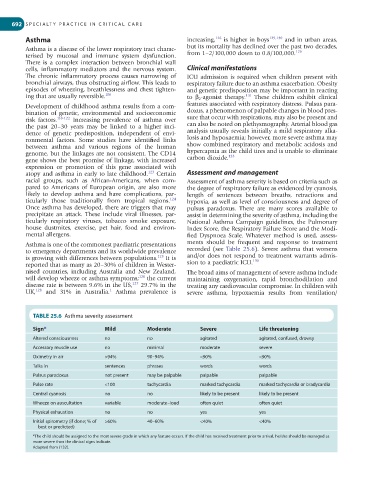
         racial  groups,  such  as  African-Americans,  when  com-  Assessment of asthma severity is based on criteria such as
         pared  to  Americans  of  European  origin,  are  also  more   the degree of respiratory failure as evidenced by cyanosis,
         likely  to  develop  asthma  and  have  complications,  par-  length  of  sentences  between  breaths,  retractions  and
         ticularly  those  traditionally  from  tropical  regions. 124    hypoxia, as well as level of consciousness and degree of
         Once asthma has developed, there are triggers that may   pulsus  paradoxus.  There  are  many  scores  available  to
         precipitate  an  attack.  These  include  viral  illnesses,  par-  assist in determining the severity of asthma, including the
         ticularly  respiratory  viruses,  tobacco  smoke  exposure,   National  Asthma  Campaign  guidelines,  the  Pulmonary
         house  dustmites,  exercise,  pet  hair,  food  and  environ-  Index Score, the Respiratory Failure Score and the Modi-
         mental allergens.                                    fied  Dyspnoea  Scale.  Whatever  method  is  used,  assess-
         Asthma is one of the commonest paediatric presentations   ments  should  be  frequent  and  response  to  treatment
         to emergency departments and its worldwide prevalence   recorded  (see  Table  25.6).  Severe  asthma  that  worsens
                                                     125
         is growing with differences between populations.  It is   and/or  does  not  respond  to  treatment  warrants  admis-
                                                                                    130
         reported that as many as 20–30% of children in Wester-  sion to a paediatric ICU.
         nised  countries,  including  Australia  and  New  Zealand,   The broad aims of management of severe asthma include
         will develop wheeze or asthma symptoms; 126  the current   maintaining  oxygenation,  rapid  bronchodilation  and
         disease rate is between 9.6% in the US, 127  29.7% in the   treating any cardiovascular compromise. In children with
         UK, 128   and  31%  in  Australia.   Asthma  prevalence  is   severe  asthma,  hypoxaemia  results  from  ventilation/
                                     1


            TABLE 25.6  Asthma severity assessment
            Sign*                  Mild          Moderate          Severe             Life threatening
            Altered consciousness  no            no                agitated           agitated, confused, drowsy
            Accessory muscle use   no            minimal           moderate           severe
            Oximetry in air        >94%          90–94%            <90%               <90%
            Talks in               sentences     phrases           words              words
            Pulsus paradoxus       not present   may be palpable   palpable           palpable
            Pulse rate             <100          tachycardia       marked tachycardia  marked tachycardia or bradycardia
            Central cyanosis       no            no                likely to be present  likely to be present
            Wheeze on auscultation  variable     moderate–loud     often quiet        often quiet
            Physical exhaustion    no            no                yes                yes
            Initial spirometry (if done; % of   >60%  40–60%       <40%               <40%
             best or predicted)
            *The child should be assigned to the most severe grade in which any feature occurs. If the child has received treatment prior to arrival, he/she should be managed as
            more severe than the clinical signs indicate.
            Adapted from (132).

