


Page 713 - ACCCN's Critical Care Nursing
P. 713
690  S P E C I A LT Y   P R A C T I C E   I N   C R I T I C A L   C A R E

                                                              prevalence rate from 22.7 to 3.3 per 100,000 children in
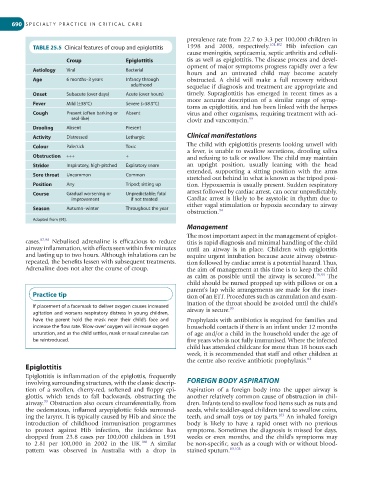
            TABLE 25.5  Clinical features of croup and epiglottitis  1998  and  2008,  respectively. 101,102   Hib  infection  can
                                                              cause meningitis, septicaemia, septic arthritis and celluli-
                       Croup              Epiglottitis        tis as well as epiglottitis. The disease process and devel-
                                                              opment of major symptoms progress rapidly over a few
            Aetiology  Viral              Bacterial
                                                              hours  and  an  untreated  child  may  become  acutely
            Age        6 months–3 years   Infancy through     obstructed.  A  child  will  make  a  full  recovery  without
                                            adulthood         sequelae if diagnosis and treatment are appropriate and
            Onset      Subacute (over days)  Acute (over hours)  timely.  Supraglottitis  has  emerged  in  recent  times  as  a
                                                              more  accurate  description  of  a  similar  range  of  symp-
            Fever      Mild (±38°C)       Severe (>38.5°C)
                                                              toms as epiglottitis, and has been linked with the herpes
            Cough      Present (often barking or   Absent     virus and other organisms, requiring treatment with aci-
                        seal-like)                            clovir and vancomycin. 99
            Drooling   Absent             Present
            Activity   Distressed         Lethargic           Clinical manifestations
            Colour     Pale/sick          Toxic               The child with epiglottitis presents looking unwell with
                                                              a fever, is unable to swallow secretions, drooling saliva
            Obstruction  +++              +                   and refusing to talk or swallow. The child may maintain
            Stridor    Inspiratory, high-pitched  Expiratory snore  an  upright  position,  usually  leaning  with  the  head
                                                              extended,  supporting  a  sitting  position  with  the  arms
            Sore throat  Uncommon         Common
                                                              stretched out behind in what is known as the tripod posi-
            Position   Any                Tripod; sitting up  tion. Hypoxaemia is usually present. Sudden respiratory
            Course     Gradual worsening or   Unpredictable; fatal   arrest followed by cardiac arrest, can occur unpredictably.
                        improvement         if not treated    Cardiac arrest is likely to be asystolic in rhythm due to
                                                              either vagal stimulation or hypoxia secondary to airway
            Season     Autumn–winter      Throughout the year
                                                              obstruction. 94
            Adapted from (95).
                                                              Management
                                                              The most important aspect in the management of epiglot-
         cases. 97,98   Nebulised  adrenaline  is  efficacious  to  reduce   titis is rapid diagnosis and minimal handling of the child
         airway inflammation, with effects seen within five minutes   until  an  airway  is  in  place.  Children  with  epiglottitis
         and lasting up to two hours. Although inhalations can be   require urgent intubation because acute airway obstruc-
         repeated, the benefits lessen with subsequent treatments.   tion followed by cardiac arrest is a potential hazard. Thus,
         Adrenaline does not alter the course of croup.       the aim of management at this time is to keep the child
                                                              as  calm  as  possible  until  the  airway  is  secured. 19,99   The
                                                              child should be nursed propped up with pillows or on a
                                                              parent’s lap while arrangements are made for the inser-
            Practice tip                                      tion of an ETT. Procedures such as cannulation and exam-
                                                              ination of the throat should be avoided until the child’s
            If placement of a facemask to deliver oxygen causes increased   95
            agitation  and  worsens  respiratory  distress  in  young  children,   airway is secure.
            have  the  parent  hold  the  mask  near  their  child’s  face  and   Prophylaxis with antibiotics is required for families and
            increase the flow rate. ‘Blow-over’ oxygen will increase oxygen   household contacts if there is an infant under 12 months
            saturation, and as the child settles, mask or nasal cannulae can   of age and/or a child in the household under the age of
            be reintroduced.                                  five years who is not fully immunised. Where the infected
                                                              child has attended childcare for more than 18 hours each
                                                              week, it is recommended that staff and other children at
                                                              the centre also receive antibiotic prophylaxis. 82
         Epiglottitis
         Epiglottitis is inflammation of the epiglottis, frequently
         involving surrounding structures, with the classic descrip-  FOREIGN BODY ASPIRATION
         tion  of  a  swollen,  cherry-red,  softened  and  floppy  epi-  Aspiration  of  a  foreign  body  into  the  upper  airway  is
         glottis,  which  tends  to  fall  backwards,  obstructing  the   another relatively common cause of obstruction in chil-
               99
         airway.  Obstruction also occurs circumferentially, from   dren. Infants tend to swallow food items such as nuts and
         the  oedematous,  inflamed  aryepiglottic  folds  surround-  seeds, while toddler-aged children tend to swallow coins,
         ing the larynx. It is typically caused by Hib and since the   teeth, and small toys or toy parts.  An inhaled foreign
                                                                                            103
         introduction  of  childhood  immunisation  programmes   body  is  likely  to  have  a  rapid  onset  with  no  previous
         to  protect  against  Hib  infection,  the  incidence  has   symptoms. Sometimes the diagnosis is missed for days,
         dropped from 23.8 cases per 100,000 children in 1991   weeks  or  even  months,  and  the  child’s  symptoms  may
                                               100
         to  2.81  per  100,000  in  2002  in  the  UK.   A  similar   be non-specific, such as a cough with or without blood-
         pattern  was  observed  in  Australia  with  a  drop  in   stained sputum. 83,103

