


Page 720 - ACCCN's Critical Care Nursing
P. 720
Paediatric Considerations in Critical Care  697

                                                                                189
             children  are  common,  with  about  4–10%  of  children   66% of disease.  There are two main peaks of disease.
                                                            181
             having  an  unprovoked  seizure  without  recurrence.    The 0–4-years age group represents 31% of all cases and
             Children between the ages of six months and six years are   with 17% occurring in the 15–19-years age group. 189  The
             more likely to develop seizures. 182  Children, particularly   incidence of meningococcal disease in children aged 0–4
             those under five years, are at higher risk, as the developing   years is 10/100,000. Of children with invasive meningo-
                                               181
             brain has a lower threshold for seizures.  Febrile convul-  coccal  disease,  47%  have  meningitis,  with  or  without
             sions occur in 2–5% of children, commonly between the   sepsis. 190,191  The mortality rate of meningococcal menin-
                                   183
             ages of 6 and 60 months.  Non-febrile seizures are typi-  gitis in children under five years of age is below 1%; with
             cally  more  common  in  the  neonatal  period,  with  the   sepsis present, the rate increases up to 10–15%.
             incidence falling with age. 182
                                                                  The  incidence  of  invasive  pneumococcal  disease  (IPD)
             Management                                           has  significantly  dropped  since  the  introduction  of
                                                                  routine vaccination, with a reported rate of 23.4 cases per
             Management  of  the  paediatric  patient  with  seizures  is   100,000 children aged less than five years in 2005.  The
                                                                                                             192
             similar to management of the adult (see Chapter 17), but   highest peak of IPD is seen in children aged one year with
             there  are  some  specific  paediatric  considerations.  The   a  rate  fluctuating  between  26.5,  37  and  51/100,000  in
             paediatric patient who is suffering seizures is more sus-  Australia,  North  America  and  Europe,  respectively. 193-196
             ceptible than an adult to hypoglycaemia. Hypoglycaemia   The highest Australian incidence occurs in the Northern
             may lead to secondary brain injury during and after sei-  Territory,  with  Indigenous  children  at  highest  risk. 197
             zures.  Blood  sugar  levels  should  always  be  checked  in   Other  risk  factors  include  extreme  prematurity,  chronic
             children  suffering  from  seizures  and  intravenous  fluids   lung disease, trisomy 21 (Down syndrome), diabetes and
             containing glucose administered. 182,184             cystic fibrosis. Clinical manifestations or symptoms vary
             The care of the seizing or post-ictal child is generally sup-  with  the  age  of  the  child,  duration  of  the  illness  and
             portive  and  includes  monitoring  for  signs  of  ongoing   history of antibiotic use for the current illness. These are
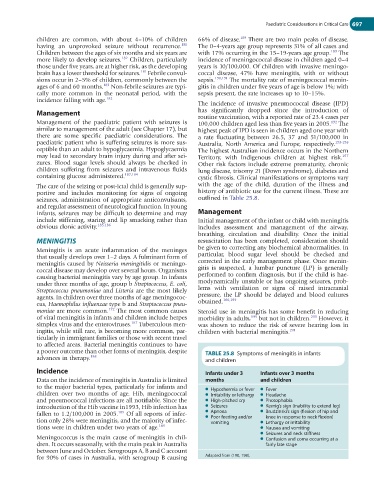
             seizures, administration of appropriate anticonvulsants,   outlined in Table 25.8.
             and regular assessment of neurological function. In young
             infants, seizures may be difficult to determine and may   Management
             include stiffening, staring and lip smacking rather than   Initial management of the infant or child with meningitis
             obvious clonic activity. 185,186                     includes  assessment  and  management  of  the  airway,
                                                                  breathing,  circulation  and  disability.  Once  the  initial
             MENINGITIS                                           resuscitation has been completed, consideration should
             Meningitis  is  an  acute  inflammation  of  the  meninges     be given to correcting any biochemical abnormalities. In
             that usually develops over 1–2 days. A fulminant form of   particular,  blood  sugar  level  should  be  checked  and
             meningitis caused by Neisseria meningitidis or meningo-  corrected in the early management phase. Once menin-
             coccal disease may develop over several hours. Organisms   gitis  is  suspected,  a  lumbar  puncture  (LP)  is  generally
             causing bacterial meningitis vary by age group. In infants   performed to confirm diagnosis, but if the child is hae-
             under three months of age, group b Streptococcus, E. coli,   modynamically unstable or has ongoing seizures, prob-
             Streptococcus pneumoniae and Listeria are the most likely   lems  with  ventilation  or  signs  of  raised  intracranial
             agents. In children over three months of age meningococ-  pressure,  the  LP  should  be  delayed  and  blood  cultures
                                                                          166,199
             cus, Haemophilus influenzae type b and Streptococcus pneu-  obtained.
             moniae are more common. 172  The most common causes   Steroid use in meningitis has some benefit in reducing
             of viral meningitis in infants and children include herpes   morbidity in adults, 195  but not in children.  However, it
                                                                                                       200
             simplex virus and the enteroviruses. 187  Tuberculous men-  was  shown  to  reduce  the  risk  of  severe  hearing  loss  in
             ingitis, while still rare, is becoming more common, par-  children with bacterial meningitis. 201
             ticularly in immigrant families or those with recent travel
             to affected areas. Bacterial meningitis continues to have
             a poorer outcome than other forms of meningitis, despite   TABLE 25.8  Symptoms of meningitis in infants
             advances in therapy. 188                               and children

             Incidence                                              Infants under 3   Infants over 3 months
             Data on the incidence of meningitis in Australia is limited   months     and children
             to the major bacterial types, particularly for infants and   l  Hypothermia or fever  l  Fever
             children  over  two  months  of  age.  Hib,  meningococcal   l  Irritability or lethargy  l  Headache
             and pneumococcal infections are all notifiable. Since the   l  High-pitched cry  l  Photophobia
             introduction of the Hib vaccine in1993, Hib infection has   l  Seizures  l  Kernig’s sign (inability to extend leg)
             fallen to 1.2/100,000 in 2005. 189  Of all reports of infec-  l  Apnoea  l  Brudzinski’s sign (flexion of hip and
                                                                                        knee in response to neck flexion)
             tion only 28% were meningitis, and the majority of infec-  l  Poor feeding and/or   l  Lethargy or irritability
                                                                      vomiting
             tions were in children under two years of age. 189                       l  Nausea and vomiting
                                                                                      l  Seizures and neck stiffness
             Meningococcus is the main cause of meningitis in chil-                   l  Confusion and coma occurring at a
             dren. It occurs seasonally, with the main peak in Australia                fairly late stage
             between June and October. Serogroups A, B and C account
             for 90% of cases in Australia, with serogroup B causing   Adapted from (190, 198).

